If you’ve ever walked into a marine supply store and felt that "Lithium Envy" staring you down from the battery shelf, you aren't alone. We’ve all seen the marketing: half the weight, twice the power, and a lifespan that’ll outlast your current mortgage. It feels like the ultimate "set it and forget it" upgrade for your pontoon or fishing rig.
But if you’ve already bought one—or you’re hovering over the "Buy Now" button—there is something your salesman (and the battery's shiny box) probably isn't telling you.
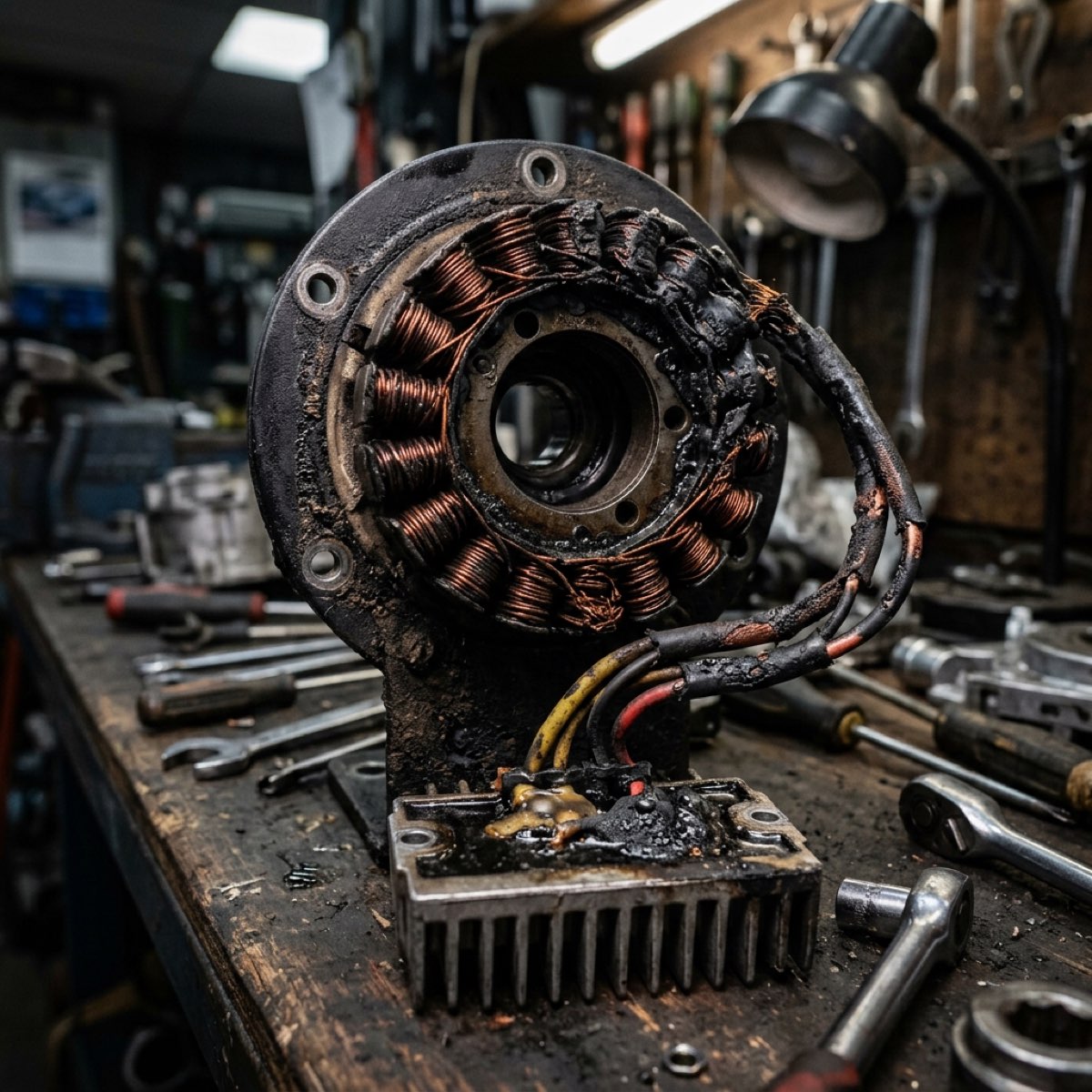
I’ve seen it more times than I care to count: A boater pulls into the shop with a 2025 Mercury 150hp that "just quit charging." When I pull the cowling, the stator smells like a burnt-out electrical substation and the voltage regulator looks like a melted piece of saltwater taffy. In every single case, the owner had just performed a "drop-in" lithium conversion without a bridge.
It’s heartbreaking, because it's a completely preventable $3,500 repair bill. If you've already made the switch, don’t panic. Your engine isn't a ticking time bomb yet, but we need to talk about why the "drop-in" promise is a lie, and how we’re going to fix it before your stator melts into a copper puddle.
Mike Callahan's Masterclass Note: "The fundamental mistake most boaters make is thinking of a battery as a bucket that you just fill up. In reality, a Lithium battery is an electrical vacuum. Because it has almost zero internal resistance, it will suck every single amp your engine can produce until the stator's copper windings literally melt their own insulation. If you don't have an IP67-rated bridge between your battery and your stator, you’re just cooking your engine from the inside out."
| Metric | Specification / Solution |
|---|
| Engine Warranty Status | Voids warranty (per Mercury SB 2022-19) |
| Primary Failure Mode | Stator Overheating & Rectifier Thermal Runaway |
| Safety Risk | High Voltage ECU Surge (Load Dump) |
| The Fix | Mandatory DC-to-DC Charger (Max 30A-50A) |
| Recommended Charger | Victron Orion-Tr Smart / Mastervolt Mac Plus |
The "Drop-In" Lie: Why Your Engine Hates Your New Battery
The term "Drop-In Replacement" is the most dangerous phrase in modern marine electronics. It implies that a LiFePO4 (Lithium Iron Phosphate) battery behaves exactly like the Lead-Acid or AGM battery you just hauled out of your bilge.
It doesn't. Not even close.
The Physics of Resistance (Or Lack Thereof)
To understand why your outboard is currently screaming for help, we have to look at Internal Resistance. Think of your battery like a hungry teenager. A Lead-Acid battery is a teenager who eats a big meal and eventually gets full. As it charges, its internal resistance naturally rises. This sends a "stop" signal to your engine's charging system, telling the alternator: "Hey, take it easy, I’m almost full."
A Lithium battery is a teenager who never gets full. It has near-zero internal resistance. It will accept the maximum amount of current your engine can produce, at a 100% duty cycle, until it is 99.9% charged.
Your outboard’s charging system (especially on engines under 200hp) was never designed for this. It was designed to provide a "burst" of power after a start, and then settle into a relaxed 60% duty cycle. When you force a stator to run at 100% for two hours of cruising, the heat buildup has nowhere to go.
Mercury Service Bulletin 2022-19: The Smoking Gun
This isn't just a "mechanic's hunch." In late 2022, Mercury Marine issued Service Bulletin 2022-19, and it was a bombshell for the industry. Mercury explicitly stated that unless an engine is specifically listed as "Lithium Approved," using a lithium cranking battery is a violation of the engine’s operating parameters.
What does this mean for you? It means if your 2024 or 2025 Mercury outboard's charging system fails and the tech sees a lithium battery in the tray, your warranty is effectively a piece of wet cardboard.
🛑
**WARRANTY VOID WARNING:** Mercury Marine Service Bulletin 2022-19 states that the use of a Lithium-ion cranking battery on any non-approved engine model voids the warranty on the entire charging system, including the stator, rectifier, and ECM. Always verify your serial number with a certified dealer before switching.
The bulletin highlights three critical failure modes that I want to walk you through (because understanding the why is the only way you’ll be able to fix it right).
1. Stator Saturation and Thermal Runaway
The stator is a series of copper coils located under your engine's flywheel. As the flywheel spins, magnets pass over these coils, generating AC power. This AC power is then converted to DC by your Rectifier/Regulator.
When a lithium battery draws maximum current continuously, those copper coils get hot. Really hot. Eventually, the enamel insulation on the copper wire breaks down. Once that insulation fails, the coils short out. At that point, you aren't just losing your charge; you’re looking at a $1,500 parts-and-labor bill to pull the flywheel and replace the stator.
2. Rectifier Diode Failure
The Rectifier/Regulator is the "brain" of your charging system. It uses diodes to "gate" the electricity into the battery. These diodes generate heat as a byproduct of their work. Because lithium batteries don't allow the system to "rest" (remember that 100% duty cycle?), the heat builds up until the diodes experience Thermal Runaway. They literally melt their own solder connections and fail.
3. The "BMS Load Dump" (The Silent Killer)
This is the one that really keeps me up at night. Every Lithium battery has a Battery Management System (BMS)—a small computer inside the battery that protects the cells. If the BMS decides the battery is too hot or the voltage is too high, it will instantly disconnect the battery from the circuit.
Imagine you are cruising at 4,000 RPM. Your engine is pumping out 40 amps of current. Suddenly, the BMS trips and disconnects. That 40 amps of energy has nowhere to go. It creates a Voltage Spike (up to 100 volts!) that rushes back into your engine's ECU.
What’ll that do? It’ll fry your engine’s computer in a millisecond. That’s a $2,500+ part that isn't covered by warranty if a lithium battery caused the surge.
The "Death Trap" Symptoms: Is Your Stator Already Dying?
If you've been running a drop-in lithium battery for a few months, you might already have damage. Here are the "Mike Callahan" field symptoms to watch for before the whole system goes dark:
⚠️
* **The "Slow Tack"**: Your RPM gauge starts bouncing or behaving erratically at high speeds.
* **Radio Interference**: You hear a high-pitched "whine" in your VHF radio that changes pitch with your engine RPM (this is a diode leaking AC current).
* **The Burnt Toast Smell**: After a long run, you smell a faint "electrical" odor coming from under the cowling.
* **Voltage Sag**: You see 14.2V at idle, but as you increase RPM, the voltage actually *drops* to 13.0V (this is a classic sign of magnetic saturation failure).
* **The "Flywheel Heat-Sync"**: The top of your flywheel is too hot to touch comfortably (stators radiate heat upward).
The Masterclass Solution: Building the Bridge
So, can you use Lithium? Absolutely. I love Lithium. I have it on my own rig. But you have to install it as an Engineered System, not a "Drop-In."
The only way to safely integrate lithium is by using a DC-to-DC Battery Charger. (I personally recommend the Victron Orion-Tr Smart or the Mastervolt Mac Plus).
How the "Bridge" Protects Your Engine
Instead of connecting your engine directly to the Lithium bank, you do this:
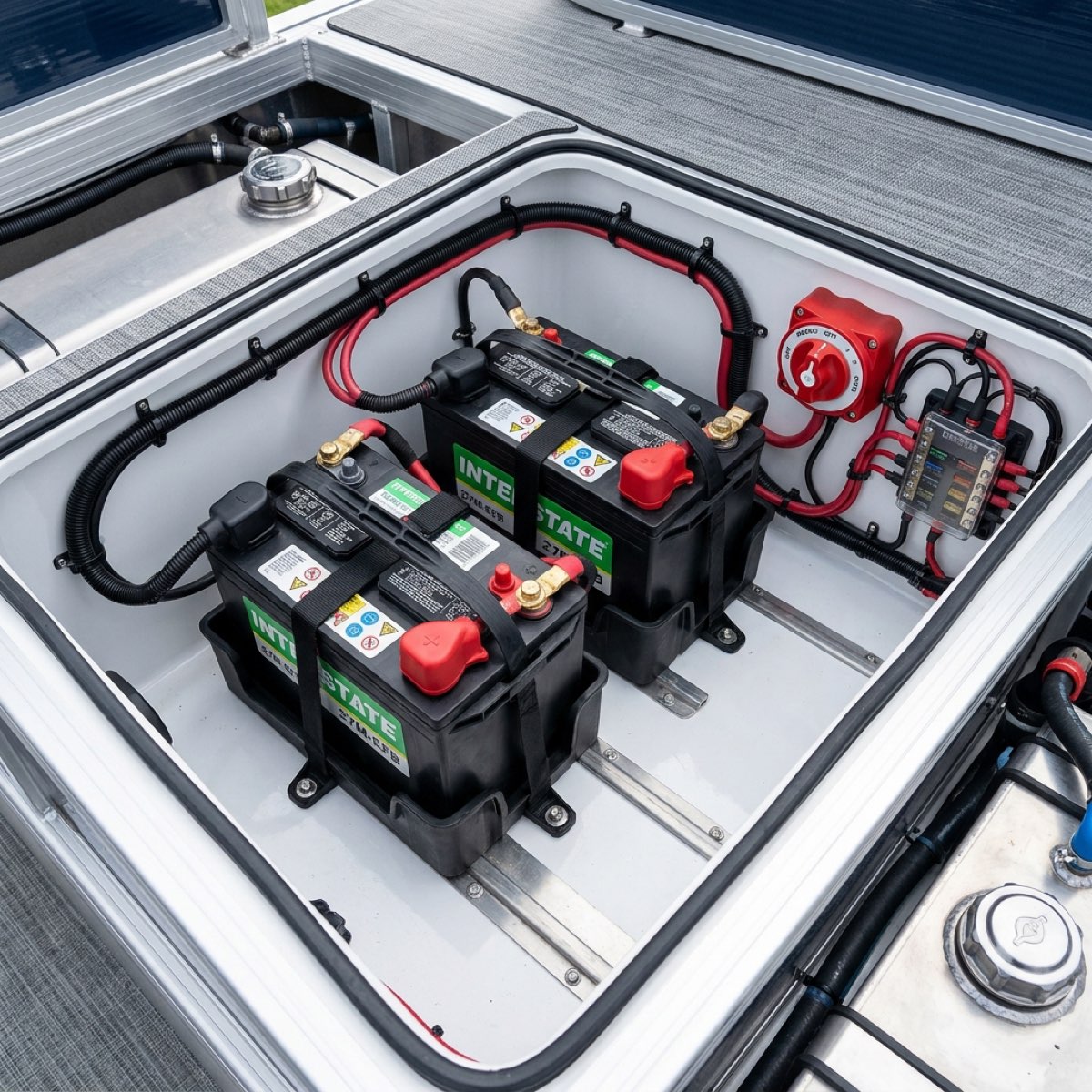
- Keep an AGM Starting Battery: Your engine needs an AGM or Lead-Acid battery to act as a "buffer" and to satisfy the warranty requirements of SB 2022-19.
- Install the DC-to-DC Charger: You connect the engine to the AGM battery, and then you connect the DC-to-DC charger between the AGM and the Lithium bank.
The DC-to-DC charger acts as a "Gatekeeper." You can program it to only pull 30 amps from the engine, even if the Lithium battery wants 100. This keeps your stator at a safe 60% duty cycle and prevents the "Load Dump" surge from ever reaching your engine's ECU.
Step-by-Step: The Mike Callahan "Bulletproof" Wiring Setup
If you’re ready to do this right, here is the exact setup I install for my clients. It’s a bit more work, but it’s the only way you’ll sleep soundly when you’re 20 miles offshore.
The Gear List
- Starting Battery: A high-quality AGM (Group 24 or 27).
- House Bank: Your shiny new LiFePO4 Lithium battery.
- The Bridge: A 30A or 50A DC-to-DC Charger (Ensure it is IP67 rated for marine use).
- Wiring: 6AWG or 4AWG tinned copper marine wire (don’t even think about using automotive wire).
The Logic
Your outboard charges the AGM battery just like it was designed to do. The DC-to-DC charger "watches" the AGM battery. When it sees the engine is running (based on voltage), it starts pulling a safe, regulated amount of current to charge the Lithium bank.
If the Lithium BMS ever trips, the surge is absorbed by the AGM battery, protecting your engine's sensitive electronics. It’s a fail-safe system that gives you the best of both worlds.
The Hidden Complexity: What’s Actually Inside Your Lithium Battery?
To understand why the "drop-in" promise fails, we need to crack open the black box. Every Lithium Iron Phosphate (LiFePO4) battery is actually a collection of individual cells managed by a Battery Management System (BMS). This BMS is a circuit board that acts as the battery's nervous system.
It has three primary jobs:
- Cell Balancing: Ensuring every cell has the exact same voltage.
- Temperature Protection: Shutting down if it gets too hot (above 135°F) or too cold (below 32°F) to charge.
- Short Circuit/Over-Voltage Protection: Disconnecting the battery if the input voltage exceeds 14.6V - 15.0V.
The "High Voltage Cutoff" Trap
Here is where the engineering gets messy. Most modern outboard alternators have a "loose" voltage regulation. It isn't uncommon to see a Mercury or Yamaha engine spike to 14.8V or even 15.1V for a split second during high-RPM runs.
If your Lithium BMS sees 15.0V, it may instantly trip its High Voltage Cutoff (HVC). In a lead-acid system, the battery would just absorb that extra voltage as heat. In a lithium system, the battery vanishes from the circuit.
This is the moment of maximum danger.
When the battery disappears while the engine is running, the alternator's magnetic field collapses. This creates a "Back EMF" (Electromotive Force) spike. Without a lead-acid battery in the circuit to soak up that spike, the energy goes straight into your engine's Electronic Control Module (ECM).
If you’ve ever wondered why a $2,500 ECU suddenly "fried" on a brand new boat, this is almost always the culprit. The owner thinks the engine was a lemon; in reality, the battery "fired" the engine.
The Physics of Stator Failure: Why Copper Melts
Let’s get nerdy for a second. Your outboard's stator is a series of copper windings wrapped around a steel core. It operates on the principle of Electromagnetic Induction.
As the magnets in your flywheel spin past these coils, they create a moving magnetic field. This field "pushes" electrons through the copper wire.
Magnetic Saturation and Joule Heating
In a normal charging scenario (Lead-Acid), the "push" is met with resistance. The electrons move, but not too fast.
In a Lithium scenario, there is no resistance. The electrons rush through the copper wire at the maximum speed possible. This causes two things to happen:
- Joule Heating: Heat is generated by the friction of electrons moving through the wire. The heat is proportional to the square of the current ($I^2R$). If you double the current, you quadruple the heat.
- Vibration: The massive magnetic forces actually cause the copper windings to vibrate at high frequency. Over time, this vibration rubs the thin enamel insulation off the wires.
Eventually, you get an "Internal Short." The stator isn't just hot anymore; it’s literally welding itself together. Once those coils short, the engine's RPMs will drop, the flywheel might get hot enough to discolor the paint, and your charging output will drop to zero.
Masterclass Guide: Programming Your DC-to-DC Charger
If you’ve taken my advice and bought a Victron Orion-Tr Smart, you’ve made a great choice. But out of the box, it isn't configured for your outboard. Here is the exact "Mike Callahan Protocol" for setting up your "Bridge."
Outboards have "dirty" power. You don't want your charger trying to pull power from the starting battery unless the engine is actually running.
- Start Voltage: Set this to 13.5V. (This ensures the engine is charging before the lithium bank starts drawing).
- Shutdown Voltage: Set this to 12.8V. (This prevents the charger from draining your starting battery after you turn the engine off).
Don't just use the "Lithium" preset. Be precise.
- Absorption Voltage: 14.2V (This is safer than the 14.4V many brands recommend and will significantly extend your battery life).
- Float Voltage: 13.5V.
- Bulk Current: Limit this to 60-70% of your alternator's rated output. If you have a 60A alternator, set the charger to 30A. This ensures your alternator stays cool even on long runs.
The "But My Friend Does It" FAQ
I hear it every day: "Mike, my buddy has been running a drop-in lithium on his old 2-stroke for three years and nothing has happened. Why should I worry?"
Here is the truth:
- Old Tech vs. New Tech: Older 2-strokes have very simple charging systems that are actually less sensitive to voltage spikes (but they still get hot). Modern 4-strokes have highly sensitive microprocessors that didn't exist 15 years ago.
- The "Ticking Clock": Stator failure isn't always instant. It’s cumulative. Your buddy might be on year three of a four-year failure cycle.
- Low Load: If your buddy only runs his boat for 10 minutes to reach his fishing spot, the stator doesn't have time to reach critical temperatures. But the day he decides to run 30 miles offshore? That’s when the "Death Trap" snaps shut.
Warranty Survival: How to Talk to Your Dealer
If you already have lithium and you’re worried about your warranty, here is how you handle the next service visit.
- Don't Hide It: Service techs aren't stupid. They’ll see the battery.
- Show the Bridge: Point out your DC-to-DC charger. Explain that you’ve isolated the engine from the lithium bank.
- Cite the Specs: "I’m running a regulated 30A draw to protect the stator, and the AGM starting battery is handling all the cranking loads per Mercury SB 2022-19."
When a tech hears that, they know they’re dealing with an informed owner. You’ve just moved yourself from the "Warranty Denied" pile to the "Expert Owner" pile.
Summary: The Final Word on Lithium Conversions
Lithium is the single best upgrade you can make to a modern boat. It enables silent nights at anchor, high-speed trolling motors, and reliable starting power. But you have to respect the physics.
If you remember nothing else from this guide, remember this: Your outboard engine is a mechanical beast, and your lithium battery is a digital one. They don't speak the same language.
The DC-to-DC charger is the translator. It’s the peacekeeper. And in my shop, it’s the only way a lithium battery gets anywhere near a customer's cowling.
Stay safe, stay cool, and I’ll see you at the sandbar.