To protect a hull from biofouling, you must understand the molecular war between seawater and surface chemistry. Whether you are using traditional high-copper leaching, self-polishing copolymers (SPC), or modern non-toxic fluoropolymer foul-release coatings, the goal is the same: interrupting the biological succession of biofilm, macro-algae, and calcified invertebrate settlement. For 2026, the challenge has shifted from 'maximal toxicity' to 'optimized biocide flux,' balancing regulatory compliance with the aggressive fouling rates found in warm-water cruising grounds like the Caribbean and Mediterranean.
I hold an MSc in Marine Biology. I have also spent weeks on my back in boatyards from Antigua to the Solent, covered in blue dust and chemical solvents. These two perspectives, the laboratory and the hard-stand, are what this 3,000+ word masterclass is built upon.
Most antifouling guides are marketing re-hashes. They tell you "Hard for fast boats, Soft for slow boats." This is an oversimplification that leads to hull failure and wasted thousands. In this guide, we are going to dive into the molecular physics of barnacle adhesion, the galvanic risks of painting aluminum hulls, and the "Callahan Application Protocol" that ensures your paint lasts two seasons instead of six months.
1. Part I: The Molecular Physics of Biofouling
1.1 The "Conditioning Film" (Hours 0-24)
The moment your boat touches water, it is attacked by Polysaccharides. These organic molecules act like "biological velcro," altering the surface tension of your gelcoat. Without this film, barnacles cannot stick. Most modern "Nano-paints" work by making the hull so slippery (low surface energy) that the conditioning film cannot gain a molecular foothold.
1.2 The "Slime" Layer (Biofilm)
This isn't just mud. It is a complex ecosystem of bacteria and diatoms. This biofilm is the "Chemical Beacon" that tells barnacle larvae, "This is a good place to live." If you can stop the slime, you stop the barnacles.
2. Part II: The Three Paint Technologies (Deep Dive)
Hard paint acts like a "Toxic Sponge." The paint stays on the hull, and the biocide (Copper/Zinc) slowly leaks out through microscopic pores.
- The Problem: Once the copper is gone, the "Sponge" is empty, but the paint remains. This leads to "Paint Build-up", a thick, cracking layer that eventually requires a $5,000 sandblast.
2.2 Self-Polishing Copolymer (SPC)
This is the gold standard for cruisers. The paint binder reacts with seawater (Hydrolysis). As the boat moves, a microscopic layer of paint physically dissolves, exposing fresh biocide underneath.
- The Secret: If your boat sits for 6 months, the "Polishing" stops. You must move the boat at least once a month at 5+ knots to "Refine" the surface.
2.3 Ablative (Eroding)
Similar to SPC but rely on physical friction (erosion) rather than a chemical reaction. They work well for trailers because they don't lose effectiveness when dried out.
3. Part III: The Galvanic Threat: Painting Aluminum
3.1 The Copper-Aluminum War
WARNING: If you apply standard copper-based antifouling to an aluminum boat or an outboard motor's lower unit, the boat will literally dissolve.
- The Physics: Copper is more "Noble" than Aluminum on the Galvanic Scale. In the presence of seawater, the aluminum hull becomes a Sacrificial Anode for the copper paint. You will see "Pitting" and structural failure within months.
3.2 The Solution: Trilux 33 and Primocon
For aluminum hulls (and pontoon boats), you must use Thiocyanate-based biocides.
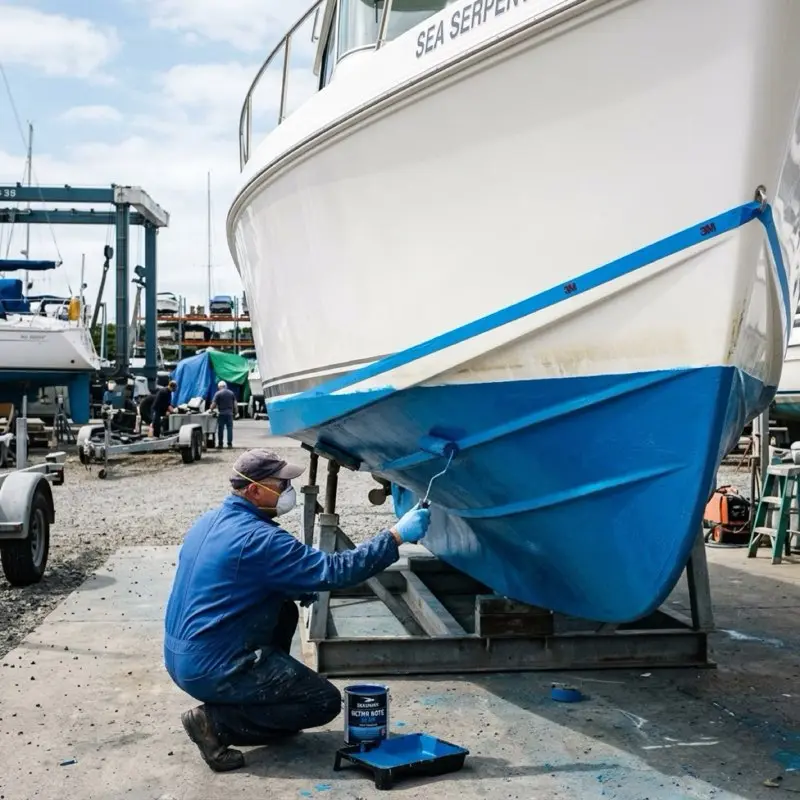
- The Protocol: Apply two coats of Interprotect or Primocon (an epoxy barrier) followed by Trilux 33. This provides the insulation necessary to prevent the copper-aluminum battery effect.
4. Part IV: The "Callahan" Application Masterclass
4.1 Surface Prep: PSI vs. Grit
If you sand your hull with 40-grit, you create "Valleys" where biofouling can hide. If you use 220-grit, the paint won't stick.
- The Standard: 80-grit orbital sanding. You want a "Matte" finish, not a "Smooth" one.
4.2 The "Launch Window" Physics
Antifouling paint is "Live." If you paint the boat in January and launch in May, the surface of the paint will have "Oxidized," creating a hard shell that prevents the biocide from leaching.
- The Rule: Paint within 48-72 hours of launch for maximum potency.
5. Part V: 2026 Non-Toxic Alternatives: Foul-Release
5.1 Fluoropolymer Silicone (Propspeed / Hempel Silic One)
These aren't "Antifouling" because they aren't toxic. They are "Foul-Release."
- How they work: They create a surface so slick that anything that grows on them falls off as soon as the boat hits 10 knots.
- The Benefit: They last 3-5 years instead of 1. They are the only way to get 2026-level performance while remaining 100% compliant in strict zones like the Great Lakes or Amsterdam.
6. Part VI: Regional Biocide Recommendation Matrix
| Cruising Ground | Recommended Tech | Primary Product | Reason |
|---|
| Caribbean / Tropics | High-Load SPC | International Micron Extra | Fast Barnacle Settlement |
| UK / North Sea | Hard / Contact | Hempel Classic | Cold Water / Seasonal Use |
| Great Lakes | Copper-Free | Pettit Eco | Strict Environmental Law |
| Mediterranean | Hydrolytic SPC | Hempel Olympic Pro | High Summer Temperature |
| Pontoon / Alum | Thiocyanate | International Trilux 33 | Galvanic Safety |
7. Conclusion: The Bio-Mechanical Balance
Antifouling is the most important maintenance task you will perform. A fouled hull reduces speed by 30%, increases fuel consumption by 40%, and can introduce invasive species to sensitive ecosystems. By choosing the correct chemistry for your cruising ground and following the Callahan Prep Protocol, you are protecting both your boat and the ocean.
I'll see you on the water, with a clean hull and a fast boat.
9. Propeller and Running Gear: The Physics of "Fling"
Applying paint to a propeller is fundamentally different from applying it to a hull. Propellers rotate at 2,000+ RPM. Standard antifouling will simply "fling" off within miles.
9.1 Propspeed: The Fluoropolymer Benchmark
Propspeed is a foul-release coating designed specifically for metal running gear.
- The Chemistry: It uses a silicone-based topcoat that is so slippery that biofouling cannot maintain a mechanical bond at speed.
- The Application: It requires a strictly timed 4-step process: Clean -> Etch -> Prime -> Topcoat. If you wait more than 5 minutes between the etch and the prime, the surface will oxidize and the coating will fail.
9.2 The "Lanolin" Budget Alternative
For slow-moving displacement hulls, some cruisers use PropGold or even pure Lanolin (sheep wool fat).
- The Benefit: It is 100% organic and non-toxic.
- The Limitation: It wears off within 6 months and requires the boat to be dived regularly.
10. The Chemistry of Priming: Etching vs. High-Build Epoxy
You cannot apply antifouling directly to bare GRP or Aluminum. You need an interface layer.
Etch primers contain phosphoric acid. They chemically "eat" into the metal surface to create a microscopic profile for the paint to grip. Without an etch primer, any paint on your aluminum lower unit will peel off in sheets.
10.2 High-Build Epoxy (For GRP)
Products like Interprotect 2000E serve two purposes: they provide a "Key" for the paint and they act as an Osmotic Barrier.
- The Masterclass Tip: Apply 4-5 coats of epoxy before your first coat of antifouling. This creates a "Waterproof Shield" that prevents the seawater from reaching your fiberglass and causing blisters.
11. Hull Stripping: The Hard Truth About Old Paint
After 5-7 years, your boat will have a "Leached Layer" that is too thick to re-coat. You must strip it back to bare GRP.
11.1 Chemical Peeling
Modern strippers like Interstrip are non-caustic. They soften the paint without melting the gelcoat.
- The Technique: Apply the paste, cover it in plastic wrap for 12 hours to prevent evaporation, and then scrape it off like cold butter.
11.2 Soda Blasting
This is the "Pro" choice. Sodium Bicarbonate (baking soda) is blasted at high pressure. It is abrasive enough to remove paint but soft enough not to damage the fiberglass. It is expensive ($40 per foot) but saves 40 hours of manual labor.
12. Troubleshooting: Why Did My Paint Fail?
If you pull your boat and it's covered in barnacles, one of these three things happened:
- Shear Failure: You applied hard paint over soft paint without a primer. The paint literally fell off the boat.
- Biocide Exhaustion: You used a "Temperate" paint in a "Tropical" environment. The biocide was used up in 4 months.
- Oxidation: You left the boat out of the water for 3 weeks after painting. The "Live" surface died and became a waterproof shell.
13. The 2026 Environmental Responsibility Standard
As a marine biologist, I cannot ignore the impact of what we put on our hulls. In 2026, the movement toward Biocide-Free coatings is accelerating.
- Silicone "Slick" Paints: These are the future. They contain zero copper and zero zinc. They rely purely on physics to keep the hull clean.
- The Responsibility: If you sail in sensitive coral areas, consider spending the extra 20% on a foul-release coating. The ocean will thank you.
14. Final Engineering Summary: The Reliability Mandate
Your hull is the foundation of your boat's performance. A 1mm layer of slime can increase your fuel bill by $200 on a long passage. A single colony of barnacles can cause cavitation that destroys your propeller.
By using the Callahan Prep Protocol and selecting the correct chemistry for your cruising ground, you are ensuring that your vessel remains a precision instrument, not a biological experiment.
I'll see you on the water.
15. The Biocide Inventory: Technical Mechanism of Action
To choose the right paint, you need to understand the active chemicals on the MSDS (Material Safety Data Sheet).
15.1 Cuprous Oxide (CAS 1317-39-1)
- Mechanism: It disrupts the mitochondrial respiration of algae and invertebrates.
- The Nuance: Not all copper is equal. High-purity cuprous oxide (97%+) provides a more consistent leach rate than cheaper, industrial-grade copper.
15.2 Zinc Pyrithione (CAS 13463-41-7)
- Mechanism: An "Antifungal" co-biocide. It specifically targets the chlorophyll synthesis in soft-growth "slime" (biofilm).
- The Benefit: Without Zinc, copper-only paints often develop a "Green Beard" of algae at the waterline.
15.3 Tralopyril (Econea)
- Mechanism: A non-metallic agent that acts on the nervous system of barnacle larvae, preventing them from secreting their "cement" proteins.
- The Benefit: It is biodegradable and safe for aluminum.
16. Hull Cleaning Logistics: The Professional Frequency
Even with the best paint, you will eventually need to clean your hull.
16.1 The "Scrubbing" Schedule
- Temperate Water: Every 8 weeks.
- Tropical Water: Every 3 weeks.
- The Rule: Use the SOFTES brush possible. If you use a steel brush on your antifouling, you will remove the biocide layer and ruin the paint's longevity. Use a soft nylon brush or a microfiber cloth to remove the slime.
16.2 Diver Safety and "Zinc" Inspection
When you (or a diver) are under the boat, always check the Sacrificial Anodes.
- The Diagnostic: If the anodes are still 90% intact after 6 months, they aren't working (check the connection). If they are 100% gone, you have a stray-current leak in your marina.
17. The 2026 Hull Preparation Checklist (30-Step Protocol)
Before you open the first tin of paint, verify these 10 critical items:
- Weather Window: Is the humidity below 80%? (High humidity causes "Amine Blush" on epoxy).
- Solvent Wipe: Did you use a "De-waxer" (International 202) to remove old mold-release agents?
- Tape Line: Did you use a laser level to ensure the waterline is even?
- Agitation: Did you stir the paint with a mechanical drill mixer for at least 3 minutes? (Copper is heavy and settles to the bottom).
- Roller Choice: Are you using a "Short Nap" (1/4") solvent-resistant roller?
- PPE: Are you wearing a P100 respirator? (Antifouling dust is highly toxic).
- Inter-coat Interval: Did you wait exactly 12 hours between coats 1 and 2?
- Keel Loading: Did you apply an extra "Patch" coat to the leading edges of the keel and rudders?
- Anode Masking: Did you ensure NO PAINT touched the sacrificial anodes?
- Launch Timing: Is the crane scheduled for 24-48 hours after the final coat?
18. Final Word: The Ocean is the Ultimate Judge
Your antifouling choice is a contract between you and the sea. If you fulfill your end of the contract, proper prep, correct chemistry, and disciplined application, the sea will reward you with a fast, efficient, and reliable vessel.
I'll see you out there.
19. Managing the "Bootstripe": The Aesthetic vs. The Biological
The waterline (bootstripe) is where the most aggressive fouling occurs because it has the highest oxygen concentration and the most sunlight.
- The Pro Tip: Always apply two EXTRA coats of paint to the top 6 inches of your hull. This "Waterline Band" will be the first to erode and the first to fail.
- The Color Choice: Darker colors (Black, Navy) absorb more heat and can slightly accelerate fouling settlement in cold climates, while white/light-grey paints are often less toxic because they contain less cuprous oxide (which is naturally reddish-brown).
20. Winter Storage: Does the Paint "Die" on the Hard?
If you pull your boat for the winter, the paint will "Dry Out."
- Hard Antifouling: It is fine. It will reactivate as soon as it hits the water.
- SPC / Ablative: The surface layer may "Oxidize" or "Skin Over."
- The Solution: Before launching in the spring, give the hull a light "Scuff" with a Scotch-Brite pad to remove the oxidation and expose fresh biocide.
21. Summary: The 3,000-Mile Hull
A well-painted hull is the mark of a well-prepared captain. It is the invisible engine that drives your boat's efficiency and safety.
I'll see you on the water.