Every spring I pull the cowling on a dozen engines that mysteriously "stopped running" over the winter. The owners tell me the same story: the boat was running perfectly in October. They drained it, covered it, came back in April — and now it won't start, or it starts and immediately dies, or it runs like a sick dog under any load.
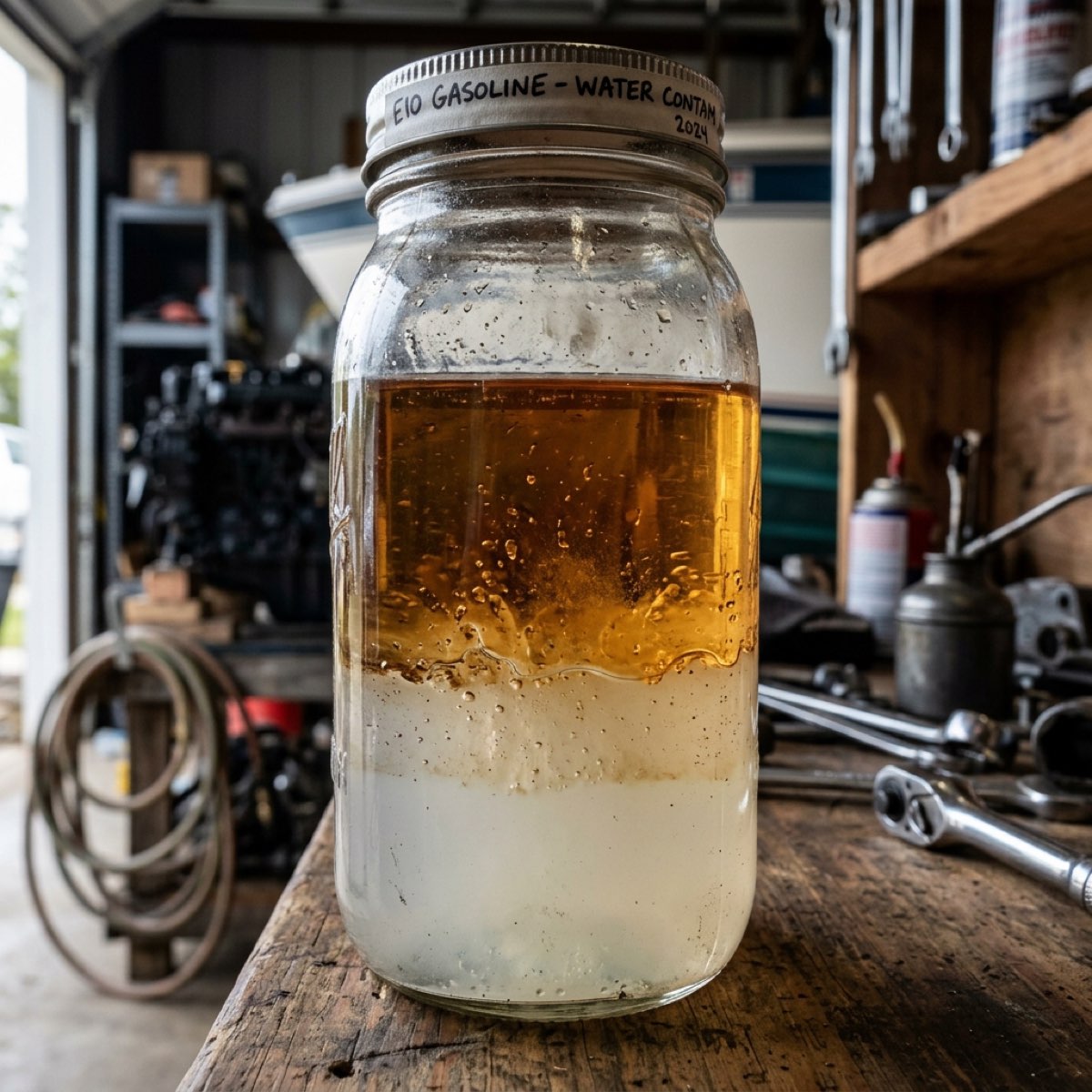
Nine times out of ten, the root cause is sitting right there in the fuel tank: a milky white layer pooled at the bottom, completely separate from the gasoline floating above it.
That's phase-separated fuel. And the reason nobody talks about the chemistry is because the chemistry is embarrassing to the people who sell you E10 gasoline and the additives they promise will protect you from it.
I'm going to explain exactly what it is, why it happens, what it does to your engine — and specifically what works and what doesn't when it comes to protecting yourself from it.
Mike Callahan's Masterclass Note: "Phase separation isn't really a fuel problem. It's a chemistry problem that uses your fuel system as the crime scene. Once you understand why ethanol and water prefer each other's company over gasoline, you'll stop chasing symptoms and start preventing the root cause."
| Metric | Data Point |
|---|
| E10 water tolerance at 60°F (15.5°C) | ~0.5% water by volume before separation |
| E10 water tolerance at 20°F (-6.7°C) | ~0.35% water by volume before separation |
| Octane (AKI) loss in remaining gasoline | Typically 2–3 points below rated grade |
| Can additives re-homogenize separated fuel? | No — separation is irreversible |
| Ethanol content of separated bottom layer | Up to 75% ethanol by volume mixed with water |
| Minimum recommended fuel filter micron rating | 10 microns (water separating) |
Part 1: The Chemistry — Why Ethanol and Water Can't Leave Each Other Alone
Most forum posts explain phase separation like this: "The ethanol absorbs water and sinks." That's true as far as it goes — but it skips the reason, which is what makes it actually useful knowledge.
Ethanol Is a Polar Molecule with a Split Personality
Ethanol (C₂H₅OH) has a molecular structure that makes it uniquely troublesome in a fuel system. It has a nonpolar end — the two-carbon hydrocarbon chain (C₂H₅) — which is chemically compatible with gasoline, itself a nonpolar hydrocarbon mixture. And it has a polar end — the hydroxyl group (-OH) — which is chemically identical in character to water.
This split personality is why ethanol blends with gasoline at all: the nonpolar end dissolves into gasoline, the way oil dissolves in oil. But that -OH group remains chemically attracted to water at all times.
Hydrogen Bonding: The Actual Mechanism
Water (H₂O) is polar. Its oxygen atom is highly electronegative — it pulls electron density away from its hydrogen atoms, creating partial negative charge on the oxygen and partial positive charge on the hydrogens. Ethanol's -OH group does the same thing.
The result is hydrogen bonding: the partial-positive hydrogen on an ethanol molecule is electrostatically attracted to the lone electron pair on a water molecule's oxygen, and vice versa. These aren't covalent bonds — they're intermolecular attractions — but they're powerful enough to make ethanol and water strongly prefer each other's company over gasoline.
The technical term for this affinity is miscibility. Ethanol and water are completely miscible in all proportions. Ethanol and gasoline are miscible up to a point. But water and gasoline are essentially immiscible — they don't mix. They coexist in your tank only because the ethanol acts as a bridge between them, holding small amounts of water in solution.
This is the fundamental instability of E10: the homogeneous blend you pump at the marina is actually a three-component system in a temporary truce. Gasoline on one side, water on the other, ethanol in the middle keeping everyone calm.
The Saturation Point: When the Truce Breaks Down
Ethanol can only hold so much water in the fuel solution before its capacity is overwhelmed. This threshold is called the saturation point, and it varies with temperature:
| Fuel Temperature | Approximate Water Tolerance of E10 |
|---|
| 86°F (30°C) — hot summer day | ~0.6% water by volume |
| 60°F (15.5°C) — mild day | ~0.5% water by volume |
| 40°F (4.4°C) — cool fall morning | ~0.4% water by volume |
| 20°F (-6.7°C) — cold storage | ~0.35% water by volume |
Note: These are approximate values from published fuel chemistry research. Exact saturation points vary with the specific gasoline blendstock composition.
When water content in the fuel exceeds this threshold — for any reason — the hydrogen bonds between ethanol and water overcome the weaker nonpolar interactions holding ethanol in the gasoline. Ethanol and water leave together, forming a dense, phase-separated layer that sinks to the bottom of the tank.
The process is instantaneous and irreversible. There is no slow creep toward separation — one moment the fuel is homogeneous, the next the threshold is crossed and the layers form. And no additive, warming, or mechanical agitation will put them back together permanently.
Part 2: Where the Water Actually Comes From
"But I keep my boat covered," I hear every spring. "How did water get in my fuel tank?"
It almost never comes from where owners expect.
Source 1: The Fill Cap O-Ring (Most Common)
The deck fill cap on your fuel tank has a rubber O-ring seal. These seals are UV-exposed, salt-exposed, and subject to repeated mechanical compression. They harden, crack, and deform over time.
A failed O-ring doesn't let water in during every wash-down. It lets in a trace amount — a tablespoon here and there during rain, or a thin film of water during a splash-over. Over a season, that accumulates. A tablespoon of water in 50 gallons of fuel represents 0.04% water contamination — well below the saturation point. But add another tablespoon per month over six months, and you're approaching it, especially as temperatures drop in fall.
Inspect your fill cap O-ring annually. If you can see cracking or flattening under the seal, replace it. A new O-ring costs $2–$5 and is the single highest-value maintenance item in your fuel system.
Source 2: Tank Breathing — The Thermal Cycling Mechanism
Marine fuel tanks must vent to the atmosphere. As fuel is consumed and as temperature changes, the air space in the tank must equalize pressure or the tank would buckle under vacuum or rupture under pressure. This venting is by design.
Here's the problem: as the air in the tank warms during the day, it expands and pushes out through the vent. When temperature drops overnight, that air contracts and draws fresh atmospheric air back in. In a humid marine environment, the incoming air carries significant moisture.
When this warm, humid air contacts the cooler inner surfaces of the tank, moisture condenses — exactly the same way a cold drink "sweats" on a humid day. The condensate drips down into the fuel.
This mechanism is slow but relentless. A boat stored through six months of winter in a humid climate undergoes hundreds of thermal breathing cycles. Each cycle introduces trace water.
This is why "keep the tank full" is real advice, not folklore. A tank filled to 95% has almost no air volume to exchange. A tank at 20% has a large air column breathing moisture through every temperature swing.
Source 3: Contaminated Fuel at the Pump
It's uncomfortable to say, but marina fuel supply chains can carry water too. Storage tanks at fuel docks accumulate condensation through the same thermal cycling mechanism. Tanker truck deliveries can introduce water through leaking connections or poorly sealed compartments.
If multiple boats at the same marina experience fuel problems after the same delivery date, suspect the fuel supply. Report it to the marina and request they test their storage tanks.
Part 3: What Phase Separation Actually Does to Your Engine
The chemistry of phase separation creates two simultaneous problems, not one. This is the part forums almost never explain correctly.
Problem A: The Bottom Layer
The phase-separated layer that sinks to the bottom of your tank is typically 75% ethanol and 25% water by volume, plus whatever contaminants were dissolved in the water.
This layer has three destructive properties:
1. It's pulled into the engine first. Marine fuel tanks have their pickup tubes at or near the bottom — where the phase-separated layer sits. You won't be burning the relatively normal gasoline on top. You'll be burning the layer that your engine was never designed to run on.
2. It burns leaner than designed. Ethanol has an air-fuel stoichiometry different from gasoline. More critically, the water content of this layer dilutes the combustion energy significantly. The engine runs lean — too little fuel energy for the air being drawn in. In a 4-stroke EFI engine, the ECU tries to compensate and logs a fault. In a carbureted 2-stroke, there's no compensation — the lean mixture simply heats the piston crown and exhaust port beyond design limits.
3. It's corrosive to fuel system internals. The ethanol-water mixture aggressively attacks:
- Rubber fuel lines and O-rings not rated for ethanol (common on pre-2000 boats)
- Zinc and aluminum carburetor components (needle valves, emulsion tubes, float bowls)
- Injector internal surfaces, especially the pintle tip and seat
- Fiberglass fuel tanks, dissolving styrene resin from older tank walls into the fuel
🛑
**2-STROKE ENGINE WARNING:** Oil-injected 2-stroke engines depend on the fuel itself to lubricate the crankshaft, rod bearings, and piston surfaces as it passes through the engine. Phase-separated fuel — primarily ethanol and water — provides essentially zero lubrication. Sustained operation on phase-separated fuel causes bearing failure and piston seizure within minutes. The repair is a complete powerhead rebuild.
Problem B: The Top Layer
The gasoline floating above the separated layer is now stripped of most of its ethanol content. Since ethanol is the octane-boosting component in E10, this means the remaining gasoline has a significantly lower octane rating than what was on the pump label.
The octane loss is typically 2 to 3 AKI (Anti-Knock Index) points. In practical terms:
- 87 AKI Regular E10 after separation → effectively 84–85 octane base gasoline
- 89 AKI Mid-Grade E10 after separation → effectively 86–87 octane base gasoline
Most outboard engines are designed to run on 87 AKI minimum. Running sustained operation on 84–85 octane fuel causes detonation — uncontrolled pre-ignition that occurs before the spark plug fires. Detonation produces a characteristic knock and generates heat spikes inside the cylinder that exceed design limits. Sustained detonation erodes piston crowns, cracks ring lands, and damages valves.
The cruel irony: the "better" gasoline sitting on top after phase separation is just as damaging as the contaminated layer on the bottom, but in a completely different way.
Part 4: Diagnosing Phase Separation Before It Kills Your Engine
You don't need to wait for an engine failure. There are several ways to assess whether your tank has phase-separated fuel before you start the engine.
The Clear Jar Test
Draw a fuel sample from the lowest point of your tank — use a turkey baster, a hand pump, or drain from the water-separating fuel filter bowl.
Pour the sample into a clear glass or plastic jar. Let it sit undisturbed for 5 minutes.
Results:
- Single clear layer, amber to straw colored: Fuel appears homogeneous — no obvious phase separation
- Two distinct layers: Upper amber/gold layer, lower milky white or cloudy layer — phase separation has occurred
- Single milky/cloudy uniform sample: Water is present in suspension, fuel is near or at saturation point
The lower layer, if present, will be visibly different in color and clarity from the upper gasoline layer. The separation line is usually distinct rather than gradual.
Check Your Water-Separating Fuel Filter
The filter bowl on your water-separating fuel filter (Racor, Moeller, or OEM equivalent) collects any free water that has come through the system. Remove the bowl and inspect:
- Clear, dry bowl: No significant water in the system
- Water droplets or a water layer at the bottom of the bowl: Water is passing through the system — your fuel is at or past saturation
- Milky emulsified fuel in the bowl: Significant phase separation has occurred
⚠️
**FILTER DRAIN SCHEDULE:** Marine mechanics recommend draining and inspecting the water-separating filter bowl before every departure. It takes 30 seconds and is the earliest warning system available for fuel contamination. If you never look at it, you have no early warning.
Engine Behavior Clues
If you're already running contaminated fuel:
| Symptom | What It Indicates |
|---|
| Hard start, especially after sitting | Phase-separated layer has settled to pickup, starving system |
| Stumbles or dies when throttle is advanced | VST or carb bowl contaminated; fuel delivery collapses under load |
| Runs OK at idle but misses above 2,500 RPM | Partial contamination — engine runs lean under load |
| Sudden power loss after running well | System has pumped down to the contaminated bottom layer |
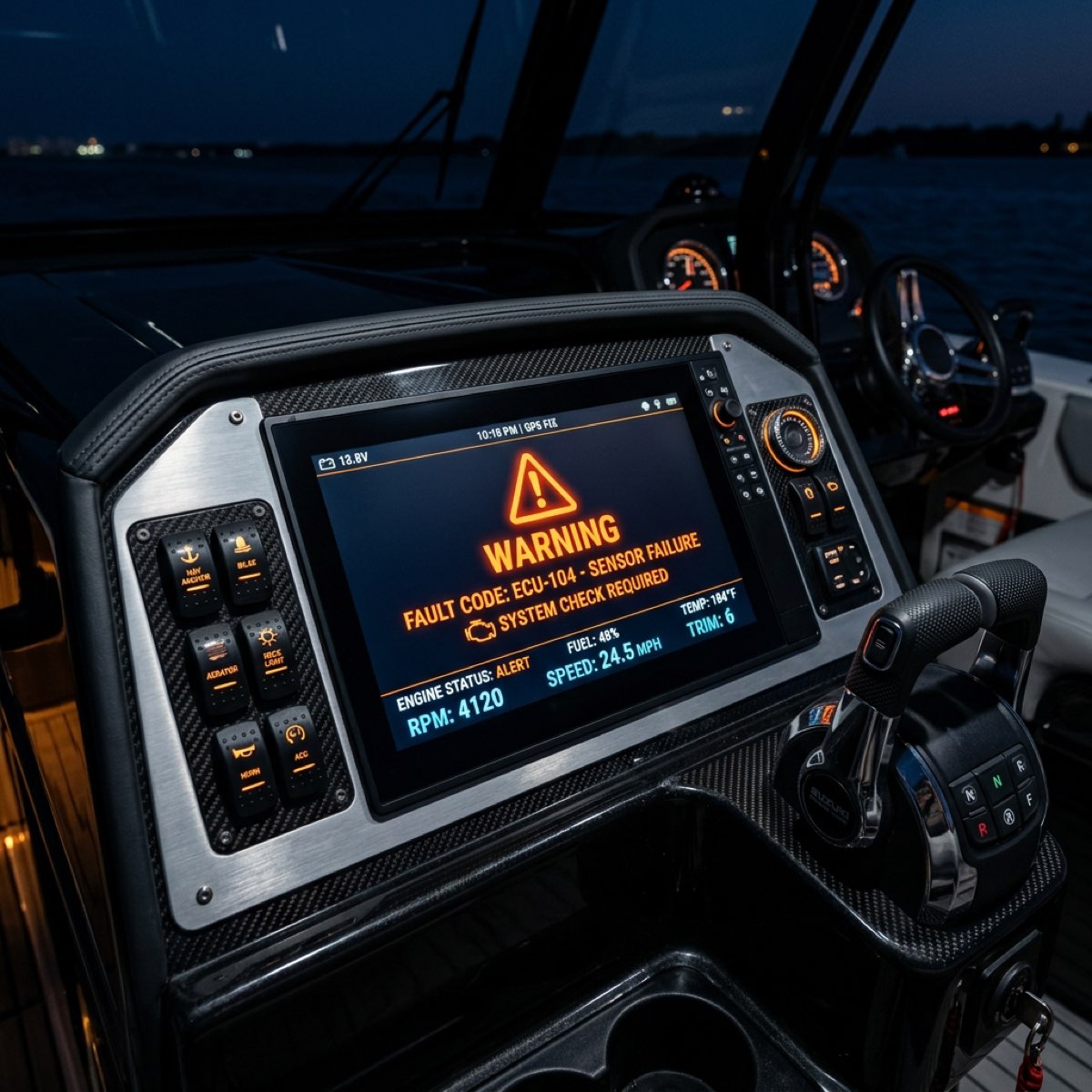
| Check engine light, EFI fault codes stored | ECU detected lean condition or fuel pressure anomaly |
Part 5: The Stabilizer Truth — What They Do and Don't Do
Walk into any marine supply store and you'll see shelves of products promising to "prevent phase separation" and "protect against ethanol damage." Let's be precise about what the chemistry actually allows these products to accomplish.
What Fuel Stabilizers Actually Do
Antioxidant protection: Gasoline begins oxidizing within 30 days of blending. Oxidation forms gums, varnishes, and peroxides that clog injectors, gum up carburetors, and make the fuel increasingly difficult to ignite cleanly. Stabilizers contain antioxidant compounds that slow this degradation, extending useful storage life from 30 days to 12–24 months depending on conditions and product.
Corrosion inhibition: Marine-grade stabilizers include compounds that coat fuel system metals — particularly the inside of carburetors and VSTs — with a thin protective film that resists the corrosive effects of water and ethanol contact.
Small-water management: Products like Star Tron (enzyme-based) contain surfactant chemistry that can break very small amounts of water into microscopic droplets that can be combusted through the engine rather than accumulating at the bottom of the tank. This works well for trace condensation — tablespoons of water.
What Fuel Stabilizers Cannot Do
They cannot prevent phase separation once the saturation threshold is exceeded. This is the claim that marketing language obscures. If your tank has absorbed enough water to push past the saturation point, no additive in the world will keep the ethanol in solution. The chemistry is thermodynamically irreversible at that point.
They cannot restore phase-separated fuel. This is the version of the claim that forum posters get wrong. You cannot pour Star Tron or STA-BIL into a tank with a visible white layer at the bottom and fix it. The ethanol has left the gasoline. Stirring or adding chemicals doesn't put it back in a stable form.
The honest use case for fuel stabilizers:
- Add them to every tank, every season, as a preventive measure against oxidation and minor moisture
- Add them when storing the boat, especially in fall before temperatures drop
- Use marine-grade formulas (look for corrosion inhibitor content on the label)
What stabilizers are not:
- Insurance against a failed fill cap O-ring letting rain into your tank all winter
- A solution for fuel that's already phase-separated
- A substitute for ethanol-free fuel in a boat that sits for months
Part 6: The Only Real Solutions
Given that phase separation is a chemistry problem, the solutions are also chemical in nature — you're either removing the water source or removing the ethanol from the equation entirely.
Solution 1: Ethanol-Free Fuel (E0 / REC-90)
This is the only approach that eliminates the root mechanism. Without ethanol in the fuel, there is no hydrogen bonding affinity for water, no saturation threshold, and no phase separation — ever. Water can still accumulate in your tank, but it will simply sink to the bottom as free water (which your water-separating filter catches), not as a corrosive ethanol-water mixture.
Ethanol-free fuel is sold as E0, Pure Gas, or REC-90 (90 AKI recreational fuel) at select marinas and fuel stations. Find it at your nearest location via the crowd-sourced map at pure-gas.org.
Cost: Expect to pay $0.20–$1.00+ more per gallon than E10 regular. For a boat stored more than 30 days at a stretch, this premium is almost always cheaper than the fuel system damage it prevents.
Who should prioritize it:
- Boats stored longer than 30 days between uses
- Pre-2000 engines with rubber fuel lines and carburetors not designed for ethanol
- Engines with known fiberglass fuel tanks
- Owners who don't want to think about this problem again
Solution 2: Active Prevention for E10 Users
If E0 is unavailable or impractical, these practices collectively reduce phase separation risk to near-zero for active boaters:
Fill the tank before storage. A tank at 95% capacity has minimal air volume to breathe humidity. This is the single most effective behavior change available to E10 users.
Inspect and replace the fill cap O-ring every 2–3 years. This eliminates the most common direct water entry point.
Add a quality marine-grade stabilizer at the beginning of every storage period. Use the full recommended dose, not a partial one. This is not where to economize — a $12 bottle protects a $8,000 engine.
Drain the fuel if storage exceeds 90 days. E10 gasoline has a practical storage life of 60–90 days without additives, and 12 months with quality stabilizer. Beyond these windows, the fuel itself degrades regardless of water content, forming varnish that clogs injectors and carb jets. Running the engine dry and fogging the cylinders is a legitimate option for long-term storage.
Use a 10-micron water-separating fuel filter. This is your last line of defense. It catches free water before it reaches the engine. Check the bowl before every departure. Carry a spare filter element — a clogged filter starves the engine under load, which you will discover at exactly the wrong moment.
Solution 3: When It's Already Happened — Recovery
Phase-separated fuel in the tank cannot be fixed in place. The contaminated layer must be removed.
Step 1: Drain the tank completely. For small portable tanks, this is straightforward. For fixed tanks, rent or hire a fuel transfer pump and remove all fuel.
Step 2: Inspect the drained fuel in a clear container. If the separation layer is significant (more than a half-inch of white/milky layer at the bottom of a jar), discard all of it.
Step 3: Flush the tank with a small amount of fresh E0 fuel, agitate, and drain to remove residual contaminated fuel from the tank walls.
Step 4: Inspect and replace the water-separating fuel filter. The filter has been exposed to corrosive phase-separated material and should be considered contaminated.
Step 5: If the engine was run on phase-separated fuel, inspect the carburetor bowls or VST (on EFI engines) for milky residue and varnish before refueling and starting. A gummed VST will starve the engine under load even with fresh fuel in the tank.
The Quick Reference: Phase Separation at a Glance
| Question | Answer |
|---|
| What causes it? | Water exceeds E10's saturation point; ethanol bonds with water and sinks |
| What's in the bottom layer? | ~75% ethanol, ~25% water — corrosive and nearly unburnable |
| What happens to the octane? | Top layer loses 2–3 AKI points — causes detonation |
| Can you fix it with additives? | No — separation is irreversible once it occurs |
| How does water get in? | Fill cap O-ring failure, tank thermal breathing, contaminated supply fuel |
| Best prevention? | Ethanol-free fuel + full tank storage + fill cap O-ring inspection |
| Best filtration? | 10-micron water-separating fuel filter, inspected before every departure |
| Stabilizer effectiveness | Prevents oxidation and delays minor moisture buildup; does NOT prevent full phase separation |
Frequently Asked Questions
I added Star Tron / STA-BIL to my tank before winter. Can I still have phase separation?
Yes. Stabilizers reduce the risk of oxidation and can help manage trace condensation, but they do not raise the saturation threshold. If enough water enters your tank through a failed O-ring or heavy thermal cycling, phase separation will still occur regardless of stabilizer presence. The stabilizer delays the problem but doesn't eliminate it.
My engine ran fine until it suddenly died. Could phase separation be the cause?
Yes, and this is the classic presentation. The engine burns through the normal gasoline on top of the tank, then the pickup tube reaches the contaminated layer. The sudden fuel composition change causes immediate stumbling, lean misfire, and often stalling.
Can I just mix fresh gasoline into the tank to dilute the contaminated fuel?
No. Once phase separation has occurred, adding fresh E10 will not re-dissolve the ethanol-water layer into the gasoline. The bottom layer is chemically stable. You will simply have fresh gasoline floating on top of the still-present contaminated layer, and the pickup tube will still pull from the bottom.
Is E15 (15% ethanol) worse than E10 for boats?
Significantly. E15 has a higher saturation threshold (it can hold more water before separating) but contains more ethanol overall, which means more ethanol in the bottom layer when separation does occur. More importantly, most outboard manufacturers have explicitly stated that E15 is not approved for use in recreational marine engines due to its higher ethanol content exceeding EPA-defined recreational engine fuel specifications. Using E15 in most outboards voids the engine warranty.
I have an old fiberglass tank. Should I be especially concerned?
Yes. Older fiberglass fuel tanks (particularly polyester resin construction common before the 1990s) can be attacked by ethanol at the concentrations found in E10 and E15. The ethanol acts as a solvent for the styrene monomer in the tank wall, introducing resin material into the fuel as a varnish-like contamination. This is separate from phase separation — it's a material compatibility issue. If you have a pre-1990 fiberglass tank, switching to E0 fuel entirely is the recommended approach.
The water saturation values cited in this article reflect published fuel chemistry research and are approximate — actual saturation points vary with specific gasoline blendstock composition, ethanol percentage, and presence of other fuel additives. Always refer to your engine manufacturer's fuel specification guidelines for product-specific recommendations.