For most boaters, winterization is a chore they try to rush through in 20 minutes with a bottle of fuel stabilizer and a cheap tarp. As a marine service advisor who has processed over $200,000 in freeze-damage insurance claims in a single season, I can tell you that "good enough" is the most expensive phrase in boating.
Winterization isn't just about "putting the boat away"—it is a coordinated chemical and mechanical defense strategy. From the "phase separation" of ethanol-laced fuel to the corrosive "acid bath" that used engine oil becomes over six months of dormancy, the winter is a relentless thermodynamic predator.
In this masterclass, we are bypassing the generic checklists. We are going to break down the actual molecular chemistry of fuel stabilization, the structural physics of gearcase expansion, and the exact sequence of technical operations our dealership uses to ensure a pontoon starts perfectly on the first turn of the key in May.
The Pro-Level Winterization Kit
Don't wait until the first hard freeze. Download our Mechanical Service Checklist to get the exact part numbers for fogging oils, lower unit gear pumps, and marine-grade lubricants for Mercury, Yamaha, and Honda outboards.
Expert maintenance data from Mike Callahan. 100% Free.
1. The Fuel System Strategy (The Ethanol Threat)
The absolute #1 cause of spring service backlogs is improper fuel winterization. If you skip this step, you aren't just risking a rough idle; you are inviting a total fuel system rebuild.
1.1 The Science of Phase Separation
Modern pump gasoline contains up to 10% ethanol (E10). Ethanol is "hygroscopic," meaning it has a chemical affinity for water. It will actively pull moisture out of the air. During the winter, as temperatures fluctuate, your fuel tank "breathes" through its vents, drawing in damp air. Eventually, the ethanol absorbs so much water that it reaches a saturation point. At this point, the ethanol and water bond together and physically separate from the gasoline, sinking to the bottom of the tank as a caustic, non-combustible sludge.
1.2 The "Full Tank" Rule vs. "Draining"
There is a debate in the marine community: do you store the tank full or empty?
- The Full Tank Argument: We recommend storing the boat with the fuel tank 95% full. This leaves exactly enough room for thermal expansion while minimizing the "headspace" for air. Less air in the tank means less moisture available for the ethanol to absorb.
- The Empty Tank Risk: If you store a plastic tank empty, it will likely "vent" and dry out, but if any fuel is left in the lines or the fuel pump, it will turn into a sticky varnish that will destroy your EFI system in the spring.
1.3 The Circulation Run: The 15-Minute Rule
Adding stabilizer to the tank is only half the battle. You must run the engine for at least 15 minutes (either on the lake or using "ear muffs") to ensure the treated fuel has reached the high-pressure fuel pumps, the fuel rails, and the fuel injectors. If you don't run the engine, the untreated fuel already in the lines will turn into varnish over the winter, clogging your injectors.
2. Engine Internal Protection (The Fogging Protocol)
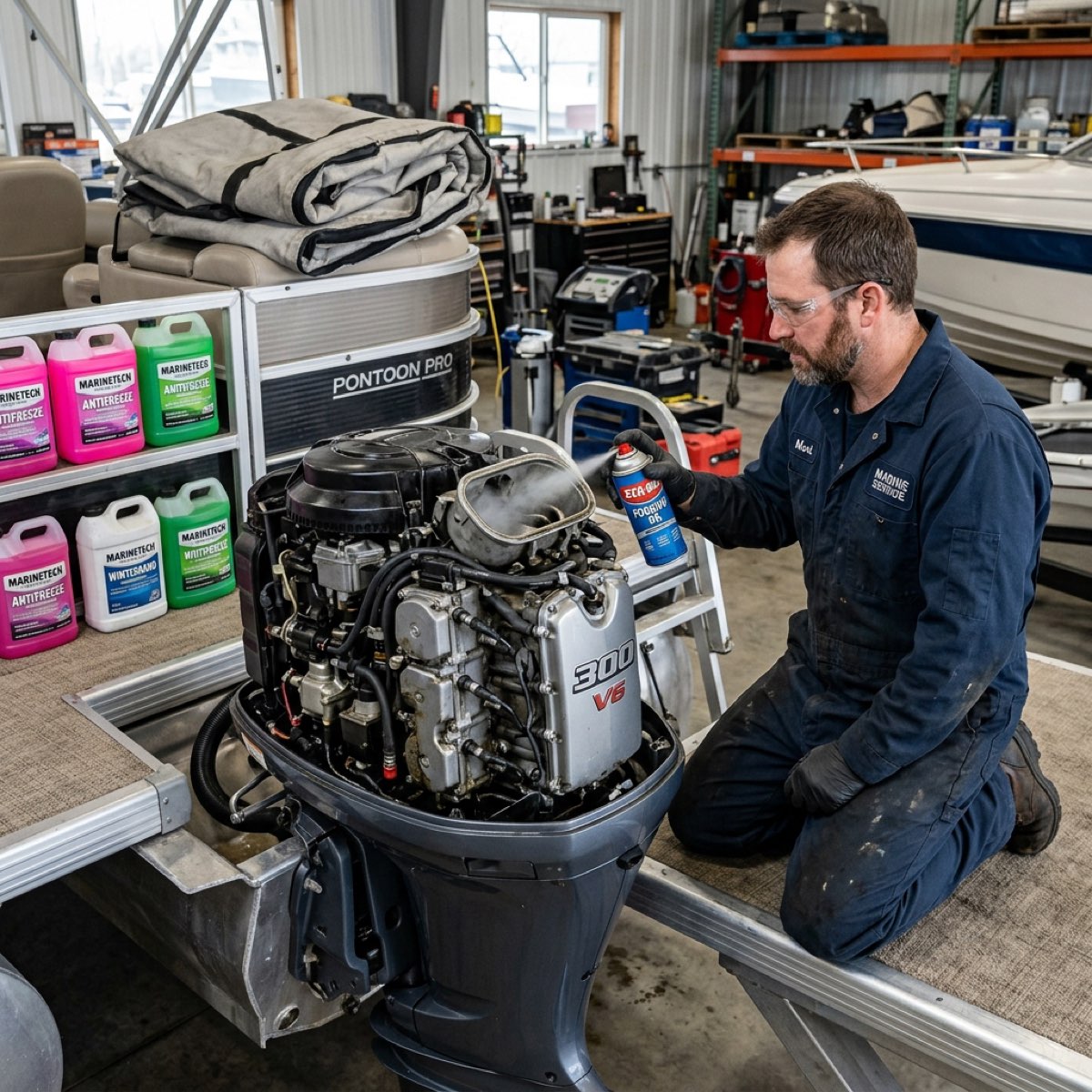
When an engine sits for six months, the thin layer of oil on the cylinder walls and piston rings eventually drains away due to gravity, leaving the raw metal exposed to the air.
2.1 How Fogging Oil Works
Fogging oil is a high-viscosity, wax-based aerosol lubricant designed to stick to internal engine components and resist "run-off" over long periods of time. It creates a temporary airtight seal that prevents oxygen and moisture from reaching the cylinder walls.
2.2 Modern Direct-Injection (DI) Precautions
If you have a modern Direct-Injection engine (like a Mercury Verado or a late-model Yamaha VMAX), check your owner's manual before spraying through the intake.
- The "Plug-Drop" Method: In many high-performance engines, you should pull the spark plugs and spray a 3-second burst of fogging oil directly into the spark plug holes.
- The Crank: Disable the ignition (pull the lanyard) and crank the engine for 2 seconds. This rotates the pistons and distributes the oil across the entire cylinder wall.
3. The Lower Unit: Gearcase Physics and "The Milk Check"
The lower unit of your outboard is the most vulnerable part of the boat in freezing temperatures.
3.1 The Expansion Danger
During the winter, if you leave water inside the gearcase, it will freeze. As water turns to ice, it expands by approximately 9% in volume. Because the lower unit is a sealed aluminum casting, the ice has nowhere to go. It will exert thousands of pounds of pressure, literally cracking the heavy aluminum housing.
3.2 The "Bottom-Up" Oil Change
- Drain: Remove the bottom "Drain" screw and the top "Vent" screw.
- Inspect: If the oil comes out a dark honey color, you are safe. If it comes out looking like "chocolate milk," your seals have failed.
- Fill: You must pump the new gear lube into the bottom hole until it comes out the top vent hole. This ensures that all air pockets are forced out.
4. 4-Stroke Engine Oil: The Acidic Threat
On a 4-stroke pontoon engine, the oil change is a mandatory winterization step.
4.1 The "Acid Bath" Effect
As you run your engine during the summer, the combustion process produces acidic byproducts and unburned fuel that contaminate the engine oil. If you leave that contaminated oil sitting in the engine for six months, those acids will slowly etch and pit the surface of your crankshaft bearings and cam lobes.
4.2 The "Plastic Bag" Filter Trick
On many pontoon engines, the oil filter is mounted horizontally. When you unscrew it, oil spills all over the motor pod. To prevent this, slide a gallon-sized Ziploc bag over the filter before you start unscrewing it. The bag will catch the filter and all the spilled oil.
5. Draining the Cooling System: Outboard vs. I/O
Water is the only substance on Earth that expands when it freezes.
5.1 Outboard Drainage (Self-Draining Design)
Outboard motors are designed to be "self-draining." If you leave the engine in the vertical (tucked down) position, gravity will pull the water out.
- The Fatal Flaw: Never leave your outboard tilted "up" for the winter. This traps water in the cylinder head where it will freeze and crack the block.
5.2 Inboard/Outboard (I/O) & Antifreeze
If you have an I/O engine, you cannot rely on gravity. You must manually drain the block via the brass drain plugs and then flush the system with Non-Toxic Marine Antifreeze (Propylene Glycol).
6. Battery Maintenance: Self-Discharge Physics
A marine battery is a lead-acid chemical reactor. Its ability to survive the winter depends entirely on its state of charge.
6.1 The Freezing Threshold
A fully charged battery will not freeze until the temperature drops below -70°F. However, a discharged battery can freeze and crack at 20°F.
6.2 The Storage Protocol
- The Negative Lead: At the very least, disconnect the negative battery terminal to stop "parasitic draw."
- The Battery Tender: We recommend removing the batteries and placing them on a microprocessor-controlled "Battery Tender." Do not use a cheap 10-amp charger.
7. Freshwater and Livewell Systems (The "Hidden" Water)
Many modern pontoons feature "galley" sinks, washdown hoses, and livewells. These are the #1 cause of spring "burst pipe" repairs.
7.1 Blowing Out the Lines
The most effective way to winterize these systems is to use a small air compressor.
- Empty the freshwater tank completely.
- Run the pump until it starts "sucking air."
- Connect a low-pressure air line to the tank outlet and blow air through every faucet and shower head until only mist comes out.
7.2 The "Pink" Flush
Alternatively, you can pour 2 gallons of Non-Toxic Marine Antifreeze into the freshwater tank and run the pump until pink fluid comes out of every faucet. This ensures that any "valleys" in the plumbing lines that air couldn't reach are protected.
8. Log Inspection: Draining the Pontoons
Most owners treat their aluminum pontoons as 100% airtight, immortal tanks. In reality, every pontoon log has a ventilation system and a drain plug for a reason.
8.1 Condensation Accumulation
Over a long season of thermal cycles, a small amount of condensation can form inside the logs. If you have three inches of water sitting at the back of your log and the temperature drops to zero, that water will freeze and expand, splitting the aluminum seam.
8.2 The Drain Step
Before you cover the boat, remove the small brass or plastic drain plugs located at the very rear (stern) of each log. If water comes out, you have a problem that needs to be addressed before spring.
9. Rodent Prevention: Pure Peppermint and Steel Wool
In the winter, your pontoon boat is a 5-star hotel for mice. They love the foam inside your seats and the plastic insulation on your wiring harness.
9.1 The "Steel Wool" Seal
If your pontoon has an opening where the wiring harness passes into the motor pod, seal it with a wad of steel wool. Rodents cannot chew through steel wool without cutting their mouths.
9.2 High-Concentration Peppermint Oil
Do not use dryer sheets. Use high-concentration Pure Peppermint Oil. It creates a scent barrier that is physically painful for rodents to breathe.
10. Hydraulic Steering and Autopilot Winterization
If your boat has hydraulic steering (standard on 150hp+ engines), it needs its own check.
10.1 Seal Integrity
Inspect the steering ram seals for any "weeping" of hydraulic fluid. If fluid is leaking now, air will enter the system over the winter, leading to "spongy" steering in the spring.
10.2 Bleeding the System
If you noticed any "dead spots" in the steering during the fall, winterization is the best time to perform a full system bleed. Use a pressurized bleeding kit (like the Seastar HA5430) to ensure 100% fluid density.
11. Specialized Fabric and Vinyl Conditioning
UV rays and humidity don't stop just because it's winter.
11.1 The UV Shield
Before covering the boat, apply a liberal coating of Aerospace 303 Protectant to all vinyl surfaces. This is not a "conditioner" (which is often oil-based and attracts mold); it is a UV blocker that prevents the vinyl from becoming brittle during cold-weather storage.
11.2 The "Pink Mold" Cleanse
If you see any "pink spots" on your vinyl, these are colonies of Serratia marcescens. Use a specialized vinyl cleaner (not bleach!) to kill the bacteria before they have six months to burrow deep into the upholstery foam.
12. Trailer Maintenance: The "Often Forgotten" Step
If your trailer fails, you can't even get the boat to the lake in the spring.
12.1 Bunk Wood Inspection
Check the wood bunks under the carpet. If they are "punky" (soft), they will trap moisture against your logs all winter. Replace them with pressure-treated 2x6s and new marine carpet.
12.2 Bearing Grease and "Flat-Spotting"
- Bearing Buddies: Pump fresh grease into your wheel bearings until the spring-loaded plate moves outward. This prevents moisture from entering the hub.
- Tire Pressure: Inflate your tires to their maximum PSI (listed on the sidewall) to prevent "flat-spotting" during long-term storage. If possible, jack the trailer up and place the frame on jack stands to take the weight off the tires and axles.
13. Regional Specifics: Deep South vs. Great Lakes
Winterization looks different depending on where you boat.
| Region | Primary Threat | Key Strategy |
|---|
| Deep South | Humidity / Mold | Maximum ventilation; moisture absorbers. |
| Midwest / Great Lakes | Hard Freeze | Complete water removal; shrink wrapping. |
| Northeast / Canada | Heavy Snow Load | Structural "backbone" supports; 7-mil shrink wrap. |
14. Spring Commissioning Preview: The "Un-Winterization"
The quality of your winterization determines the ease of your spring launch. Here is the exact sequence we follow on May 1st.
14.1 The First "Start" Protocol
- Charge the Battery: Even if it was on a tender, give it a 2-amp "topping" charge for 2 hours before the first launch.
- Fuel Primer: If your boat has a primer bulb, pump it until it is rock-hard. For EFI engines, cycle the key 3-4 times to let the high-pressure pump prime the fuel rail.
- The "Dry" Start: Never start your boat on the trailer without a water source. Connect the earmuffs and turn the water on before you crank the engine.
14.2 The "Tell-Tale" Inspection
Within 10 seconds of the engine starting, you must see a steady stream of water (the "tell-tale") coming out of the back of the engine. If you don't see water, shut the engine off immediately. The rubber impeller in your water pump may have "stuck" to the housing over the winter and shredded itself.
Don't start your winterization without these 12 items:
- Lower Unit Lube Pump (fits standard quart bottles)
- Engine Fogging Aerosol (Star Brite or Quicksilver)
- Marine Fuel Stabilizer (Sta-Bil 360 Marine)
- Microprocessor Battery Tender
- Refractometer (for testing antifreeze)
- 600D Solution-Dyed Canvas Cover
- Marine Triple-Guard Grease
- Aerospace 303 UV Protectant
- Pure Peppermint Oil Repellent
- Teflon Tape (for log drain plugs)
- Oil Filter Ziploc Bag
- Zebra Mussel Scraper (for log cleaning)
16. Conclusion: The May 1st Dividend
Winterization is the single most important maintenance task you will perform every year. It is the difference between a boat that starts on the first turn of the key in May, and a boat that spends the first three weeks of the prime boating season sitting in a service bay.
Take your time. Do not skip the "milk check" on the lower unit. Use the right chemical stabilizers. And most importantly, always store your outboard in the full down position.
Stay safe, watch the thermometer, and I'll see you at the launch ramp in the spring!