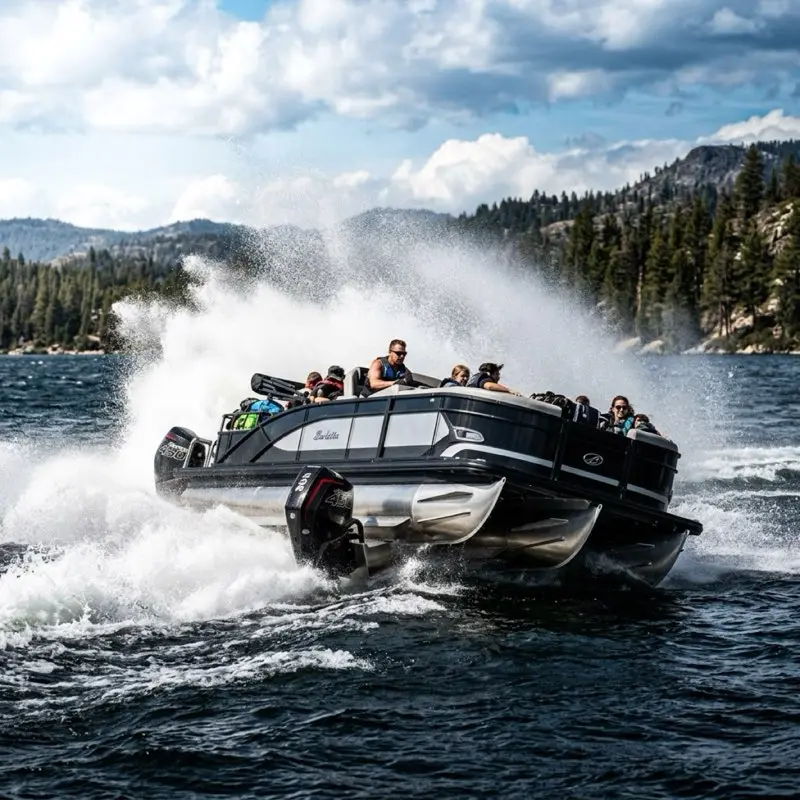
You push the throttle forward, the engine roars to life, and the wake behind you turns into a chaotic mountain of white water. You look at your GPS: 22 MPH. You push the throttle the last 10%, expecting a surge, but the needle doesn't move. The engine just gets louder, the fuel flow spikes, and the boat stays exactly where it was.
You’ve hit the "Pontoon Wall."
To make a pontoon boat faster, you must focus on reducing hydrodynamic drag rather than just adding horsepower. Most pontoons are limited by 'Surge Drag' (water hitting exposed cross-members) and 'Wetted Surface Area' (the logs plowing deep in the water). The most effective speed upgrades are aluminum underskinning, which adds 3–5 MPH by smoothing the hull, and adjusting the engine mounting height to ensure the cavitation plate is skimming the surface.
The good news: You don't need a $20,000 engine upgrade to find your missing 5–10 MPH. By optimizing the physics of how your hull interacts with the water, you can unlock speeds that your boat was never "supposed" to hit.
Mike Callahan's Masterclass Note: "Pontoons are essentially two giant, un-aerodynamic pipes trying to move through a liquid medium. They aren't designed to plane; they are designed to float. When we talk about making a pontoon 'fast,' we are really talking about tricking the water into letting go of the aluminum logs."
| The ROI of Speed | Est. Speed Gain | Approx. Cost | Technical Difficulty |
|---|
| Log Polishing/Cleaning | 1 – 2 MPH | $40 (Acid) | Low (Scrubbing) |
| Engine Height Adj. | 1 – 3 MPH | $0 | Medium (Hoists) |
| Propeller Cupping | 2 – 4 MPH | $150 | High (Pro Shop) |
| Underskinning | 3 – 5 MPH | $450 | Medium (Riveting) |
| Lifting Strakes | 5 – 10 MPH | $1,800 | Expert (Welding) |
Scenario A: The "Surging" Deck (Underskinning vs. Cross-member Drag)
If your boat feels like it’s "surging" or hitting a series of small speed bumps in rough water, you are losing massive energy to Surge Drag.
Look under your deck. If you see open C-channel cross-members (the "ribs" of the boat), each one of those is acting like a bucket. As water sprays up between the logs, it slams into those horizontal beams. This creates a massive "braking" force that your engine has to fight.
The Fix: Aluminum Underskinning
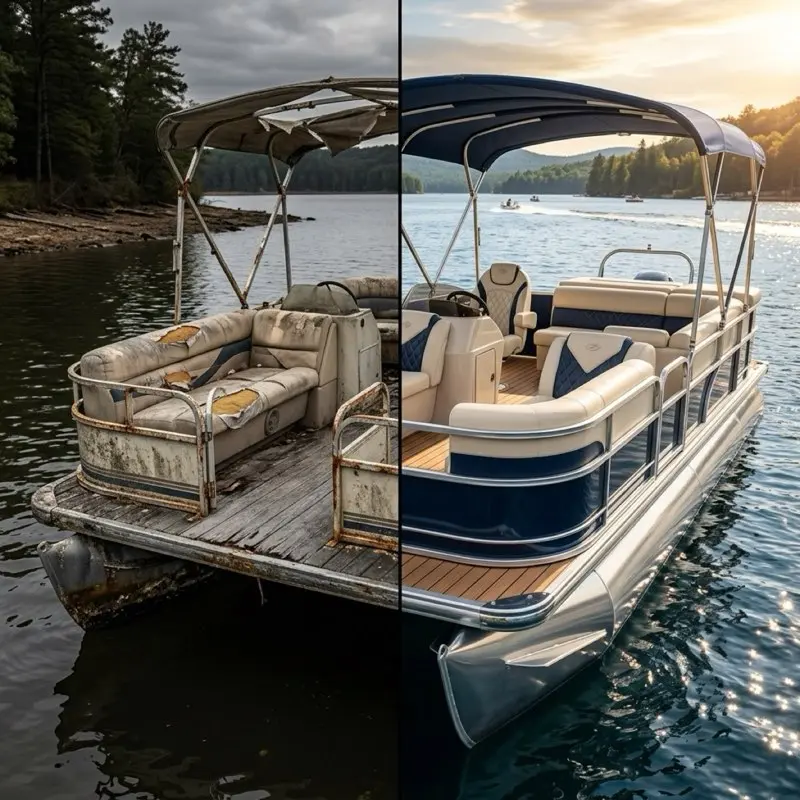
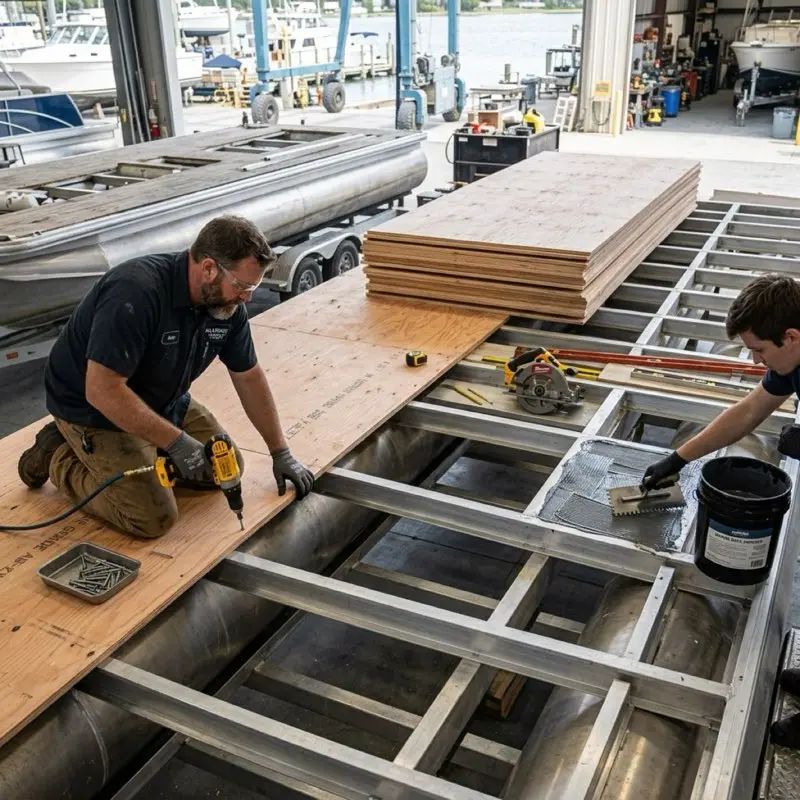
By riveting thin (.063 gauge) aluminum sheets to the bottom of those cross-members, you create a "shield." Instead of the water hitting the beams, it slides across a smooth surface.
- The Gain: This is the #1 upgrade for any pontoon. It makes the boat quieter, drier, and almost always adds a solid 3–5 MPH to the top end.
Scenario B: The "Plowing" Nose (Strakes and Trim Physics)
Standard round pontoon logs provide buoyancy, but they don't provide Lift. As you add speed, the logs just plow deeper into the lake.
1. The Physics of Lifting Strakes
Lifting strakes are triangular aluminum fins welded to the bottom-inner and outer edges of your logs.
- How they work: At speed, the water hits the flat surface of the strake and creates upward pressure. This "jack" lifts the logs several inches out of the water.
- The Result: By reducing the "Wetted Surface Area" (the amount of aluminum touching water), you reduce friction. This is how 150HP pontoons hit 40+ MPH.
2. The "Teeter-Totter" Weight Rule
If your passengers sit in the front "playpen," the nose of the logs will plow, increasing drag. To go fast, you want the bow light. Move the heavy coolers and extra batteries to the rear. You want the boat to ride with a slight "Bow-Up" attitude, which allows the front of the logs to skip over the water rather than pushing through it.
Scenario C: The "Buried" Lower Unit (Engine Height Adjustment)
Most dealers mount pontoon outboards too low. They do this because they are afraid of "Ventilation" (where the prop sucks air in turns). But if your engine is too low, the Anti-Ventilation Plate is buried underwater.
The "Cavitation Plate" Rule
When you are at top speed, have a passenger look at the engine. The flat horizontal plate above the prop should be skimming the top of the water.
- If it is 2 inches underwater, that lower unit is acting like a massive metal anchor.
- The Fix: Raise the engine by one or two mounting holes. This reduces drag and almost always increases your Wide Open Throttle (WOT) RPMs, which translates directly to speed.
Technical Deep Dive: The 2 MPH Algae (Skin Friction)
Algae and "bottom growth" feel soft to the touch, but at 25 MPH, they have the hydrodynamic drag of 80-grit sandpaper.
The Drag Factor
Water molecules want to "stick" to a rough surface. A clean, polished aluminum log allows for "Laminar Flow," where the water slides smoothly. A dirty log creates "Turbulent Flow," where tiny eddies of water spin against the hull.
- The Test: If you haven't cleaned your logs in two months, pull the boat and pressure wash them. If you see a "fuzz" of algae, you are likely losing 2–3 MPH.
- The Pro Tip: Use an acid-based aluminum cleaner to restore the mirror finish. A polished log is a fast log.
Frequently Asked Questions
Will a Stainless Steel prop make me faster?
Yes, but only if you are already going over 30 MPH. Below 30, aluminum props are fine. Above 30, aluminum blades "flex" under the pressure, losing their pitch. Stainless steel stays rigid and delivers more thrust.
Does high-octane (91/93) gas make a difference?
Only if your engine's ECU is programmed for it. High-output outboards (Mercury Verado, Yamaha SHO) have knock sensors. If you put 87 octane in them, they will retard the timing to prevent knocking, which can rob you of 10-15 horsepower.
Will adding a third log (Tritoon) make me faster?
Counter-intuitively, yes. While a third log adds weight, it provides so much extra lift and "planing surface" that the boat rides much higher in the water. A tritoon with the same engine as a twin-log will almost always be 5–8 MPH faster because it stops plowing.
What is 'Prop Cupping'?
Cupping is a small curved lip on the edge of the propeller blade. It allows the prop to "grip" the water better, especially when you are trimming the engine out to lift the bow. It’s like adding "tires with better tread" to your boat.