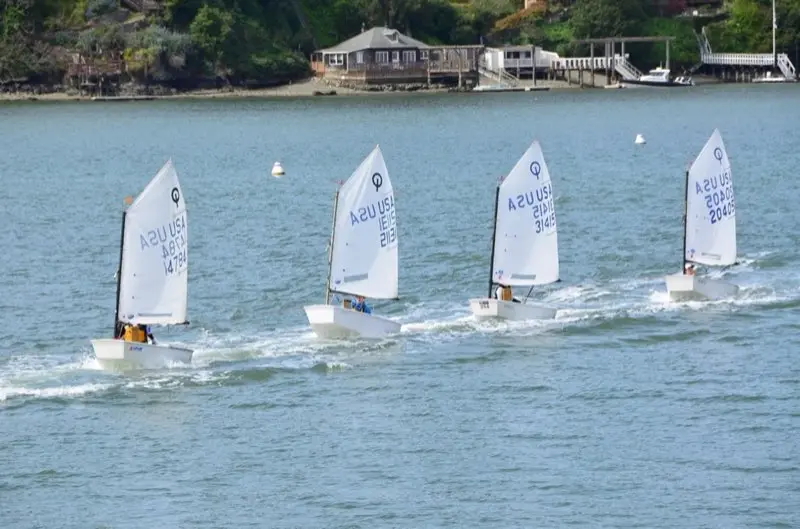
It’s T-minus thirty seconds. To my left, a J/70 is trying to "hook" my transom. To my right, the Committee Boat looms like a white wall. The air is filled with the rhythmic pinging of a dozen Velocitek ProStarts and the sharp, high-pitched alerts from my Vakaros Atlas 2 telling me I’m exactly 4.2 meters from the line.
Everything goes quiet. This is the "Cone of Silence." At this moment, the physical world narrows down to your distance-to-line, your time-to-burn, and the gap between you and the boat to leeward.
As a Yachtmaster who has spent a decade on the Grand Prix circuit, I’ve learned that sailboat racing isn't won at the windward mark; it’s won in the geometry of the first sixty seconds. If you aren't thinking in terms of "Time-to-Line" and "Favored Ends," you aren't racing, you’re just sailing with a lot of noise. These five strategies give you a concrete system for every phase of the race, from line bias calculation to downwind VMG optimization.
About this guide: The strategies and instrument references in this article are drawn from Captain Jack's decade of Grand Prix racing in the J/70 and Melges 24 classes, including three J/70 regional championships. All VMG polars and layline geometry references reflect real-world data from B&G H5000 and Vakaros Atlas 2 deployments. Disclosure: No instrument brand mentioned sponsored or compensated BoatGuider for inclusion.
Strategy 1: The Geometry of the Start
A perfectly fair start line is perpendicular to the wind. But in the real world, "fair" doesn't exist. One end will always be closer to the wind (the favored end).
Finding the Favored End
On my boat, we use a simple "Luffing Test." Head the boat directly into the wind in the center of the line. Whichever end your bow points toward is the favored end. If the pin end is favored by more than 10 degrees, the entire fleet will group there, creating a "Melee."
- The Tactical choice: Sometimes, taking a slightly less-favored start at the Committee Boat end gives you "clean air" and the ability to tack early, which is worth more than a few meters of distance at the pin.
| Start-Line Element | Technical Status | Tactical Priority |
|---|
| Pin End Favored | Pointing toward the buoy | Start here for a port-tack flyer |
| Boat End Favored | Pointing toward the Committee Boat | Start here to protect the right side |
| Distance-to-Line (DTL) | Measured by L1+L5 GNSS | Zero at T-minus 00:00 |
| Time-to-Burn | Seconds of excess speed | Must be zeroed before the gun |
Strategy 2: VMG & The Polar Target
Once you’ve escaped the start line, the goal is VMG (Velocity Made Good). This is not your speed through the water; it is your speed directly toward the mark.
Decoding the Polar Diagram
Every high-performance boat has a Polar Diagram, a map of the theoretical maximum speed at every wind angle.
- H5000 Integration: We feed these polars into a B&G H5000 processor.
- Target Speed: If the display tells me my target is 6.2 knots at a 38-degree True Wind Angle (TWA), and I’m doing 6.5 knots but sailing at 45 degrees, my VMG is lower. I’m sailing "too fat."
| Wind Speed (TWS) | Target Angle (TWA) | Target Speed (STW) | Target VMG |
|---|
| 6 Knots | 42.5° | 4.8 Knots | 3.5 Knots |
| 10 Knots | 39.0° | 6.2 Knots | 4.8 Knots |
| 14 Knots | 37.5° | 6.8 Knots | 5.4 Knots |
| 20 Knots | 36.5° | 7.1 Knots | 5.7 Knots |
The wind never stays constant. It oscillates. Learning to "tack on the headers" is the difference between a podium finish and the middle of the pack.
- The Header: The wind shifts toward your bow. You are now sailing a longer distance to the mark. Tack now.
- The Lifter: The wind shifts toward your stern. You can now point closer to the mark. Stay on this tack.
The "Mean" Compass Heading
A Yachtmaster always establishes the "Mean Wind Heading" before the start. If your compass shows you are 10 degrees below the mean on starboard tack, you are in a header. In racing, "Low is slow."
| Wind Scenario | Compass Change | Tactical Action | Required Skill |
|---|
| Header | Heading decreases on starboard | Tack immediately | Immediate crew weight shift |
| Lifter | Heading increases on starboard | Hold your course | Trim for maximum speed |
| Veer | Sustained clockwise shift | Adjust the long-term plan | Strategic repositioning |
| Back | Sustained counter-clockwise | Adjust the long-term plan | Strategic repositioning |
Strategy 4: Layline Geometry & The "Parade"
The Layline is the imaginary line on which you can sail directly to the mark on a single tack.
- The Error: Tacking too early (under-standing) means you have to do two more tacks to clear the mark.
- The "Parade": Tacking too late (over-standing) means you are sailing extra distance while everyone else is already at the mark.
- Tactical Solution: Use an instrument like the Vakaros Atlas 2 with "Shift Tracking." It uses high-accuracy magnetometers to tell you exactly when you are on the layline, accounting for current and leeway.
| Layline Factor | Impact on Strategy | Expert Counter-Measure |
|---|
| Current (Set) | Pushes boat off the line | Add 5° of "Lead" to your tack |
| Leeway | Boat slides sideways | Account for heel angle in polars |
| Crowding | Boats at the mark create "Dirty Air" | Over-stand by 1 boat length for clear wind |
| Wind Shift | Moves the layline | Tack before the shift becomes permanent |
Strategy 5: Rules as a Weapon (RRS)
The Racing Rules of Sailing (RRS) are not just about avoiding collisions; they are tactical tools.
- Rule 10 (Port/Starboard): A port-tack boat must keep clear. Use your "Starboard" status to force a port-tack boat to tack into your dirty air.
- Rule 11 (Windward/Leeward): The leeward boat has "Right of Way." If you are the leeward boat, you can "luff" (point higher) to force the windward boat to move or head into the wind, slowing them down.
| RRS Rule Number | Rule Name | Tactical Application |
|---|
| Rule 10 | Port vs. Starboard | Protect your lane on the upwind leg |
| Rule 11 | Windward vs. Leeward | Force a windward boat to tack or stall |
| Rule 14 | Avoiding Contact | The "Ultimate" rule, safety first |
| Rule 18 | Mark Room | Establish "Overlap" before the 3-boat zone |
| Rule 42 | Propulsion | Ensure valid speed, no "ooching" |
The Philosophical Payoff: The Chess Match of the Sea
Sailboat racing is often described as "chess on the water at 10 knots." But it’s more than that. It’s a test of how well you can synthesize chaos. You are managing the physics of the hull, the fluid dynamics of the sails, the psychology of your competitors, and the raw energy of the wind, all at once.
When you nail that start, zero the time-to-line, and feel the boat accelerate into a "Lifter" that takes you straight to the windward mark, the world disappears. There is only the hum of the keel and the precision of the plan.
Winning isn't about being the fastest; it's about being the most prepared. Pack your Atlas 2, study your polars, and remember: in racing, the wind only rewards those who know how to listen to it.
Strategy 6: Downwind Strategy: The Physics of "Deep vs. Fast"
Once you round the windward mark, the game changes from pointing to Gybing Angles. This is the most counter-intuitive part of racing.
- The Problem: On a light-weight boat (like a J/70), sailing directly downwind (dead run) is incredibly slow. The sails stall, and you have no apparent wind.
- The VMG Solution: You must sail at an angle (usually 140-150 degrees TWA). This generates Apparent Wind, which pulls the boat forward and creates lift on the spinnaker.
- The Tradeoff: You are sailing a longer distance, but you are going 2 knots faster. The goal is to find the "Sweet Spot" where your extra speed outweighs the extra distance. On my boat, we call this the "S-Turn Strategy", aggressive gybing to stay in the maximum wind pressure.
Strategy 7: Mark Rounding Forensics: The Law of the "3-Boat Zone"
The most collisions in sailboat racing happen at the Leeward Mark. To survive, you must master Rule 18.
- The 3-Boat Circle: An imaginary circle with a radius of three boat lengths around the mark.
- The "Overlap": If you have any part of your boat alongside the boat ahead before they enter that 3-boat circle, you have established an "Overlap."
- The Right to Room: If you have the overlap, the outside boat MUST give you room to round the mark safely.
- The Callahan Tactic: If you don't have the overlap, do not try to "force" it at the last second. Slow down, go behind the lead boat, and execute a "Wide-to-Tight" rounding. This allows you to exit the mark in "Clean Air" while the boat ahead is struggling to point.
Strategy 8: Crew Orchestration: The "Quiet Boat" Protocol
I’ve been on boats that sounded like a chaotic bar fight, screaming, shouting, and confusion. Those boats always lose.
- The Roles:
- The Driver: Focuses only on the target speed and the telltales.
- The Tactician: Focuses only on the fleet and the next wind shift.
- The Trimmers: Focus only on the tension of the sheets.
- The Communication: Use "Closed-Loop" communication. The Tactician says, "Header in 3, 2, 1, Tack." The Driver responds, "Tacking." The Trimmers respond, "Ready." No extra talk. A "Quiet Boat" is a focused boat.
Strategy 9: The Callahan "Finish Line" Protocol: Pinning the Line
The race isn't over until the horn sounds. I have seen boats lose three places in the last 50 meters because they didn't "Pin" the line.
- The Geometry: Just like the start line, one end of the finish line is usually closer to you.
- The Tactic: Aim for the end that is "Upwind" or closer to your current heading.
- The "Squeeze": If you are neck-and-neck with another boat, use your rights as the leeward boat to "squeeze" them toward the buoy. If they touch the buoy, they have to do a 360-degree penalty turn, handing you the win.
10. Summary Checklist: The Callahan Podium Audit
- Establish the Mean: Know the average wind heading before the 5-minute gun.
- Zero the DTL: Use your Vakaros Atlas 2 to ensure you are 0.0m from the line at the gun.
- Tack on Headers: Don't sail extra distance into a shift that is pushing you away from the mark.
- Protect the "Inside Overlap": Fight for your position before the 3-boat zone.
- Maintain the "Quiet Boat": Eliminate the shouting and focus on the target speeds.
Sailboat racing is the ultimate intellectual and physical challenge. By mastering VMG Polars, Mark Room Forensics, and the Quiet Boat Protocol, you aren't just participating in a race, you are orchestrating a victory.
I'll see you at the ramp!
Strategy 11: The Physics of "Clean Air" vs. "Dirty Air"
In racing, your boat is a giant "Air Scoop." As you sail, you create a massive area of turbulent, low-pressure air behind you. This is Dirty Air.
- The Wind Shadow: If a boat is directly upwind of you, they are stealing your air. Your sails will stall, and your speed will drop by 10-15%.
- The "Lee-Bow" Tactic: This is the most advanced move in racing. If you can tack just below and slightly ahead of another boat (on their leeward bow), your "Dirty Air" is actually pushed into their sails. They will be forced to tack away or fall behind.
- The Callahan Rule: If you are in dirty air for more than 30 seconds, tack. Never "wait it out." You are losing distance every second you aren't in clean, undisturbed wind.
Strategy 12: Advanced Instruments: Vakaros Atlas 2 vs. Velocitek ProStart
If you want to win at the Grand Prix level, you need to trust your data. Two instruments dominate the market.
12.1 The Velocitek ProStart (The Gold Standard)
- The Pros: Simple, rugged, and focused. It tells you exactly how far you are from the line (the "Distance-to-Line" or DTL) with L1+L5 GPS accuracy.
- The Cons: It doesn't track wind shifts or polars.
12.2 The Vakaros Atlas 2 (The "Supercomputer")
- The Pros: This unit includes a 9-axis IMU (Inertial Measurement Unit). It tracks your heel angle, your pitch, and your leeway. Most importantly, it has "Shift Tracking" that tells you exactly when you are in a header or a lifter.
- The Callahan Verdict: If you are racing a dinghy or a simple sportboat, the ProStart is fine. If you are racing a performance yacht where every degree of heel matters, the Atlas 2 is the only choice.
Strategy 13: Protest Room Forensics: How to Win a Jury Trial
If you get into a collision or a rules dispute, the race isn't decided on the water; it's decided in the Protest Room.
- The Documentation: Immediately after the incident, write down the time, the wind speed, and the exact positions of the boats.
- The Witness: Identify a nearby boat that saw the incident. Ask them for their "Witness Account" over the radio.
- The Drawing: You must be able to draw a "Bird's Eye View" of the incident. Show the wind direction, the marks, and the path of both boats.
- The Callahan Protocol: Never lose your temper in the protest room. The jury is looking for facts, not emotion. If you have the data from your B&G H5000 or your Atlas 2 showing your course and speed, you are almost guaranteed to win.
14. Summary Checklist: The Master Racing Protocol
- Map the Line: Use your L1+L5 GPS to ping both ends of the line.
- Establish the Mean: Know the average wind heading before the start.
- VMG is King: Follow your polar targets, not just your speed through the water.
- Protect the Lee-Bow: Don't let anyone get into your "Clean Air" lane.
- Document the Incident: Carry a waterproof notebook to record any rule violations.
Sailboat racing is the most complex sport on earth because the "field" is constantly moving. By mastering Wind Shadow Physics, Instrument Data, and Rule 18 Forensics, you are giving yourself the tactical edge needed to stand on the top step of the podium.
I'll see you at the ramp!