The Salt-Jacket Effect: Why Your Outboard is Overheating (Even with a Strong Stream)
AuthorMike Callahan
PublishedMarch 10, 2026
Read Time12 min
UpdatedMarch 10, 2026
Quick Brief
TL;DR Protocol
Why does your engine alarm trigger even with a brand new water pump? Discover the chemistry of Ionic Crystallization and the Masterclass guide to closed-loop acid descaling.
UNIT-REF: BG-NAV-742
#outboard engine overheating saltwater#engine salt crystallization#barnacle buster outboard#flushing outboard motor saltwater#marine engine cooling system cleaning#salt-jacket effect outboard
If you’ve ever stood on your swim platform, watched a healthy, strong "tell-tale" stream arching into the water, and still heard the high-pitched shriek of an overheat alarm, you aren't alone. It’s one of the most maddening mysteries in boating. Your water pump is brand new, your thermostats are clear, and yet the engine computer is telling you the head is melting.
Most boaters respond by flushing the engine again. They stick the garden hose in the port, let it run for ten minutes, and assume they’ve "scrubbed" the internals.
But here is the engineering truth that most mechanics won't tell you: Flushing with a garden hose is like rinsing a dirty lasagna pan with cold water. You’ll get the loose sauce off, but you aren't touching the baked-on crust.
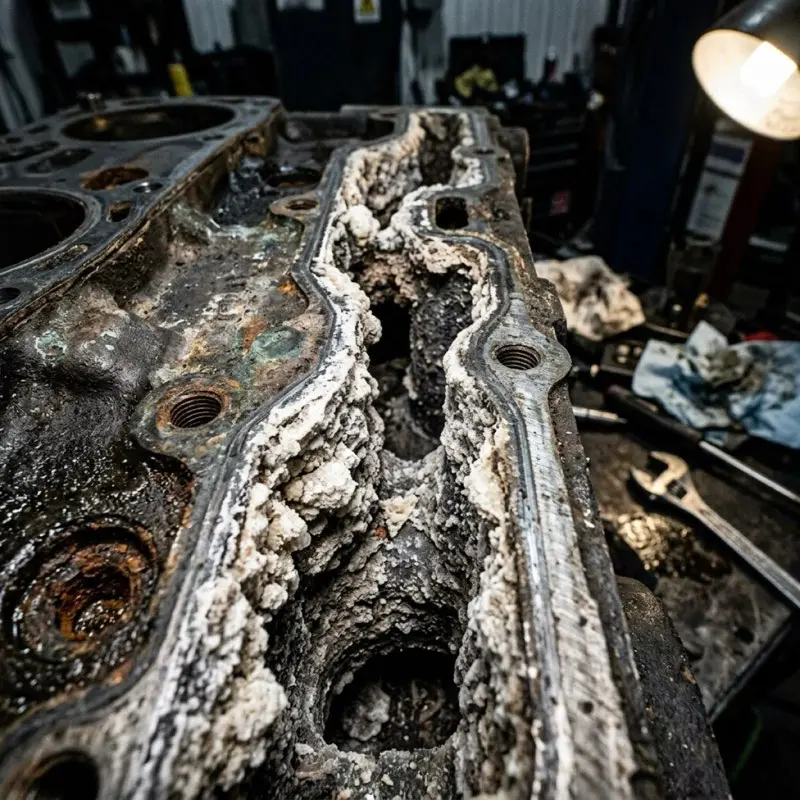
In the maritime world, we call this the Salt-Jacket Effect. It’s a silent, invisible insulation that is slowly cooking your engine from the inside out, regardless of how much fresh water you pump through it at the dock. Today, we’re going to talk about the chemistry of Ionic Crystallization and the only way to truly "clean the pan."
Mike Callahan's Masterclass Note: "The mistake people make is thinking salt is just 'salty water.' It isn't. At temperatures above 140°F, salt doesn't just stay dissolved; it undergoes a phase change. It precipitates out of the water and bonds to your aluminum cooling passages like a layer of ceramic. Once that 'jacket' is on there, fresh water won't touch it. You need an acid-based chemical 'scrubber' to break the bond."
Parameter
Technical Specification
Crystallization Threshold
140°F (60°C) and above
Thermal Conductivity
Salt is 1/10th as conductive as Aluminum
Descaling Frequency
Every 200 hours or 2 years in Saltwater
Chemical Solution
Phosphoric Acid based (Barnacle Buster/Rydlyme)
The 'Flush' Myth
Garden hose pressure: ~40 PSI (Insufficient for scaling)
The Science of the "Ghost Overheat": Ionic Crystallization
To understand why your engine is overheating, we have to look at what’s happening at the molecular level inside your water jackets.
Aluminum is an incredible conductor of heat. That’s why your engine block is made of it. It’s designed to pull the massive heat of combustion away from the cylinders and transfer it to the cooling water passing by.
The Ceramic Barrier
When you operate in saltwater, that water is loaded with dissolved sodium chloride, calcium, and magnesium. As that water hits the hot cylinder walls (which are often much hotter than the 140°F coolant temp), the water evaporates at the boundary layer.
When the water evaporates, it leaves the minerals behind. This is Ionic Crystallization. Over hundreds of hours, these minerals bond together to form a "jacket" around your cylinders.
Here is the kicker: Salt is a terrible conductor of heat. It’s practically an insulator. A layer of salt only 1/16th of an inch thick can reduce the heat transfer efficiency of your engine by up to 40%.
So, even though your water pump is moving plenty of water, that water is just sliding over a "ceramic" salt wall. The heat stays inside the metal, the metal expands, and the alarm goes off.
The Flush Fallacy: Why Your Garden Hose is Failing You
We’ve all been taught that a "freshwater flush" is the holy grail of outboard maintenance. And don't get me wrong, you should absolutely flush your engine every time you use it. It prevents new salt from settling.
But a freshwater flush is preventative, not curative.
Once the salt has crystallized and bonded to the aluminum, fresh water lacks the "solubility headroom" to dissolve it. It would take thousands of hours of freshwater flushing to dissolve a salt-jacket that formed in just fifty hours of hard running.
THE THERMOSTAT TRAP
Most boaters flush their engines while they are cold. But if the engine is cold, the thermostats are closed. This means the fresh water from your garden hose is only reaching about 30% of the internal cooling passages. The most critical areas, the ones around the exhaust ports and spark plugs, are stayng full of stagnant saltwater.
The Masterclass Solution: Closed-Loop Acid Descaling
If you've got a "Ghost Overheat," it’s time to stop flushing and start Descaling. This is a professional procedure that used to require pulling the heads off the engine. Today, we do it with a "Closed-Loop" system.
The Gear List
A 5-Gallon Bucket: This will be your "sump."
A Small Bilge Pump: (500 GPH to 800 GPH) to circulate the fluid.
A 12V Power Source: To run the pump.
Clear PVC Hoses: So you can see the "gunk" coming out.
The Chemical: Barnacle Buster or Rydlyme Marine. These are phosphoric-acid-based cleaners that eat salt and calcium but won't harm your rubber seals or aluminum.
The Protocol: The Callahan Method
Remove the Thermostats: This is the most important step. If you leave the thermostats in, they will block the acid from reaching the "hot zones."
The Loop Setup: Disconnect the water intake hose from your lower unit and connect your pump's outlet to it. Connect another hose to the engine's "tell-tale" or exhaust relief and run it back into the bucket.
The Mix: Mix your descaling solution with fresh water according to the label (usually a 4:1 ratio).
The Circulation: Turn on the pump. You are now circulating the acid through the engine in a continuous loop.
The Wait: Let it run for 2 to 4 hours. You will see the water in the bucket turn a murky white or brown. That is your engine's "Salt Jacket" literally dissolving into the liquid.
The "Death Trap" Symptoms: How to Identify a Salt-Jacket
How do you know if you need a descale before you're stuck 20 miles offshore? Here are the field signs I look for:
The "Delayed Alarm": The engine runs fine for 20 minutes, but the moment you drop to idle after a long run, the alarm sounds. (This is because the water flow drops, but the salt-insulated heat can't escape).
The Discolored Paint: Look at the paint around your cylinder head bolts. If it’s bubbling or turning brown, that head is getting way hotter than the cooling water suggests.
The "Dry" Tell-Tale: If your tell-tale stream is hot enough to burn your hand, your cooling system isn't absorbing the heat, it’s just passing it through.
The Anode Sacrifice: Pull your internal engine anodes. If they are covered in white, hard "calcium" instead of just being eroded, your engine is undergoing heavy mineralization.
Advanced Lore: The "Zinc-Salt" Reaction
Here is a piece of technical lore that even some pros miss. Your engine has internal "sacrificial" anodes. Their job is to corrode so your engine doesn't.
However, in a salt-jacketed engine, the salt acts as an electrolyte "bridge" between the anode and the engine block. This causes the anode to corrode faster, but it also creates a byproduct called Zinc Oxide. This zinc oxide is even harder than salt. It creates a "concrete" that can literally block a water passage entirely.
Mike’s Tip: If you find an internal anode that is "swollen" and stuck in its hole, you have a major mineralization problem. Don't just replace the anode; descale the engine immediately.
FAQ: Can I use Muriatic Acid or Vinegar?
I see this on the "cheapskate" forums every week.
"Mike, Barnacle Buster is $80 a gallon. Can I just use $5 Muriatic acid or Vinegar?"
The short answer: NO.
Muriatic Acid: This stuff is way too aggressive for aluminum. It will eat the salt, but it will also "pitting-corrode" your cylinder walls in minutes. I’ve seen engines ruined in a single afternoon by DIYers trying to save $50.
Vinegar: It’s too weak. It’ll take three weeks of circulation to do what a professional descaler does in two hours. By that time, your bilge pump will have burned out and you’ll have wasted more in electricity than the proper chemical costs.
The Chemistry of the Crust: Calcium vs. Sodium
To truly understand the "Salt-Jacket," we have to look at the two distinct types of minerals trying to kill your engine. Most boaters just call it "salt," but in reality, you are dealing with a two-headed monster.
1. Sodium Chloride (The Common Salt)
This is the salt you taste. It is highly soluble in water, but its solubility decreases as the temperature rises. When your engine is running at 4,000 RPM, the water passing over the cylinder walls is reaching a "Critical Saturation Point." The sodium chloride precipitates out and forms those white, crumbly crystals you see when you pull a water jacket cover.
2. Calcium Carbonate (The Ceramic Wall)
This is the real villain. Calcium carbonate is what makes up limestone and coral. Unlike common salt, once calcium carbonate precipitates out and bonds to your aluminum, it is insoluble in fresh water. You could flush your engine with a garden hose for a thousand years and you wouldn't move a single molecule of calcium carbonate.
This is why "Salt-Away" and other freshwater additives are great for rinsing, but they aren't "Cleaners." They don't have the acidity required to break the molecular bond of the calcium carbonate "ceramic" wall.
The VST Cooling Crisis: Why Your Fuel is Boiling
Here is a piece of technical lore that explains a lot of "mystery" engine stalls. Most modern fuel-injected outboards have a Vapor Separator Tank (VST). Inside this tank is a high-pressure fuel pump. To keep that pump and the fuel cool, the manufacturer runs a small cooling water line through a copper or stainless coil inside the VST.
Because this cooling line is very small (often no thicker than a pencil), it is the first place the "Salt-Jacket" forms.
The Vapor Lock Chain Reaction
When the VST cooling coil scales up, the fuel inside the tank starts to boil. This creates "Vapor Lock." The engine will run perfectly at idle, but the moment you try to get on plane, the engine stumbles and dies because it’s trying to pump gas bubbles instead of liquid fuel.
Most mechanics will try to sell you a new fuel pump ($600+). But in my shop, the first thing I do is blow air through that VST cooling line. If it’s blocked, a 2-hour acid descale will "fix" your fuel system for the price of a gallon of chemical.
Masterclass Technique: The "Pump-Pulse" Method
When you are performing your closed-loop descale, don't just turn the pump on and walk away. Modern engines have complex, winding water passages with many "high spots" where air can get trapped.
Breaking the Air Pockets
If an air pocket forms in the top of a cylinder head, the acid won't touch the salt jacket in that area. To prevent this, use the Pump-Pulse Method:
Cycle the Power: Every 20 minutes, turn the pump off for 60 seconds. This allows the fluid to settle and the air bubbles to migrate.
Reverse the Flow: If your setup allows it, swap the intake and outlet hoses halfway through the process. Pushing the acid in the "wrong" direction often dislodges larger chunks of scale that have become wedged in narrow passages.
The Temperature Boost: Acid works faster when it’s warm. I like to let the pump run in the bucket for 15 minutes before connecting it to the engine. The heat from the pump motor will naturally warm the acid to about 90°F, which makes it significantly more aggressive against the calcium wall.
Chemical Safety & Neutralization: Don't Kill the Grass
We are using acid. It’s "safe" for the engine, but it isn't safe for your driveway, your trailer, or the local ecosystem.
PPE IS MANDATORY
When mixing and circulating descaling acids, you must wear eye protection and nitrile gloves. A single drop of concentrated phosphoric acid in your eye will cause permanent damage before you can reach a garden hose.
The Neutralization Protocol
Once you are done with your 4-hour descale, you are left with 5 gallons of "dirty" acid. You cannot just pour this down the drain or into the grass.
Baking Soda: Slowly add boxes of baking soda to your bucket until the "fizzing" stops. This neutralizes the pH.
Dilution: Once neutralized, the solution is mostly just water and dissolved minerals. Dilute it with another 10 gallons of fresh water before disposing of it according to your local regulations.
The Final Flush: After the acid is out of the engine, run fresh water through the engine for at least 20 minutes to ensure every trace of acid is gone. If you leave acid in the cooling passages, it will eventually start to etch the aluminum.
FAQ: Is this safe for my rubber impeller?
This is the #1 question I get from DIYers.
"Mike, won't the acid melt my water pump impeller?"
The short answer: No.
Professional descalers like Barnacle Buster are formulated to be "rubber-safe." They are specifically designed to be circulated through cooling systems that contain impellers, O-rings, and gaskets. In fact, by removing the salt from the water pump housing, you are actually extending the life of your impeller by reducing the friction caused by a "crusty" housing.
Summary: The Final Word on Salt-Jackets
Your outboard is a mechanical athlete. It needs to breathe, it needs to be fed, and above all, it needs to stay cool.
Don't let a 1/16th inch layer of "marine concrete" kill a $20,000 engine. Freshwater flushing is your daily maintenance, but Descaling is your deep-cleaning. Respect the chemistry, follow the protocol, and your engine will give you a thousand hours of silent, cool operation.
Stay cool, stay clear, and I’ll see you at the ramp.