A seller tells you his 2018 pontoon is in "excellent condition." He's had it freshwater-only, always stored indoors, serviced every year. It's priced $4,000 below what similar boats are listing for.
What he doesn't mention: the transom flexes. The starboard tube has 150 gallons of water in the rear chamber. The engine has 1,340 hours on it and the compression numbers haven't been checked since the original owner sold it to him in 2021.
I'm not inventing this. I've sat across this exact situation — different seller, different boat, same story — more times than I can count. Every time, the buyer who walked in with a checklist caught it. Every buyer who walked in with enthusiasm and a handshake offer did not.
This is the checklist. All 47 points, organized so you can work through the boat systematically in about two hours. I've marked each point with a severity rating: 🔴 Deal Breaker (walk away or price for full repair), 🟡 Negotiating Leverage (factor into offer), and 🟢 Expected on Used Boats (normal, don't panic).
Mike Callahan's Field Note: "Bring a flashlight, a flathead screwdriver, a rubber mallet, and a notebook. The mallet is for tapping the deck and tubes. The screwdriver is for probing soft spots. The notebook is for writing down everything the seller tells you — memory is unreliable when you're excited about a boat."
What You Need Before You Start
Bring with you:
- Flashlight (bright, handheld)
- Rubber mallet or heavy-handle screwdriver
- Small flathead screwdriver (for probing)
- Multimeter (for electrical spot checks)
- Phone (to photograph every finding)
- This checklist, printed or on your phone
The right conditions:
- Inspect in daylight where possible — artificial light hides a lot
- Boat should be on the trailer for the first half of the inspection; in the water for the sea trial
- Do not inspect in rain — wet surfaces hide moisture damage
Part 1: Documentation (Before You Touch the Boat)
These checks happen before the inspection even starts. A clean boat with bad paperwork is not a clean deal.
Point 1 — HIN Match 🔴
Locate the Hull Identification Number on the boat. On pontoons it's typically stamped or affixed to the aft crossmember within one foot of the starboard (right) side. It's a 12-character alphanumeric code. Compare it letter-for-letter to the HIN on the title and registration. Any mismatch — even one character — is a stop-everything problem. It can indicate the title belongs to a different boat, or that the HIN plate has been swapped to conceal a stolen vessel or insurance claim.
Point 2 — Clear Title, Seller Named 🔴
The person standing in front of you must be the person named on the title. If the title is in someone else's name, the seller must have documented legal authority to sell (power of attorney, estate documentation). Buying from someone who isn't the titled owner creates risk you cannot fully assess at the point of sale.
Point 3 — Lien Check 🔴
Look at the title for any lienholder listed in the lien section. If the seller financed the boat through a bank or credit union, that lender holds a legal interest in the boat until the loan is paid off. If you buy a boat with an unsatisfied lien and the seller doesn't pay off the loan, the lender can legally repossess the boat from you. Ask the seller directly: "Is there a loan against this boat?" If yes, either require that the lender is paid at closing, or use an escrow service.
Point 4 — Service Records 🟡
Ask for every service receipt the seller has. You're looking for: annual oil changes, impeller replacements (every 3 years or 100 hours is standard), spark plug changes, lower unit fluid changes, and any repair documentation. A seller with no service records is not automatically hiding something — many private owners simply don't keep them. But no records means you're buying blind on the engine's history.
Point 5 — Registration History / State Records 🟡
Ask which state(s) the boat has been registered in. A boat previously registered in a coastal state (Florida, South Carolina, Louisiana) may have saltwater exposure even if the current seller says "freshwater only." Request the registration documents and look at the registration history if your state provides it. Some states allow a VIN/HIN history check similar to a Carfax — worth $20–$40 for a major purchase.
Point 6 — Capacity Plate Intact 🟢
The USCG-required capacity plate (listing maximum persons, weight capacity, and horsepower rating) should be present and legible. A missing or defaced capacity plate is a minor regulatory flag but may indicate a history of non-compliance or modification.
Part 2: Pontoon Tubes (Logs)
This is the section that separates a good inspection from a five-minute walkaround. Budget at least 20 minutes on the tubes.
Point 7 — The Sloshing Test 🔴
With the boat on the trailer, have someone drive the tow vehicle forward 15 feet and stop abruptly. You stand beside the tubes and listen. Water inside a tube sounds like a washing machine mid-cycle. Air-only tubes are silent. Any sloshing sound means water is present — the amount and location determine severity.
Point 8 — Tube Tap Test 🟡
Using the rubber mallet or your knuckles, tap along the full length of each tube at 12-inch intervals. Healthy, air-filled sections return a clear, resonant ring. Water-filled sections return a flat, dull thud. Use this to narrow down which chamber is affected before pulling drain plugs.
Point 9 — Drain Plug Check 🟡
Locate all drain or test plugs on each tube (typically one per chamber, on top, sometimes at the stern end). Remove them one at a time. Any water draining out confirms intrusion in that chamber. The volume and color of the water matters — a tablespoon of clear water is condensation; continuous flow of dark or turbid water means a breach with long-term saturation.
Point 10 — Bracket Weld Inspection 🔴
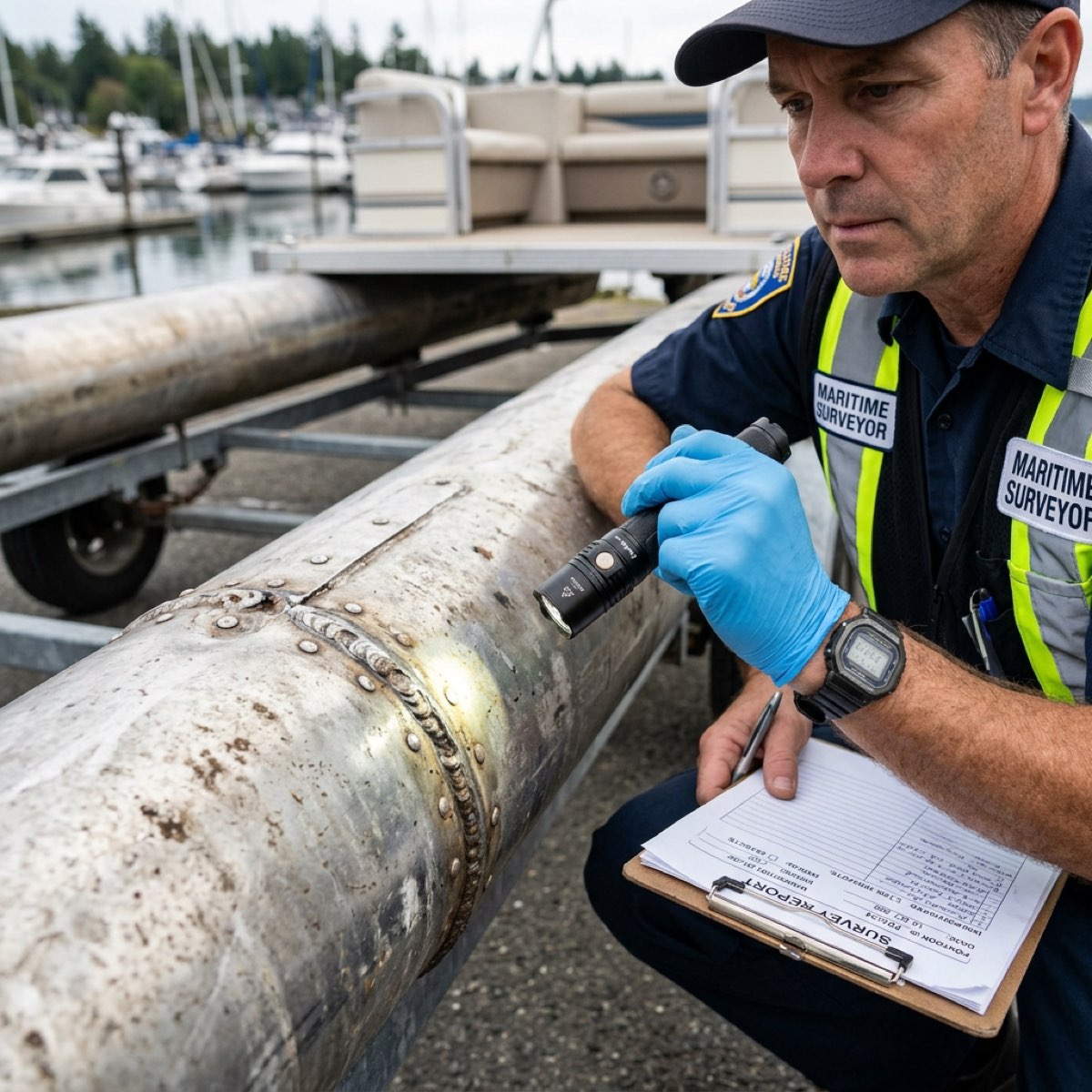
The most common failure point on aluminum pontoon tubes is not the main seam — it's the weld toes adjacent to external bracket attachment points (M-brackets, deck support risers, lifting strake weld toes). Run your finger along the tube surface immediately beside each bracket. You're feeling for:
- Hairline cracks visible as dark lines in the metal
- White chalky residue (aluminum oxide — active corrosion)
- Raised or rough texture at weld toes
Use your flashlight here. These cracks are easy to miss in low light.
Point 11 — Nose Cone Condition 🟡
The front five feet of each tube are the most vulnerable to impact damage from beaching and debris. Inspect the nose cone for dents, creases, and any evidence of repairs (look for discoloration, weld marks, or paint overspray inconsistencies). A dent that has creased the metal rather than simply denting it is far more likely to have a stress crack.
Point 12 — Full Tube Exterior Walk 🟡
Walk the full length of each tube on both sides. You're looking for:
- Any dents, gouges, or scrapes
- Inconsistent paint or surface finish (may indicate patching or repair painting over damage)
- Galvanic corrosion pitting — small, whitish craters in the aluminum surface, common near any stainless steel fittings
- "Dock rash" — horizontal scratches at a consistent height along the tube, indicating the boat has been pushing against a dock or pilings
Point 13 — Keel and Lifting Strake Integrity 🟢
Inspect the bottom keel extrusion and any lifting strakes (the triangular fins welded to the tube sides). Look for deep gouges in the keel (from gravel ramps), and check lifting strake weld toes as an additional bracket-type weld point to inspect per Point 10.
Point 14 — Tube Straightness 🟡
Stand at the stern and look along the length of each tube toward the bow. They should be straight. A tube that bows visibly or has a noticeable kink has likely been damaged by an impact or an improper trailer bunk bearing the full load at a single point.
Point 15 — Anode Condition 🟡
Locate the sacrificial anodes (zinc, aluminum, or magnesium plates) bolted to the tubes. They should be attached with metal-to-metal contact (no paint between the anode and the tube). If they're more than 50% consumed, they need replacement — and their condition tells you how aggressively the boat's aluminum has been under galvanic attack. If the anodes are nearly pristine on a 5-year-old boat, verify they're the correct type for the water environment: zinc anodes in freshwater film over and become non-functional.
Point 16 — Full Deck Walk 🔴
Walk slowly across every square foot of the deck, including corners, under furniture, and behind the helm console. You're feeling for soft spots — areas where the deck flexes or feels spongy underfoot. Soft spots indicate water-damaged plywood subfloor. Even a small soft area is expensive: pontoon decking replacement often runs $3,000–$8,000 depending on size and material.
Point 17 — Deck Tap Test 🟡
Using the handle of your screwdriver, tap the deck surface in a grid pattern. A solid, healthy deck returns a crisp, dense tap sound. A delaminated or rotted section returns a hollow, dull thud. Pay particular attention to areas around hardware penetrations — cleats, cup holders, the helm console base — as these are common water entry points into the subfloor.
Point 18 — Underskin Inspection 🟡
If the boat has underskinning (aluminum panels on the underside of the deck framing), look for any discoloration, corrosion, or deformation. On boats without underskinning, use your flashlight to inspect the subfloor and cross-members from below. Look for dark staining or soft wood on the underside of the decking boards.
Point 19 — Cross-Member Inspection 🟡
The aluminum cross-members that connect the tubes and support the deck should be straight, uncorroded, and securely fastened. Look for any members that are bent or twisted (sign of impact or stress). Check the bolts connecting cross-members to the M-brackets — they should be tight with no evidence of movement or elongation of the bolt holes.
Point 20 — Railing and Gate Integrity 🟢
Grab each section of railing and apply firm outward pressure. Railings should be solid with no visible flex or movement at the weld points. Gate hinges and latches should operate smoothly and close positively. Loose or wobbly railings are a safety issue and a sign of either poor construction or weld fatigue.
Point 21 — Boarding Ladder 🟢
Extend the swim/boarding ladder fully and apply your body weight to each rung. Ladders should operate smoothly and be mounted to the tube or transom with no flex. A ladder that wobbles or has corroded mounting points is a liability issue.
Part 4: Transom
The transom is the most structurally critical part of a pontoon boat. This is where the engine transfers all of its force into the boat. A compromised transom is a 🔴 Deal Breaker.
Point 22 — The Push Test 🔴
Stand at the stern with the engine in the down position. Place both hands on the outboard motor midsection and push firmly downward, then upward. There should be absolutely zero flex or movement visible in the transom structure. Any visible flex, creaking, or "give" means the transom substrate (the wood core inside the aluminum skin) is compromised. This repair requires complete transom reconstruction — budget $1,500–$4,000.
Point 23 — Transom Hardware 🔴
Inspect all through-bolts on the transom mounting plate. Look for:
- Dark water staining around bolt holes (water has been entering through the hardware)
- Corrosion weeping from bolt holes
- Any soft material around hardware penetrations (probe with the screwdriver tip — the wood should feel solid and dry)
Point 24 — The Smell Test 🟡
Lean close to the transom, especially near hardware penetrations and the bottom edge. Rotted marine plywood has a very specific odor — damp, musty, slightly organic. If you smell it at the transom before you see anything, trust your nose. The rot has already started inside.
Part 5: Engine
The engine section is where a seller's omissions cost buyers the most money. Budget significant time here.
Point 25 — Engine Hours 🟡
Locate the hour meter on the dashboard. On fuel-injected engines, the ECU stores tamper-resistant hour data that a diagnostic scan tool can retrieve. Compare the dash meter reading to the ECU reading — discrepancies can indicate meter manipulation. General benchmarks: below 500 hours is low use; 500–1,200 hours is moderate; above 1,200 hours warrants close scrutiny of service records and a compression test.
Point 26 — Compression Test 🔴
This is the single most important mechanical test on the engine. A compression test reveals the internal condition of pistons, rings, and valves — components that cannot be evaluated by visual inspection. All cylinders should be within approximately 10% of each other. Readings significantly below spec or significant cylinder-to-cylinder variance indicates internal wear or damage. Do not accept a seller's refusal to allow a compression test. If he won't allow it, assume the worst and price accordingly.
Point 27 — Lower Unit Gear Oil 🔴
Remove the lower unit oil drain plug and catch a small sample. Healthy gear oil is dark amber to brown, slightly opaque. Milky or grey-tinged oil means water has entered the lower unit through a failed propeller shaft seal or a drained-damaged gearcase — water in gear oil causes rapid gear and bearing corrosion. Lower unit repair/replacement: $800–$2,500.
Point 28 — Tell-Tale Water Flow 🟡
Start the engine and immediately observe the tell-tale (the stream of water exiting from the cooling indicator hole, usually on the lower cowling). Within 30 seconds of starting, a strong, steady stream should be visible. Weak flow, intermittent flow, or no flow indicates a failing water pump impeller. Impeller replacement is $100–$300 but must happen before the engine overheats.
Point 29 — Prop Condition 🟡
Remove the propeller and inspect it with the engine off and the battery disconnected. Look for:
- Bent or missing tips (impact with a hard object)
- Nicks and gouges along the blade leading edge (debris contact)
- Erosion pitting (cavitation damage, indicates a trim or ventilation problem)
- Fishing line wound around the prop shaft behind the propeller (can damage the shaft seal if driven far)
A damaged prop is a negotiating point, not a deal killer. A good prop runs $150–$400. But a severely damaged prop that was run at speed can indicate the lower unit was also stressed.
Point 30 — Corrosion Under Cowling 🟡
Remove the engine cowling and inspect the powerhead and all accessories. Look for:
- White aluminum oxide buildup on any aluminum components
- Rust on steel components (bolts, brackets)
- Oil leaks — fresh or dried — anywhere on the block
- Any evidence of overheating: discolored paint on the block, melted wiring insulation, or heat staining on the cylinder head
Point 31 — Throttle and Shift Operation 🟡
With the engine idling, shift deliberately from neutral to forward and from neutral to reverse. Both transitions should be positive and immediate with no grinding, clunking, or delayed engagement. A clunk during shift engagement can indicate shift cable wear or internal gearcase wear. Advance the throttle smoothly through the range — hesitation, stumbling, or flat spots in acceleration suggest fuel system issues (carb or injector).
Point 32 — Engine Trim Function 🟡
Test the power trim through its full range — full down to full up. It should move smoothly and hold position when you release the switch. Slow operation, jerking, or failure to hold position indicates low hydraulic fluid, a failing motor, or internal seal wear. (See our full trim/tilt diagnosis guide.)
Part 6: Fuel System
Point 33 — Fuel Tank Condition 🟡
If the tank is accessible, inspect it. Aluminum tanks: look for any white corrosion buildups, pinhole weeps, or evidence of sealing compound applied to the exterior (a sign of a repaired leak). Fiberglass tanks on older boats: inspect for any soft areas or delamination. Plastic tanks: check for crazing (fine surface cracks that indicate UV degradation).
Point 34 — Fuel Line Condition 🟡
Trace all fuel lines from the tank to the engine. They should be pliable, not brittle or cracked. Squeeze each line — it should give without cracking. Cracked or hardened fuel lines are a fire hazard and must be replaced. On pre-2000 boats, verify that the fuel lines are ethanol-compatible (many older lines are not and will swell or crack when exposed to E10 fuel).
Point 35 — Water-Separating Fuel Filter 🟡
Remove and inspect the fuel filter bowl. It should be clear or slightly amber in color. Any white or milky appearance indicates water contamination in the fuel — potentially phase-separated E10. This is fixable, but it means the tank needs to be drained and inspected, and the engine's fuel system may need servicing.
Part 7: Electrical System
Point 36 — Battery Condition and Mounting 🟡
Inspect the battery terminals for white or green corrosion (clean it back and look for pitting on the terminal itself). The battery must be mounted in a secured tray or box with a lid — it should not be able to move freely in rough water. Test the battery voltage with your multimeter: 12.6V or above at rest indicates a healthy charge; below 12.4V suggests the battery may not hold a full charge.
Point 37 — Fuse Panel Inspection 🟡
Locate the fuse/breaker panel (usually under the helm console). Look for:
- Any burnt or melted fuses
- Any circuit with a mismatched fuse (a 30A fuse in a 10A circuit slot)
- Evidence of previous electrical fires: melted wire insulation, discoloration around fuse slots
- Any circuit labeled "unknown" or unlabeled — a sign of amateur wiring additions
Point 38 — Wiring Quality Check 🔴
Look for any visible wiring under the helm console, in the engine bay, and near the battery. All marine wiring should use stranded, tinned copper wire — the tinned coating (silver-gray appearance) distinguishes it from automotive wire. Look for:
- Wire nuts (the plastic caps used in household wiring) — never acceptable in a marine application
- Exposed copper at connection points without heat-shrink or waterproof terminals
- Wire runs in contact with sharp edges without chafe protection
- Any "rat's nest" of added wiring that suggests multiple amateur modifications
Point 39 — Navigation and Running Lights 🟢
Test all nav lights: bow light (red and green), stern light (white), and anchor light if equipped. Each should illuminate at full brightness without flickering. Check that no bulb is missing or showing a burned-out dark spot.
Point 40 — Electronics Function 🟢
Power up all installed electronics — chartplotter/GPS, depth finder, stereo. They should boot normally and hold a GPS lock within a few minutes. Look for cracked screens, sun-faded displays, or water intrusion marks inside the screen bezels.
Part 8: Steering, Controls, and Safety
Point 41 — Steering System Check 🔴
Turn the steering wheel lock-to-lock. The movement should be smooth and consistent throughout the range with no stiff spots, binding, or dead zones. Then, with the engine running at idle in neutral, turn the wheel hard to both stops — the engine should respond immediately and smoothly. On cable steering systems: count the turns lock-to-lock (most pontoons are 3.5–4.5 turns). Excessive free play at center indicates a worn cable. On hydraulic steering: look for any fluid at the helm unit or at the steering cylinder on the engine.
Point 42 — Throttle Cable Condition 🟡
Have someone advance the throttle while you watch the cable at the engine connection point. It should move smoothly with no kinks or stiff spots. A throttle that sticks or returns slowly creates a dangerous situation — the engine won't respond predictably at speed.
Point 43 — Safety Equipment 🟢
Verify that the boat has the USCG-required safety equipment appropriate for its hull size:
- Life jackets in usable condition (check for brittle straps, missing buckles, foam that doesn't spring back)
- Working fire extinguisher (check the gauge — needle should be in the green zone)
- Visual distress signals (flares within their expiration date)
- Sound-producing device (horn, whistle)
- Registration numbers properly displayed
Part 9: Trailer
A quality pontoon trailer is worth $3,000–$8,000 new. A bad trailer is a dangerous one. Inspect it as seriously as the boat.
Point 44 — Frame and Bunk Condition 🟡
Inspect the entire trailer frame for rust. Surface rust on a trailer is normal and manageable. Flaking rust that comes off in sheets indicates deep corrosion — probe the affected area with the screwdriver. If the screwdriver tip penetrates the metal, the frame is structurally compromised. Check the bunk boards (the carpeted wood supports the tubes rest on) for rot — press them firmly. They should be solid wood, not spongy. Check that the bunks are properly positioned to support the center of each tube.
Point 45 — Wheel Bearings 🔴
With the trailer unhitched and the wheels off the ground, spin each wheel by hand. They should spin freely and quietly for several rotations. Any grinding, roughness, or rumbling indicates worn bearings. Then grab the top and bottom of each tire and try to rock it — more than 1/8" of play indicates worn bearings or a loose hub. Worn bearings left unchecked seize and fail — often at highway speed. Bearing repack: $50–$100 per wheel. Bearing failure and axle damage: $500+.
Point 46 — Lights, Coupler, and Winch 🟡
- Connect the trailer to a tow vehicle and test all lights: tail, brake, turn signals, reverse
- Inspect the coupler: it should latch firmly on the ball with no excessive play
- Check safety chains for rust, cracked links, and proper S-hook attachment
- Pull the winch strap fully out and inspect for fraying or mold. Test the ratchet mechanism under a light load — it should hold without slipping
Point 47 — Tire Age 🟡
Locate the DOT date code on each tire sidewall — it's a 4-digit code near the rim, where the last four digits represent week and year of manufacture (e.g., "2319" = 23rd week of 2019). Replace any tire older than 6 years regardless of tread depth. Trailer tires age from UV exposure and heat cycling, not just tread wear. An old trailer tire can fail catastrophically at highway speed with almost no visible warning.
The Sea Trial: What You're Listening and Feeling For
Never skip the sea trial. No amount of inspection on the trailer or at the dock tells you how the boat actually performs.
On departure: Let the engine warm up for 3–5 minutes at idle. Watch the temperature gauge — it should stabilize and not climb. Confirm the tell-tale is flowing.
At speed: Advance to WOT (Wide-Open Throttle) in open water with adequate distance. Your tachometer should reach the engine manufacturer's specified WOT RPM range. Under-propped engines spin above spec and wear fast. Over-propped engines can't reach spec and carbon up. Check your engine's WOT spec in the owner's manual before the sea trial.
During turns: Turn hard in both directions. The boat should respond cleanly without excessive lean or reluctance. Any vibration through the steering wheel at speed points to prop damage, drive shaft wear, or a loose motor mounting.
At idle: Shift to neutral and let the engine idle for two minutes. It should idle steadily without hunting or dying. Any rough idle suggests fuel delivery, ignition, or compression issues.
After docking: Check the bilge area for any water accumulation from running. A small amount of spray water is normal. Any significant water in the bilge area warrants investigation.
The Severity Summary: Walk-Away vs. Negotiate vs. Accept
| Category | Walk Away | Negotiate Hard | Accept and Budget |
|---|
| Tubes | Water in multiple chambers; cracked weld at multiple bracket points | Water in one chamber; single accessible crack | Minor dock rash; single small dent |
| Transom | Any flex under engine push test | Dark staining at hardware | Surface oxidation only |
| Engine | Milky lower unit oil; failed compression test; no tell-tale flow | High hours with no records; rough idle | Normal hours with clean oil |
| Deck | Multiple soft spots throughout deck | One soft area in a corner | Surface wear, fading vinyl |
| Electrical | Burnt panel; non-marine wiring throughout | Corroded battery terminals; aged wiring | Minor light bulb out |
| Trailer | Structural frame rust; seized bearings | Bunk rot; tires over 6 years old | Surface rust; worn carpet on bunks |
When to Hire a Marine Surveyor
A professional marine survey costs $300–$500 for a pontoon. It is worth it when:
- The purchase price exceeds $20,000
- You cannot personally access the underside of the deck or interior of the tubes for inspection
- The engine has high hours and no service records
- You're buying sight-unseen or traveling a long distance
A surveyor carries insurance for his findings, uses moisture meters (which detect sub-surface deck rot invisible to the tap test), and can pressure-test the tubes on-site. For a major purchase, the survey fee is the cheapest insurance you can buy.
Frequently Asked Questions
How many hours is too many on a used pontoon outboard?
There's no hard cutoff number. A 1,200-hour engine with complete service records and clean compression is a better buy than a 400-hour engine that's never had its lower unit oil changed. Hours matter less than maintenance history. The compression test (Point 26) tells you the actual engine health regardless of what the hour meter says.
The seller won't let me do a compression test. What does that mean?
It means he knows something you don't. A seller with a healthy engine has nothing to lose by allowing a compression test. A seller who refuses is either hiding known engine problems or afraid of what you'll find. Either way, it's not a boat you should buy at the asking price without a significant discount factored in for unknown engine condition.
Is it worth buying a pontoon with a soft spot in the deck?
It depends on size and location. A single soft spot of 12–18 inches in a low-traffic corner can sometimes be repaired DIY for under $500. Multiple soft spots, or a soft spot at the helm or boarding area, indicates widespread sub-floor failure — budget $3,000–$8,000 for professional repair. Always factor the full repair cost into your offer, not just the cost of materials.
What's the biggest red flag sellers try to hide?
In my experience: water in the tubes (cosmetically invisible until the sloshing test), transom flex (only obvious under the push test), and milky lower unit oil (only visible when you crack the drain plug). These three things are expensive to fix and easy to miss if you don't know to specifically check for them.
This checklist reflects common inspection practices for recreational pontoon boats. Specific conditions and requirements vary by boat design, age, and manufacturer. This guide is an informational framework and does not replace the judgment of a qualified NAMS or SAMS marine surveyor. For any purchase involving significant uncertainty, commission a professional survey before proceeding.