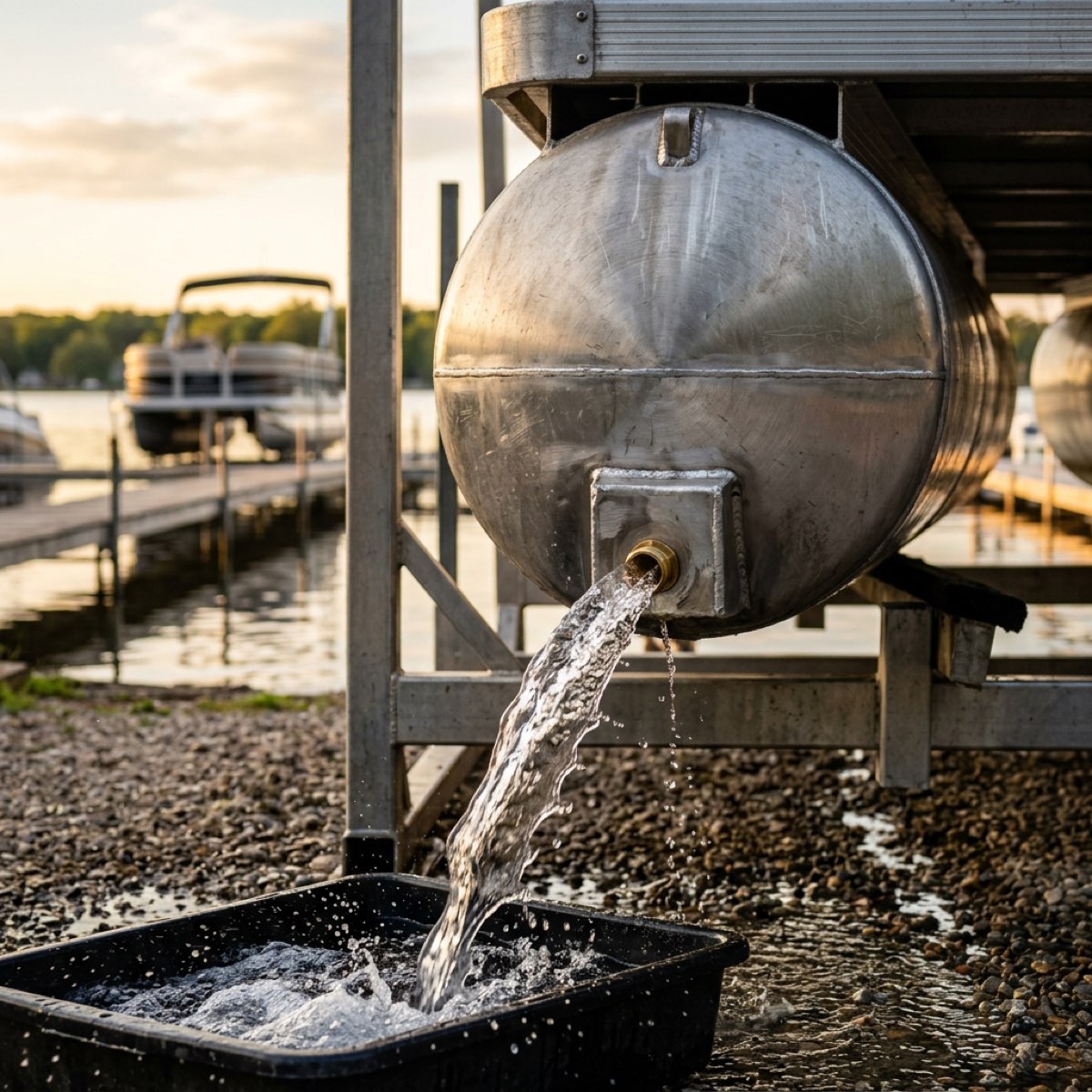
A boater I know bought a used pontoon boat a couple of seasons ago. The deal looked solid — a well-known brand, a reasonable price, new upholstery. He took it out the first weekend and noticed it felt sluggish off the hole. He figured it was the prop pitch. Then he noticed the stern end sitting about two inches lower than the bow when he tied up. He figured it was load distribution.
By mid-summer he was back at the dealer scratching his head because the boat could barely get on plane with four people aboard.
When they pulled the drain plugs, water ran out of the starboard rear tube for eleven minutes straight.
The prior owner knew. That boat had been sitting at a dock with a leaking weld for at least one full season, slowly taking on hundreds of pounds of water. By the time my friend bought it, two of the four internal chambers in the rear tube were full. The weight difference between that tube and the other two was over 600 pounds.
This guide covers everything you need to know to catch this before it gets that bad — or deal with it if it already has.
Mike Callahan's Field Note: "Water in pontoon tubes is the marine equivalent of a slow oil leak. On its own it won't sink you today — but it compounds. More water means more stress on the compromised weld, more corrosion inside the tube, lower performance putting more strain on the engine. Every season you ignore it, the repair bill grows."
| Diagnostic | What It Tells You |
|---|
| Boat sits lower on one side or at stern | Water is present, likely in a specific tube or chamber |
| Sloshing sound on trailer stop | Water confirmed; tube significantly filled |
| Hollow thud becomes a flat thump | Water in that section; use as guide to locate chamber |
| Engine struggling to plane | Weight penalty significant — performance meaningfully compromised |
| Drain plug releases water on trailer | Confirmation; volume indicates severity |
Part 1: How Pontoon Tubes Are Built — And Why That Matters for Diagnosis
To understand where leaks come from, you need to know what you're looking at.
The Tube Itself
Pontoon logs are fabricated from marine-grade aluminum alloy sheet — almost universally 5052 or 5086 alloy, chosen for corrosion resistance and the ductility to absorb impact without cracking outright. The aluminum sheet is rolled into a cylinder and welded along a longitudinal seam running the full length of the tube.
Wall thickness varies by manufacturer and segment:
- General-purpose pontoons: typically .080" to .090" tube wall
- Performance and premium models: .100" to .125" tube wall
- Nose cone reinforcement: .125" or heavier on quality builds, because the nose contacts underwater obstacles during beaching
These are thin walls. A sharp dock corner, a gravel bottom during beaching, or a fatigue crack from years of trailer vibration can penetrate them. The question isn't whether they can be breached — they can — but whether you know it when it happens.
Inside every quality pontoon tube are internal bulkheads — welded aluminum dividers that separate the tube into 3 to 4 isolated, airtight chambers. These serve two critical purposes:
Safety: If one chamber is breached, only that chamber fills with water. The other chambers remain pressurized with air and continue providing buoyancy. A boat with chambered tubes and a single breached chamber is inconvenienced. A boat with non-chambered tubes and a breach can sink.
Diagnosis: Because chambers are isolated, you can identify which chamber contains water by probing systematically — tapping the exterior for the sound change, checking individual drain plugs if present, or running your pressure test section by section.
How to identify your tube design:
- Count the vent plugs or test plugs along the top of each tube. One plug per chamber is the standard configuration for chambered designs. Three plugs on a tube means three chambers.
- Look for external vertical weld seams on the tube exterior — these typically indicate the location of internal bulkhead welds.
- Check your owner's manual or manufacturer website for your specific model's tube specification.
⚠️
**NOT ALL TUBES ARE CHAMBERED:** Some entry-level pontoons use flow-through baffles with holes at the bottom rather than sealed bulkheads. These provide structural stiffness but no water containment. If your boat has this design, a single breach can eventually result in the entire tube filling. Know your tube design before you assess the severity of an intrusion.
Part 2: The Six Ways Water Gets In
Water doesn't randomly appear inside sealed aluminum tubes. Every case has a specific physical mechanism. Knowing which one caused your problem determines the correct repair — and whether the same thing will happen again in two years if you only fix the symptom.
Cause 1: Weld Failure at Bracket Attachment Points
This is the most common cause I see in the shop, and it's also the most misunderstood. The failure isn't usually in the main longitudinal seam. It's at the points where external hardware is welded to the tube surface — M-brackets, deck support brackets, lifting strake weld toes.
Here's the engineering: when you weld something to the outside of a tube, you create a "hard point" — a location where the tube cannot flex. Everywhere around that hard point, the aluminum can flex under load (engine vibration, wave impacts, road trailer vibration). The stress concentrates at the edge of the weld, specifically in the Heat-Affected Zone (HAZ) — the narrow band of metal adjacent to the weld where the heat of welding altered the aluminum's temper and made it slightly less ductile.
Over years of cyclic loading — every wave, every trailer bump — the HAZ develops microscopic fatigue cracks. Eventually those cracks propagate through the tube wall. The leak starts as a pinhole. Water enters slowly, often without any obvious symptoms for months. By the time you notice the boat sitting low, there can be hundreds of gallons inside.
Where to look: Inspect the tube surface immediately adjacent to every external bracket weld — M-bracket feet, deck riser support points, lifting strake weld toes. Look for white powdery residue (aluminum oxide, the corrosion byproduct), surface discoloration, or hairline cracks visible as dark lines.
Cause 2: Physical Impact — Dock Rash, Gravel Bottoms, Debris
A sharp dock corner at speed. A gravel boat ramp that's shallower than expected. A submerged branch. These create dents, gouges, and in the worst cases, direct penetrations of the tube wall.
Not every dent leaks. The 5052 and 5086 alloys are designed to deform without cracking under moderate impact — the metal dents rather than cracks. But a sharp impact that creases the metal, especially near an existing weld, can penetrate the wall. And a dent that looks cosmetically minor from the outside can have an interior crack that's invisible without pressure testing.
Where to look: The bottom and lower sides of the tubes, especially the bow area (which contacts the water first when waves are running) and any areas with visible dents or scrapes.
Cause 3: Galvanic Corrosion — The Invisible Attack
Galvanic corrosion is an electrochemical process that creates microscopic pinholes in aluminum over time, without any obvious physical impact. It requires three things: two dissimilar metals, an electrolyte (water), and electrical contact between the metals.
Aluminum sits low on the galvanic series — it's relatively "active" (anodic). When aluminum is in electrical contact with a nobler metal (stainless steel fittings, bronze drain plugs, copper-based antifouling paint) in the presence of water, electrons flow from the aluminum to the nobler metal. The aluminum corrodes.
The result is pitting — small divots that deepen over years until they penetrate the tube wall entirely. In freshwater, this process is slow. In saltwater or brackish water, it's dramatically faster. A pontoon kept in saltwater without proper sacrificial anodes can develop pinhole leaks from galvanic corrosion in 3–5 years.
The antifouling paint mistake: Some owners apply copper-based antifouling paint to their pontoon tubes to discourage growth. This is one of the most destructive things you can do to an aluminum tube. Copper and aluminum in saltwater create a galvanic cell with significant voltage differential. The aluminum sacrifices itself to protect the copper — rapidly.
Anode selection by water type:
| Water Environment | Correct Anode Material | Why |
|---|
| Freshwater | Magnesium | Higher driving voltage needed to overcome freshwater's low conductivity |
| Saltwater | Aluminum or Zinc | Both effective; aluminum anodes increasingly preferred for longevity |
| Brackish/Mixed | Aluminum | Best balance across variable salinity |
Do not use zinc anodes in freshwater — they develop an oxide film that renders them non-conductive and ineffective. Do not use magnesium anodes in saltwater — they dissolve too rapidly, leaving the boat unprotected.
Cause 4: Improper Trailer Support and Road Vibration
Every mile you tow your pontoon, the tubes are loaded — their weight resting on the trailer bunks, the whole assembly vibrating with road imperfections. If the trailer bunks are misaligned, the load is concentrated at contact points rather than distributed evenly across the tube length.
This concentrated loading is worst when a bunk edge or end contacts the tube directly below a bracket weld — compounding the already-elevated stress at the HAZ. Owners who do significant mileage with misaligned bunks can accelerate weld fatigue cracking by years.
Check your trailer alignment: The bunks should provide continuous, even support along the full length of each tube. There should be no single points where the bunk edge is the only support. If your tubes show a wear pattern (raw aluminum scraped clean) in a localized spot, the trailer support is incorrect.
Cause 5: Manufacturing Defects — The Inherited Problem
Not every leak is earned through use. Some pontoon tubes leave the factory with weld defects — incomplete penetration, porosity (gas bubbles trapped in the weld), or cold welds that look solid but have inadequate fusion.
Reputable manufacturers pressure-test completed tubes at the factory before installation. But this catch isn't universal across the industry, and borderline defects can pass a factory test and fail years later under actual use conditions.
If your tube leak presents on a relatively new boat that hasn't been subjected to obvious impact, and the failure point is in a weld (not at a bracket attachment), a manufacturing defect warrants a warranty discussion with your dealer.
Cause 6: Condensation — The Overrated Cause
Forum posts frequently blame condensation for water inside tubes. This is largely overstated. Condensation — moisture forming from temperature-differential humidity inside the tube — exists, but the volumes it produces are small. A few ounces from condensation is meaningless. The gallons that cause performance loss and list always have a structural cause.
If you drain a tube and find only a cup or two of water with no identifiable external leak, condensation is a plausible explanation. If you find liters — find the leak.
Part 3: Confirming Water Is Present — Four Tests in Order of Confidence
Test 1: The Sloshing Test (On the Trailer, High Confidence)
With the boat on the trailer, have someone drive the tow vehicle forward approximately 10–15 feet and stop abruptly. Both of you then immediately put your ears near the tubes and listen.
Water in a tube is unmistakable — you'll hear it moving, either as a slosh or a low surge sound. Air-only tubes are silent. This test works best when there's meaningful water present (several gallons or more). It won't detect a single quart in a large chamber.
Test 2: The Tap Test (Free, Directional)
Use your knuckle or a rubber mallet to tap along the tube at 12-inch intervals. An air-filled chamber returns a clear, resonant, hollow ring. A water-filled section returns a dull, flat thud — similar to tapping a full glass vs. an empty one.
This test is imprecise but directional. It narrows down which chamber to target for your pressure test. It's not reliable for small water volumes or in the presence of interior foam.
Test 3: Drain Plug Removal (Definitive for Equipped Boats)
If your tubes have factory-installed drain or test plugs (typically 1/4" or 3/8" NPT plugs on top of each chamber, sometimes at the stern end of each tube), remove them one at a time while the boat is on the trailer with the stern lowered slightly.
Any water in that chamber will run out through the plug opening. Even a small stream confirms water is present. Volume gives you severity.
Where plugs are located: Most commonly at the uppermost point of each chamber when the boat is level — meaning you may need to tilt the boat on the trailer to get the plug at the highest point for a complete drain.
If your boat has no drain plugs, do not drill holes into the tube without understanding the chamber layout. Drilling into the wrong location can penetrate a bulkhead and connect two previously isolated chambers.
Test 4: Low-Pressure Air Test (Most Accurate, Requires Equipment)
This is the professional standard — it not only confirms water presence but locates the exact leak point.
Equipment needed:
- Low-pressure air source (compressor with pressure regulator, or a hand pump — a bicycle pump works)
- Accurate low-pressure gauge (0–10 PSI range; standard automotive tire gauges are not accurate enough at these pressures)
- Soapy water in a spray bottle (dish soap + water works fine)
- A test plug fitting with a Schrader (tire) valve core, sized to your tube's plug opening
Procedure:
- Drain as much water from the tube as possible first
- Seal all tube openings except the one you're using for air injection
- Insert your test fitting and connect your air source
- Pressurize the tube slowly — stop at 2–3 PSI. Do not exceed 3 PSI under any circumstances
- Disconnect the air source and cap the fitting
- Spray soapy water across all exterior welds, all bracket attachment points, and any visible dents or damage areas
- Watch for bubbles — even slow, small bubbles indicate air escaping through a defect
🛑
**PRESSURE LIMIT: MAXIMUM 3 PSI.** Pontoon tubes are not designed as pressure vessels. Exceeding 3 PSI risks permanent tube deformation or, in the worst case, a seam blowout. Use a gauge calibrated for low pressure — standard tire gauges are designed for 30+ PSI and are inaccurate at the 2–3 PSI range you need here. A purpose-made low-pressure gauge costs $15–$25 at any hardware store.
Part 4: How Much Water Adds How Much Weight
This is the math that explains why performance degradation is the first symptom — and why people miss it. The water accumulates gradually. Performance degrades gradually. The owner adjusts expectations gradually until the boat is carrying hundreds of extra pounds and it feels like it always ran this way.
The volume calculation:
Pontoon tubes are cylindrical. Volume = π × r² × L
A common tube configuration: 25-inch diameter (12.5-inch radius), with a 6-foot chamber segment:
- Volume = 3.14 × (1.04 ft)² × 6 ft ≈ 20.4 cubic feet per chamber
- At 7.48 gallons per cubic foot: approximately 152 gallons theoretical maximum per chamber
- At 8.34 pounds per gallon: approximately 1,270 pounds of water capacity per chamber
In practice, tubes don't fill completely because the water pickup is limited by the size of the breach and the depth at which the tube operates. But even a 20% fill of one chamber — around 30 gallons — adds 250 pounds of dead weight to one corner of your boat.
What 250 extra pounds on one tube does:
- Drops that corner of the boat 1–3 inches lower in the water
- Creates drag asymmetry — the boat pulls toward the heavier side
- Forces the engine to work harder to achieve the same speed
- Puts the motor under load conditions it wasn't tuned for
- Masquerades as a "prop pitch problem" or a "motor needing a tune-up"
Part 5: Repair Options — Honest Costs and What Each Actually Fixes
Option 1: Marine-Grade Epoxy (Temporary, Specific Use Cases Only)
Products like TotalBoat TotalFair or similar marine epoxies can seal a small, accessible pinhole or hairline crack as a temporary measure. This is appropriate when you need to get through a weekend and have the repair welded properly the following week.
Why it's not a permanent repair:
- Epoxy has significantly different thermal expansion characteristics than aluminum. Seasonal temperature cycling will eventually debond the patch.
- Epoxy creates a contamination problem for the subsequent welder. Before TIG welding aluminum, the metal must be completely clean. Any epoxy residue must be ground off — adding time and cost to the professional repair.
- Epoxy does not address the structural cause. If the leak is at a bracket weld due to fatigue cracking, the crack will continue to propagate beyond the patch because the underlying stress concentration is unchanged.
Do not use: JB Weld, automotive body filler, or any non-marine-rated compound. These are not suitable for aluminum, for submerged applications, or for pressurized cavities.
Option 2: TIG Welding — The Permanent Fix
TIG (Tungsten Inert Gas) welding is the industry standard for pontoon tube repair. It provides precision on thin aluminum (you're working with .080"–.090" material) and produces a clean, high-strength weld that restores structural integrity.
The procedure for a bracket-point fatigue crack repair involves:
- Identifying the full extent of the crack (dye penetrant or the soapy water test under pressure)
- Drilling a small "stop hole" at each end of the crack to prevent further propagation during repair
- Grinding out the crack to create a clean V-groove for full-penetration welding
- Cleaning the aluminum to bare metal — aluminum oxide forms within minutes and must be mechanically removed immediately before welding
- Welding the groove with appropriate filler rod (ER4043 or ER5356 for 5052/5086 base alloy)
- For bracket-point cracks: welding a reinforcement plate over the repaired area to distribute future stress away from the repair zone
- Post-repair pressure testing to confirm integrity
Cost estimate:
| Repair Type | Estimated Cost Range |
|---|
| Simple accessible pinhole or seam crack | $100 – $350 |
| Crack under or near a bracket (bracket removal required) | $350 – $800 |
| Multiple failures, multiple chambers | $800 – $2,000+ |
| Professional pressure test only (location identification) | $200 – $400 |
These are labor estimates and vary significantly by region and shop. The cost of bracket removal is the major variable — accessing a crack beneath a welded M-bracket or lifting strake requires cutting or removing the external hardware, repairing the leak, then re-welding the hardware. It's time-intensive.
Finding a qualified welder: Not every welding shop works with .080"–.090" aluminum at the precision required for tube repair. Look specifically for shops advertising aluminum boat or pontoon repair, or marine welding experience. A TIG welder accustomed to structural steel will produce an oversized, porous weld on thin aluminum tube material. Ask to see examples of previous aluminum marine work.
Option 3: Tube Replacement
If a tube has multiple failure points, significant internal corrosion from prolonged water exposure, or galvanic pitting that compromises the wall thickness across a large area, replacement is more economical than repeated welding.
Replacement tubes are available from major manufacturers (Bennington, Crest, Manitou, Sun Tracker, etc.) as replacement parts for current models. For older boats or discontinued models, aftermarket tube suppliers can fabricate replacement logs to your specifications.
Tube replacement requires removing the entire deck, cross-members, and hardware from the old tube, transferring everything to the new tube, and professional welding of all mounting points. This is a significant shop job — expect $2,000–$5,000+ depending on boat size and configuration — but it results in a structurally sound, properly warranted replacement rather than a repaired tube with ongoing monitoring requirements.
Part 6: Prevention — The Annual Inspection Protocol
Water inside tubes is almost always preventable with a systematic annual inspection. This takes 30 minutes and costs nothing.
Annual Inspection Checklist
On the trailer, before launch:
-
Run the sloshing test — drive forward 15 feet, stop hard, listen. Do this before the boat touches water for the season.
-
Inspect all external bracket weld perimeters — with clean hands or a rag, wipe down the tube surface adjacent to every welded bracket. You're feeling for:
- Raised or rough areas at weld toes (indicating the start of a fatigue crack)
- White chalky powder (aluminum oxide — sign of active corrosion)
- Any dark line or hairline crack in the base metal near a weld
-
Inspect the full tube exterior — walk the length of each tube and look for any new dents, scrapes, or impact marks from the previous season. Note their location and assess depth.
-
Check all drain/vent plugs — remove and reinstall with fresh thread sealant. Look for any corrosion on the plug or the plug boss. A corroded plug boss is a potential water entry path.
-
Check the trailer bunk support — confirm that each bunk provides even, distributed contact along the tube length. Look for wear patterns in the tube that indicate point loading.
Annually in the water:
-
Check anode condition — sacrificial anodes on pontoon boats should be replaced when they've been consumed by approximately 50%. An anode that's down to a stub provides minimal protection. An anode that looks almost unused may have filmed over (common with zinc in freshwater) and should be replaced with the correct material.
-
After a significant impact — any collision with a dock, a gravel ramp, or a submerged object warrants pulling the boat and doing a visual inspection plus the sloshing test before the next outing. Don't let a small impact become a slow-leak problem that fills a tube all season.
Frequently Asked Questions
My boat is sitting slightly lower on one side but I don't hear any sloshing. Is that water in the tube?
Not necessarily — asymmetric loading (gear stored on one side, a heavy engine that's off-center) can cause a slight list. But if the list is consistent regardless of load distribution and wasn't present when the boat was new, water in a tube is the most likely cause. Start with the drain plug test and the tap test before assuming it's load-related.
Can I just drill a drain hole to empty the tube?
Not without understanding your tube's internal design. If you drill into the wrong location, you may penetrate an internal bulkhead, connecting two previously isolated chambers. If you drill and leave the hole open, you've created an ongoing water entry point. If you're going to drill a drain hole, it must go into a specific chamber at its lowest accessible point (at the stern when the boat is on the trailer, nose slightly elevated), and it must be properly plugged and sealed after draining. This should be discussed with a professional who knows your specific tube layout.
I fixed the weld and the leak stopped, but now I can't get the water out. How do I drain a sealed tube?
If your tube has no drain plug and the welded repair sealed the only access point, you have a few options: (1) use a hand bilge pump or automotive hand pump with a long tube inserted through the plug opening before closing it; (2) have the welder install a proper drain plug in a logical location as part of the repair; (3) siphon from the plug opening. Option 2 is the best long-term solution — you'll want that drain access for future inspections.
How long can I run the boat with water in one tube?
You can operate it carefully at reduced speed, but you should not ignore it indefinitely. The water inside the tube is in contact with raw aluminum, accelerating interior corrosion. The added asymmetric weight stresses the boat's crossmember structure. The compromised tube buoyancy reduces your safety margin. Repair it before the end of the season at the absolute latest.
My boat has foam-filled tubes instead of chambered air tubes. Does this article apply to me?
Foam-filled tubes behave differently. They can still take on water — the foam isn't a perfect barrier to water migration — but because the foam provides positive buoyancy independent of air pressure, the buoyancy loss is much less dramatic. The diagnostic tests (sloshing, tap, pressure) are either inapplicable or less reliable for foam-filled designs. For foam-filled tubes, visible exterior damage inspection and weight comparison (a section that's noticeably denser when tapped) are your primary diagnostic tools.
Tube construction specifications and repair cost ranges reflect general industry standards and field experience. Actual specifications vary by manufacturer, model year, and product line. All pressure testing should be performed using a calibrated low-pressure gauge and must not exceed 3 PSI. Consult an experienced marine aluminum welder for any structural repair assessment.