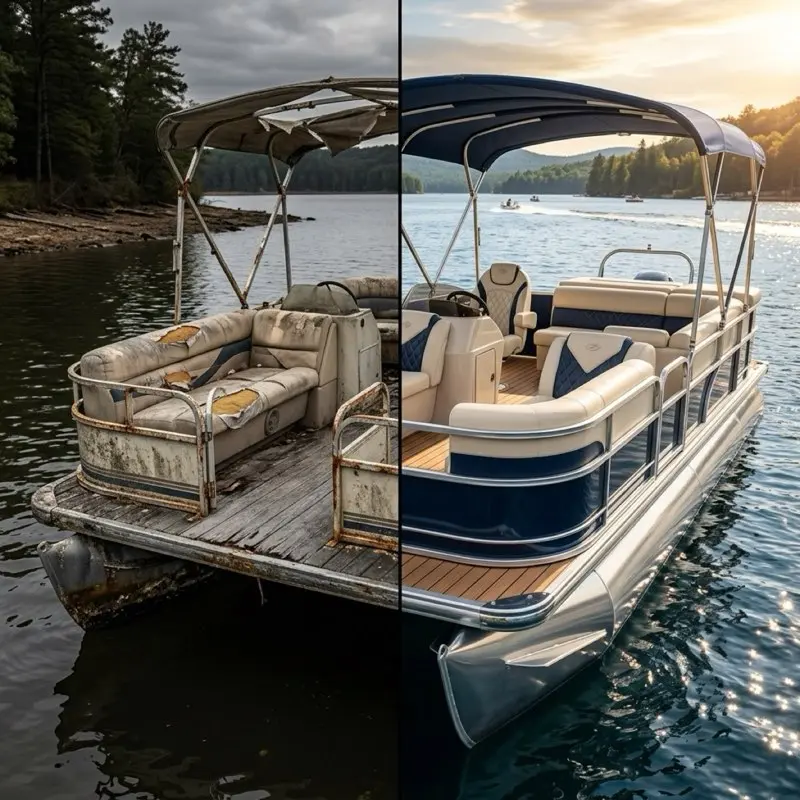
If you live in Minnesota, Wisconsin, or Michigan, you know that snow isn't just "white rain." It is a dynamic, shifting structural load. As a marine service advisor in the upper Midwest, every April I walk the yard and document the carnage left behind by cheap winter covers. I’ve seen bent aluminum side-fencing, shattered bimini top frames, and cracked fiberglass helms, all because an owner tried to save $200 on a big-box store "universal" cover.
A single cubic foot of wet, heavy snow can weigh up to 20 pounds. On a standard 22-foot pontoon boat (which has roughly 180 square feet of deck space), a 6-inch wet snowfall can effortlessly dump 1,800 to 2,500 pounds of pressure directly onto your fencing and seating.
If your boat cover is not engineered to shed that load through a proper architectural pitch, or if the fabric lacks the tensile strength to resist the stretching forces, your pontoon will become a casualty of the winter freeze-thaw cycle.
In this technical guide, we will bypass the marketing fluff. We will break down exactly how to construct a load-bearing "backbone" system, how to interpret Denier ratings, the critical difference between solution-dyed acrylics and pigment-dyed polyesters, and the precise cover specifications you need to survive a brutal Northern winter.
1. The Physics of Snow Load: The "Bathtub Effect"
The single most common cause of catastrophic cover failure is a phenomenon we call the "Bathtub Effect."
How it Happens:
When a boat cover is installed with insufficient tension or an inadequate internal support structure, the fabric sags slightly between the support poles. When snow falls, it naturally accumulates in these depressions.
As the sun comes out the next day, the top layer of snow melts into heavy slush. This water flows down into the sag, increasing the weight and stretching the fabric further. When the temperature drops again that night, the slush freezes into a solid block of ice. Over the course of a month, this freeze-thaw cycle creates a massive, frozen "bathtub" suspended directly over your seats.
The Mechanical Failure:
A 5-cubic-foot block of solid ice sitting in a cover sag weighs nearly 300 pounds. This is a dead, concentrated load. The polyester fabric cannot stretch endlessly. Eventually, the tension transfers to the aluminum side rails (the D-rails) where the cover is strapped.
Standard pontoon fencing is designed to withstand lateral impacts from waves, but it has very little vertical crush resistance. Under the immense tension of a frozen bathtub, the 1.25-inch aluminum square tubing will buckle inward, permanently warping the entire side of your pontoon.
2. The Fabric Technicality: Denier Count vs. GSM
When you shop for a winter cover, you are immediately bombarded with "D" numbers (e.g., 300D, 600D, 900D, 1200D).
Understanding Denier (D):
Denier is a textile measurement that dictates the linear mass density of the fibers. Specifically, it is the weight in grams of 9,000 meters of the yarn. The higher the Denier count, the thicker and heavier the individual threads.
- 300D Fabric: This is the standard "free" cover that comes from a big-box store. It is paper-thin and designed exclusively to keep dust off the boat inside a garage. If you use a 300D cover in the snow, it will tear like tissue paper under the first heavy load.
- 600D Fabric: This is the absolute bare minimum for Northern winter storage. It provides adequate tensile strength to resist the stretching forces of snow accumulation, provided you have a highly pitched support system underneath.
- 900D+ Fabric: This is the heavy-duty standard for open-field storage in high-snow areas. It is incredibly thick, difficult to tear, and highly resistant to UV degradation.
We heavily recommend Taylor Made’s 600D Elite series for standard yard storage or Oceansouth’s heavy-duty 900D custom-fit covers for extreme climates where the boat is exposed to heavy crosswinds.
3. Solution-Dyed vs. Pigment-Dyed Fibers (The UV Threat)
While snow weight is the physical mechanism that destroys a cover, UV radiation is the invisible killer that sets the stage. Even in winter, the sun's UV rays relentlessly attack the polyester fibers, drying them out and making them brittle.
Pigment-Dyed Covers (The Cheap Route):
Most covers under $250 are pigment-dyed. This means the manufacturer takes a roll of white polyester and essentially "paints" the color onto the surface of the fabric. Within one or two seasons, the UV rays burn off the surface pigment. The fabric fades rapidly, and more importantly, the underlying polyester becomes incredibly brittle. When a heavy snow load hits this brittle fabric, it shatters.
Solution-Dyed Covers (The Professional Standard):
High-end marine fabrics (like Sunbrella acrylic or premium Taylor Made polyester) are solution-dyed. In this process, the color pigment and UV inhibitors are mixed directly into the liquid polymer before it is extruded into thread.
Because the color and UV protection are baked completely through the core of every fiber (like a carrot, rather than a radish), the fabric retains its tensile strength for years. It will not become brittle in freezing temperatures, allowing it to flex and support heavy snow loads without catastrophic failure.
4. The Support System: Architecting the "Backbone"
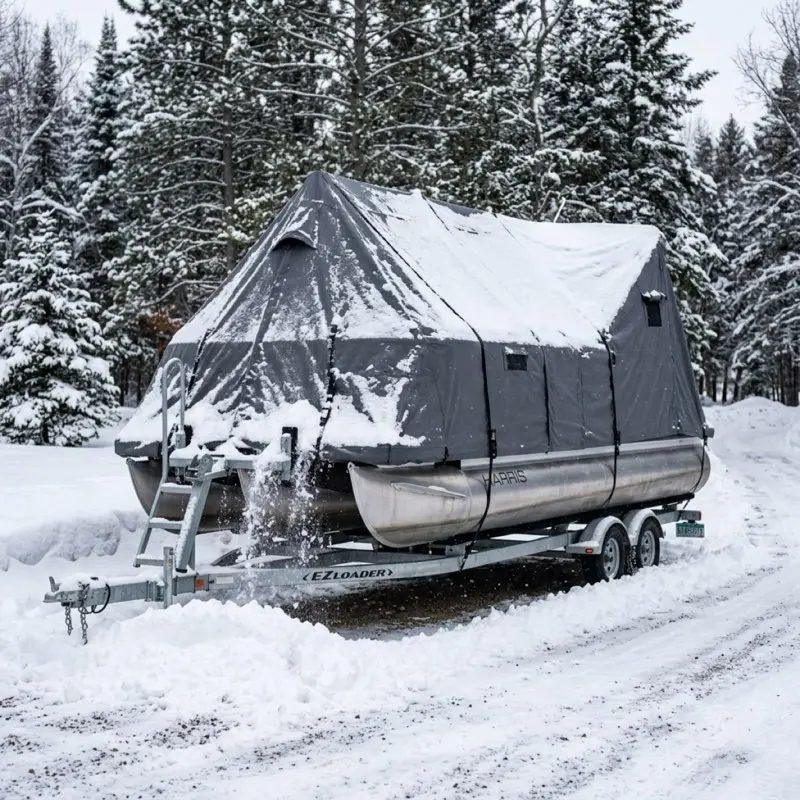
A high-denier cover is useless if the structural framework beneath it is flawed. If the cover is flat, the snow stays on it. If it is pitched like a roof, the snow slides off. The goal is to build an architectural A-frame over your pontoon.
The Danger of Individual Poles:
Many budget covers ship with two or three cheap, telescoping aluminum poles that you place under the fabric. These are disastrous in the snow. Under a heavy load, these poles act like spear tips. They will punch cleanly through the fabric, tearing a hole in your cover and allowing the snow to collapse directly onto your seats.
The "Backbone" Strap Strategy:
To survive a Northern winter, you must implement a "Backbone" support system. This is a heavy-duty webbing strap that runs the entire length of the boat, from the bow eye to the stern cleats.
- The Ridge Line: You run the primary strap tightly down the center of the boat, supported by three telescoping poles with wide, mushroom-shaped caps.
- The Lateral Pitch: By pulling the strap drum-tight, you create a rigid "ridge line" (like the peak of a house roof).
- The Shedding Angle: When you drape the cover over this backbone, it forces a steep downward angle on both the port and starboard sides. When heavy snow hits this steep angle, gravity pulls it right off the side of the boat before it can accumulate.
Oceansouth offers an excellent "Heavy Duty Boat Cover Support System" that includes telescoping poles and a network of adjustable straps that create a perfect, unyielding A-frame shape. It is a mandatory upgrade for winter storage.
5. Breathability vs. Waterproofing: The Black Mold Problem
During the winter, the temperature inside your boat fluctuates wildly. A sunny 40-degree afternoon followed by a 10-degree night creates massive condensation inside the cabin.
The Airtight Trap:
Many owners make the mistake of buying a 100% waterproof PVC-coated tarp, thinking it will provide the ultimate protection. While PVC blocks water, it is completely non-breathable. Any moisture trapped under the cover (from condensation or a slightly damp carpet) cannot escape.
Over six months of winter storage, this trapped moisture creates a greenhouse effect. Come spring, you will pull the cover off to find your entire interior decimated by black mold and mildew.
Vented Marine Canvas:
You need a cover that is highly water-resistant but breathable. Premium polyester and acrylic covers are treated with a Durable Water Repellent (DWR) coating that forces water to bead up and roll off, but the microscopic weave of the fabric still allows water vapor to pass through from the inside.
Furthermore, the best covers feature integrated "sewn-in" vents at the highest points (near the ridge line). These vents have protective hoods that prevent snow from blowing in while allowing the damp, stale air to draft out of the cabin.
6. Brand Comparison: Taylor Made vs. Oceansouth
When outfitting pontoons at the dealership, we primarily steer customers toward two brands for winter storage, depending on their budget and exact geographic location.
| Feature | Taylor Made Elite Series | Oceansouth Heavy Duty |
|---|
| Fabric Density | 600D Solution-Dyed Poly | 900D Atlas Fabric |
| Water Coating | Urethane Backing | Advanced DWR Top-Coat |
| UV Resistance | High (5-Year Warranty) | Superior (7-Year Warranty) |
| Fit Type | Semi-Custom (Length/Width) | Custom / Universal Hybrid |
| Best For... | General Northern Winter | Extreme Snow / Open Field |
| Price (Avg.) | $400 - $600 | $500 - $800 |
Note: While Sunbrella is the absolute gold standard for marine canvas, a fully custom-sewn Sunbrella winter cover with a frame will easily cost $2,000+. For off-season storage, heavy-duty solution-dyed polyester from these mid-tier brands offers a much better return on investment.
7. Installation Protocols for Extreme Cold
If you want your cover to survive from November to April, how you install it is just as important as the fabric you buy.
1. Padding the Sharp Edges (The Chafing Threat):
The sharp corners of your pontoon's aluminum fencing, the corners of your windshield, and the edges of your bimini frame are "stress points." When a heavy snow load presses down, or the winter wind violently buffets the fabric, the cover will rub against these sharp edges. At -10°F, polyester becomes stiff and highly susceptible to chafing.
- The Fix: Buy cheap foam pool noodles, slice them lengthwise, and slide them over the top rails of the fencing and any sharp corners. This creates a soft, rounded buffer that makes it impossible for the fabric to cut itself.
2. The Tennis Ball Trick:
If your support poles do not have wide mushroom caps, or if you are using an older support system, take a standard tennis ball, cut an "X" into the bottom, and jam it onto the top of the support pole. This drastically increases the surface area pressing against the fabric, preventing the pole from punching through under a heavy snow load.
3. Strapping to the Trailer, Not the Rails:
Never secure your tie-down straps to the aluminum fencing of the pontoon. Under a massive snow load, the tension will pull the fencing down, bending it. You must run the tie-down straps all the way down past the tubes and loop them under the heavy steel frame of the boat trailer. This anchors the cover to the strongest part of your rig and allows the cover to wrap tightly over the rub rail.
8. Trailering with a Winter Cover: The "Ballooning" Problem
One of the biggest mistakes Northern boaters make is attempting to pull their boat down the highway at 70 MPH in November with their heavy-duty winter cover installed.
The Aerodynamic Trap:
A winter cover is engineered to shed vertical loads (snow) from a stationary boat. It is not necessarily designed to handle horizontal aerodynamic drag. At highway speeds, the immense air pressure hitting the front of the boat forces its way under the hem of the cover.
This causes the cover to "balloon" violently upward. The lifting force is staggering, it can snap support poles, rip D-rings clean out of the fabric, and break your windshield.
The Shredding Risk:
If your cover is not specifically rated as "Trailerable," the high-frequency vibration and wind pressure will cause the fabric to whip against the aluminum rails. Within just 50 miles of highway driving, you will find "friction burns" and large, shredded holes where the fabric has been worn straight through.
If you must trailer the boat with the cover on, verify that the manufacturer rates it for highway speeds (like Oceansouth's 900D Atlas). You must also utilize a dedicated "trailering strap kit" that crisscrosses under the hull to prevent any lifting or ballooning.
9. Custom vs. Universal Fit: The "Tension Requirement"
If you’ve ever wondered why custom-fit covers cost $1,000 more than universal ones, it comes down to a single engineering principle: Tension.
The "Drum-Tight" Rule:
For a cover to successfully shed snow and repel water, the fabric must be under constant, unyielding tension. When you flick the installed cover with your finger, it should bounce and sound like a tight snare drum.
The Flaw of Universal Covers:
Universal covers are cut as giant rectangles designed to fit a wide range of boat shapes. Because they are not tailored to your specific hull, they have massive amounts of "extra" fabric that bags, bunches, or wrinkles near the bow and stern.
Every single wrinkle is a structural failure point. A wrinkle stops water from flowing off the cover, creating a micro-pool that eventually turns into a massive ice sag.
The Semi-Custom Compromise:
Brands like Taylor Made offer "Semi-Custom" fits based on the exact width and length parameters of your specific pontoon (e.g., 22' L x 102" W, with square bow). This is the smartest middle ground. They fit significantly tighter than generic universal covers but are thousands of dollars cheaper than a fully custom-sewn Sunbrella cover. By utilizing the proper support backbone and high-tension straps, you can eliminate the wrinkles and ensure a perfect, snow-shedding surface.
10. Open Field vs. Barn Storage (Environmental Threats)
Where you park your pontoon dictates the environmental threats your cover must defeat.
The "Open Field" Wind Load:
If your boat is stored in an open driveway or an exposed field, your primary threat (alongside snow) is "Wind Loading." A 50 MPH winter blizzard can violently lift a poorly secured cover and pack the interior with snow drifts. For open storage, you need a cover with an aggressive, all-around elastic shock-cord in the hem, and you must utilize tie-down straps every 2 to 3 feet along the perimeter.
The "Barn" Micro-Environment:
If you are storing your boat in an unheated barn or pole building, you do not need to worry about heavy snow loads crushing the frame. However, you do need to worry about aggressive dust, bird droppings, and rodents. For indoor storage, a lighter, highly breathable 300D or 600D cover is actually preferable. It keeps the destructive dust off the upholstery while allowing maximum airflow to prevent mold from blooming in the stagnant barn air.
Final Thoughts: The Insurance Policy
A high-quality, 600D+ winter cover and a robust backbone support system should be viewed as the cheapest insurance policy you can buy for your pontoon. Spending $600 on a proper Oceansouth or Taylor Made cover today will absolutely save you a $6,000 structural repair bill three years from now.
Do not let the "universal fit" marketing fool you, if you live north of the Mason-Dixon line, you need heavy-duty solution-dyed fabric, aggressive tension, and a steep architectural pitch. Take the time to install it properly on a dry afternoon in October. Use the pool noodle trick on your rails, crank the straps tight, and verify your vents are open.
Your pontoon will survive the brutal freeze-thaw cycles and be ready for the water on the first warm day of May without a single ripped seam, mold spot, or bent railing. Stay warm, over-engineer your support poles, and sleep easy knowing your floating patio is protected from the worst of the winter.