The marine service department usually sees the first casualty of the boating season by mid-May. It is almost always a brand-new pontoon owner who pulled up to a crowded public gas dock in a 15 MPH crosswind using the tiny, round fenders the dealership threw in for free.
The wind caught the massive bimini top, pushed the flat side of the pontoon into an exposed wooden piling, and the round fender simply popped out from between the boat and the dock. The result? A three-foot gouge down the side of custom-painted aluminum siding, a shredded vinyl graphic, and a $2,800 repair bill for a cosmetic "dock rash" that the insurance company might flag as at-fault negligence.
As a marine service advisor, I have replaced thousands of square feet of ruined pontoon fencing. The harsh reality is that standard boat fenders do not work on pontoon boats.
The geometry of a pontoon—a vertical aluminum wall sitting flush above the waterline—requires specialized fender systems designed to grip square 1-inch or 1.25-inch anodized aluminum rails. In this engineering deep-dive, we are going to abandon the generic advice. We will break down the exact physics of pontoon windage, the chemical degradation of PVC fenders in UV light, the hidden dangers of "fender socks," and the only three fender systems you should trust to protect a $60,000 to $120,000 investment in 2026.
1. The Square Rail Problem: Why Round Fenders Fail
To understand why your boat keeps getting scratched, you have to understand the fundamental difference in hull architecture between a traditional V-hull runabout and a modern pontoon.
The Fiberglass "Rub Rail" Advantage
Traditional fiberglass boats have a V-shaped hull that flares outward as it goes up, culminating in a thick, rubberized "rub rail" at the widest point of the boat. This rub rail creates a natural shelf. When you hang a standard round fender over the side of a fiberglass boat, it rests neatly below the rub rail, trapped between the boat and the dock. As the boat moves up and down in the water, the fender stays exactly where it needs to be.
The Pontoon "Vertical Wall" Deficit
Pontoon boats do not have rub rails. They have a flat aluminum M-bracket deck, topped by completely vertical aluminum siding (the "playpen" or fencing).
When you hang a standard round fender against a flat vertical wall, there is nothing holding it in place laterally. If the boat slides forward against a dock piling, the round fender acts like a roller bearing—it spins, slides backward, and pops completely out from between the boat and the wood. Instantly, your painted aluminum panels are grinding against raw timber or rusty dock bolts.
The Solution: Corner-Radius Wrapping
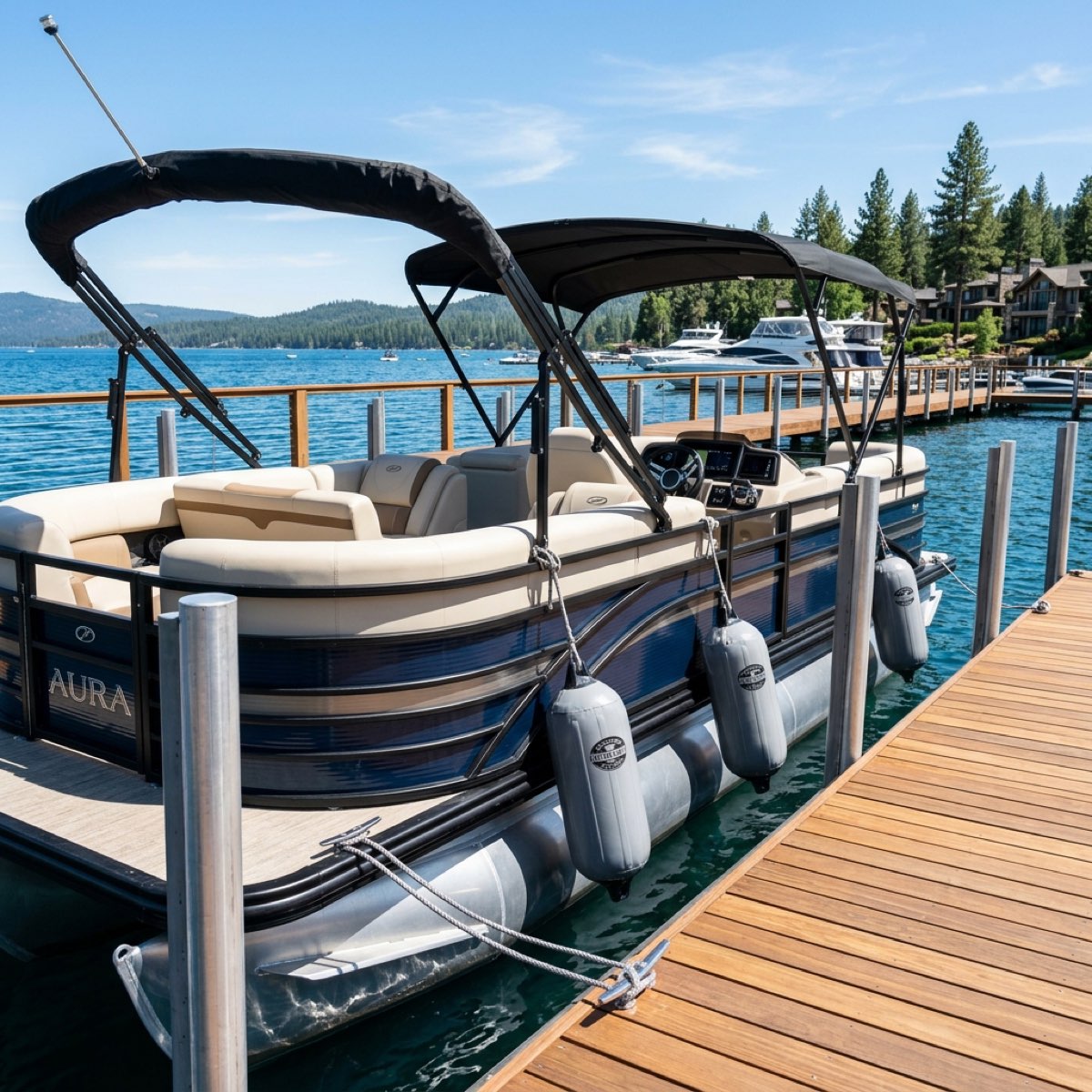
The only effective pontoon fender is one that geometrically matches the boat. Pontoon-specific fenders (like the Taylor Made series) feature a sharp 90-degree internal angle cut into the PVC. This allows the fender to wrap around the lip of the aluminum deck trim, locking it into place. When the boat slides against a dock piling, the "wrapped" fender cannot spin out. It absorbs the kinetic energy exactly where it is supposed to.
The 2026 Pro Docking Setup
A $2,800 panel replacement is not worth the risk. Grab the exact fender setup that we mandate for our dealership's rental fleet to ensure the aluminum stays in showroom condition.
Affiliate disclosure: We may earn a commission if you purchase through these links to support our independent mechanical testing.
2. Top 3 Pontoon Fenders Reviewed for 2026
When choosing the best pontoon boat fenders, you are deciding between traditional air-filled Polyvinyl Chloride (PVC) and modern closed-cell EVA foam. Both have distinct structural advantages depending on the weight of your vessel.
The Market Baseline Comparison
| Fender Model | Best For | Material Tech | Price (Pair) | Hanger Required? |
|---|
| Mission Sentry | Modern Luxury Pontoons | Closed-Cell EVA Foam | $140 - $180 | No (Built-in Strap) |
| Taylor Made Pontoon | Heavy Tri-toons (5,000+ lbs) | Marine-Grade PVC | $90 - $120 | No (Hooks Deck) |
| Polyform G-Series | Sandbar Rafting (Spacing) | High-Durability PVC | $40 - $60 | Yes (Essential) |
1. Mission Boat Gear Sentry (The Best Overall Innovation)
The Mission Sentry has fundamentally disrupted the marine fender industry. Instead of being a hollow, air-filled tube, it is a solid, molded piece of cross-linked closed-cell foam.
The Engineering Advantage:
The primary flaw with traditional fenders is the rope. Tying a clove hitch to a square rail while the wind is blowing you into a dock is stressful. The Sentry eliminates the rope entirely. It features a patented locking mechanism molded directly into the foam. An adjustable woven strap wraps over the top of your 1-inch or 1.25-inch square rail, and you simply pull it tight to lock the fender flush against the paneling.
Pros:
- Zero Roll: Because it has a flat back, it sits flush against the aluminum siding and cannot roll out of place during a dock strike.
- No Inflation Required: It cannot pop, leak, or lose pressure in cold weather.
- Low Profile Docking: If you are pulling into a low floating dock, the Sentry can be adjusted down to sit almost entirely below the deck line, protecting the critical M-bracket edge.
Cons:
- Storage Volume: Because they are solid foam, they do not compress. Storing four Sentry fenders on a 20-foot pontoon consumes significant under-seat storage space.
2. Taylor Made Pontoon Fenders (The Structural Workhorse)
If you own a massive 25-foot tri-toon with a 300HP engine, you need air volume to absorb kinetic energy. Foam can only compress so far before it becomes rigid. The Taylor Made dedicated pontoon fenders are engineered from thick, marine-grade PVC and are shaped like a capital "L."
The Engineering Advantage:
The "L" shape is critical. The top lip of the fender hooks over the edge of the aluminum deck, while the long vertical section hangs down to protect the logs. This means the fender is physically anchored by the geometry of the boat itself. Even if the mooring line comes loose, the fender is unlikely to fall into the water.
Pros:
- Massive Energy Absorption: For heavy boats hitting a fixed dock in strong currents, the large internal air chamber provides superior cushioning.
- Deck-Level Protection: By hooking over the deck, it protects the fragile aluminum J-trim that holds your carpet or woven vinyl flooring in place.
Cons:
- Aesthetics: They are undeniably ugly. They look like massive, utilitarian rubber blocks strapped to the side of your luxury boat.
- Friction Wear: Because they hang over the deck, dirt trapped under the lip can act like sandpaper on your deck trim over time.
While we have established that round fenders are terrible for docking pontoons against fixed pilings, they are absolutely necessary for one specific scenario: "Rafting up" (tying your boat to another boat at the sandbar).
The Engineering Advantage:
When two 5,000-pound pontoons are tied together in a cove, the wake from passing boats will cause them to pitch and roll independently. You need massive distance between the boats to prevent their respective bimini frames from crashing into each other. A pontoon-specific fender like the Mission Sentry only provides about 3 inches of stand-off distance. A Polyform G-5 round fender provides 8.5 inches of stand-off distance.
The Golden Rule: Keep two dedicated pontoon fenders (Sentry or Taylor Made) for the dock, and two massive Polyform G-Series round fenders stored in your changing room specifically for rafting up with friends.
3. The Physics of Kinetic Energy (Why Heavy Tri-toons Destroy Fenders)
One of the most common mechanical failures we see is a new owner upgrading from an old 18-foot twin-log pontoon (weighing roughly 2,200 lbs) to a modern 24-foot Tri-toon (weighing upwards of 5,500 lbs), but keeping their old 5-inch fenders.
In marine physics, Kinetic Energy is calculated using the formula: $KE = 1/2 * m * v^2$ (where m is mass and v is velocity).
When a 5,500-pound tri-toon drifts into a wooden dock piling at just 2 miles per hour, it generates massive kinetic force. If you attempt to use a standard 5.5-inch diameter fender, the air inside the PVC simply compresses to zero. The fender goes completely flat, and the mass of the boat drives the aluminum J-trim straight through the compressed rubber into the dock.
The Size Mandate:
For a modern tri-toon, your fender must be a minimum of 8 inches in diameter (or possess the equivalent foam density of the Mission Sentry). You are not just trying to prevent scratches; you are trying to decelerate 2.5 tons of mass before the aluminum yields. Never under-size your fenders to save storage space.
4. Fender Hanger Mechanics: Plastic vs. Stainless Steel
If you have purchased the correct high-volume fenders, the next point of failure is how they attach to the boat.
The traditional method is tying a clove hitch knot around the square aluminum railing. This is structurally secure, but operationally disastrous. When the wind is blowing 20 MPH and the current is pushing you toward a concrete seawall, you do not have time to meticulously tie and adjust four knots to match the exact height of the dock.
The Danger of Cleat Tying
Many new owners bypass the rails entirely and tie their fenders to the deck cleats. Do not do this on a pontoon. The cleats on a pontoon are located at the extreme corners of the deck. If you tie a fender to the corner cleat, it leaves the entire 20-foot broadside of the boat exposed to the dock pilings. Fenders must be deployed along the mid-ship railing.
Plastic "Clip-On" Hangers (The Budget Trap)
Marine stores sell cheap $10 plastic clips that snap over the square rail, with a hole for the fender rope. They are convenient, but they are a liability.
The plastic is highly susceptible to UV degradation. After one summer in the sun, the plastic becomes brittle. When the boat strikes the dock, the sudden tension on the rope snaps the brittle plastic clip, dropping your $60 fender directly into the lake just as the boat crashes into the wood.
Stainless Steel Quick-Release Hangers (The Pro Standard)
The only acceptable mounting hardware for a premium pontoon is a marine-grade 316 stainless steel quick-release bracket (such as those made by PWC Bracket or Extreme Max).
These systems involve a small, permanent stainless steel receiver that bolts tightly to the square railing using set screws (with rubber backing to prevent scratching the anodized aluminum). The fender rope is permanently tied to a stainless steel "key."
When approaching the dock, you simply insert the key into the receiver. It "clicks" into place in one second. The height is pre-set perfectly every time. This transforms docking from a frantic, multi-person knot-tying exercise into a calm, one-handed operation that the driver can handle from the helm.
5. The "Fender Sock" Myth (Protection or Paint Destruction?)
A persistent myth in the pontoon community is the necessity of "fender socks"—fuzzy fleece or polyester covers that slide over PVC fenders. Dealerships sell them at a massive markup, claiming they prevent the rubber fender from squeaking against the aluminum panels.
In reality, fender socks are the leading cause of micro-scratching on custom-painted pontoon paneling.
The Sandpaper Effect:
When you boat in a lake with any amount of silt, sand, or algae, the fuzzy fabric of the fender sock acts like a trap. Microscopic grains of sand embed themselves deep within the fleece fibers. When the boat is tied to the dock, the constant motion of the wake causes the fender to rub back and forth against the aluminum siding thousands of times per hour.
You have essentially strapped a piece of 400-grit sandpaper to the side of your boat. After one weekend, you will notice severe, irreversible swirling and "hazing" in the clear coat or the vinyl graphics.
The Bare PVC Protocol:
Professional detailers strongly advise against using covers. You must use "naked" PVC or closed-cell foam fenders. Yes, a bare PVC fender might occasionally squeak, but it will not hold sand. To prevent the rubber from leaving black scuff marks, you must clean the bare fenders monthly using a dedicated marine solvent to remove oxidized rubber and dock tar.
6. UV Degradation: The "Sticky Fender" Phenomenon
If you have owned PVC fenders for more than three years, you have likely encountered the "sticky fender" phenomenon. You pull the fender out of storage in the spring, and it feels like it is coated in an aggressive adhesive. Dirt, hair, and leaves stick to it instantly.
This is a chemical failure. Cheap PVC fenders use low-quality plasticizers to keep the material flexible. When exposed to the intense UV radiation of the sun, these plasticizers break down and "leach" out of the PVC matrix to the surface.
Why it matters for Pontoons:
When a sticky, leaching fender presses against your pontoon's fencing in the hot sun, the plasticizers can chemically bond with the clear coat on your painted panels or melt into your vinyl decals. When you pull the fender away, it leaves a permanent, sticky black stain that cannot be removed with standard boat soap.
To prevent this, you must buy premium fenders molded from marine-grade, UV-stabilized vinyl (like Polyform), or bypass the chemical issue entirely by switching to cross-linked foam (like the Mission Sentry). Furthermore, never leave your fenders hanging over the side of the boat while running or sitting on the lift—stow them in the shade to preserve the plasticizers.
7. Floating Docks vs. Fixed Pilings: Elevation Geometry
The most common docking error is setting the fender height incorrectly for the specific marine infrastructure.
The Floating Dock Scenario
Floating docks (common on reservoirs and deep lakes) rise and fall with the water level. This is the easiest docking scenario. Because the dock and the boat are floating on the same surface, their relative heights never change. You can set your pontoon fenders extremely low—so the thickest part of the fender is defending the aluminum M-bracket deck trim—and never touch them again.
The Fixed Piling (Tidal or River) Scenario
Fixed wooden pilings driven into the seabed are common in coastal tidal zones, rivers, and older lakes. This is highly dangerous for pontoons.
If you set your fenders low to protect the deck, and the tide drops (or the river level falls), the fender can get caught underneath the horizontal cross-beams of the dock. As the water rises again, the boat floats up, but the fender is trapped below the wood. The immense upward buoyancy of the boat will transfer directly to the fender line, which is tied to your aluminum railing. The force will literally rip the square aluminum railing completely off the deck, resulting in thousands of dollars in structural damage.
When docking against fixed infrastructure in changing water levels, you must use vertical hanging methods and you must constantly monitor and adjust your lines. You cannot tie up tightly and walk away for four hours.
Final Thoughts: The Docking Discipline
Every marine service center stays busy fixing preventable docking damage. The aluminum siding on a modern pontoon is incredibly thin—often just 0.032 inches thick. It does not take a massive collision to dent it; a slow, grinding rub against a wooden dock piling will ruin the aesthetics of your boat in seconds.
Although the marine accessory market is flooded with cheap, round fenders marketed to new boaters, you must ignore them. Your pontoon’s vertical architecture demands specialized gear.
Invest the $200 into a set of Mission Sentry foam fenders or Taylor Made square-rail wraps. Pair them with stainless steel quick-release brackets mounted strategically at the widest points of your beam. Keep a set of oversized Polyform G-Series rounds in the changing room specifically for rafting up at the sandbar. By implementing this specific, geometry-driven fender system, you will eliminate the stress of docking in the wind and ensure your aluminum remains in pristine condition for years to come.
8. The Physics of "Fender Squeak" and Panel Resonance
If you have ever tried to nap on a tied-up pontoon, you know the "Squeak."
- The Cause: High-friction PVC fenders rubbing against smooth aluminum panels create a high-frequency vibration.
- The Amplification: Because the aluminum paneling is thin and tensioned between the rails, it acts like a drum head, amplifying the squeak throughout the entire boat.
- The Callahan Solution: Do not use "socks." Instead, apply a thin layer of Marine Wax to the paneling where the fender rests. This reduces the coefficient of friction enough to silence the squeak without the abrasive risk of sand-trapping fabrics.
9. Mooring Integration: The "Spring Line" Hack
Fenders are only 50% of the solution. If your boat is moving too much, even the best fenders will fail.
- The Problem: Most boaters only use bow and stern lines. This allows the boat to move back and forth (surge).
- The Hack: Use Spring Lines. These are lines that run from the bow of the boat back to the center of the dock, and from the stern of the boat forward to the center of the dock.
- The Result: Spring lines lock the boat's longitudinal position. This ensures your fenders stay aligned with the dock pilings, rather than sliding back and forth and eventually rolling out of place.
10. Inflatable vs. Solid Fenders: The Storage Trade-off
If you have a 20-foot pontoon, space is a luxury.
- Inflatables (Polyform HTM-Series): These have a "Hole Through the Middle." You can deflate them for winter storage, but they require a pump.
- Solid Foam (Mission Sentry): These are always ready, but they take up a massive amount of "Cubic Footage" under your seats.
- The Verdict: If you boat in a region with major temperature swings, air-filled fenders will sag in the cold. I prefer the Mission Sentry for 2026—the lack of maintenance and "always-on" readiness outweighs the storage footprint.
11. Emergency Fendering: Crisis Management
What happens if a fender snaps or floats away in a storm?
- The Life Jacket Trick: In an absolute emergency (e.g. your engine dies and the wind is pushing you into a rock wall), you can use Type II "Orange" life jackets as temporary fenders.
- The Execution: Fold the life jacket in half and tie it to the rail. The foam will provide enough "Crush Space" to prevent the aluminum from hitting the rock for a few minutes while you wait for a tow. It will ruin the life jacket, but it will save the boat.
12. Maintenance: The "Fender Cleaning" Masterclass
PVC fenders eventually look gray and disgusting from "Dock Tar" (the black residue from pressure-treated wood).
- What NOT to use: Do not use Acetone or Gasoline. These solvents will "Melt" the surface of the PVC, making it permanently sticky.
- What TO use: Use a dedicated Vinyl Cleaner or a "Magic Eraser" with simple boat soap. For heavy tar, use a citrus-based cleaner (Goo Gone). Always follow up with a UV-protectant spray (like 303 Aerospace) to "Seal" the pores of the PVC.
13. Summary: The Discipline of Protection
Protecting your boat isn't about being "fussy"; it's about preserving a major financial asset. Dock rash is the #1 reason for "Condition Downgrades" at trade-in time. By using Geometry-Specific Fenders and Stainless Steel Quick-Release Brackets, you are treating your boat like the precision machine it is.
I'll see you at the ramp.