The first time I opened a life raft during a Sea Survival course at the RNLI College in Poole, I was immediately struck by how different the inside of a good raft felt from the outside of a bad one. Both were roughly the same cylindrical valise. Both were strapped to the pushpit of the practice boat in identical-looking canisters. The first, a Survitec Ocean ISO 9650 offshore raft, inflated with a single sharp pull on the painter, produced a rigid double-tube buoyancy ring, a solid overhead canopy, a CO2 inflation indicator visible from inside, and a survival pack that included a thermal protective aid for every occupant, a knife, a bailer, and a sea anchor.
The second, a non-compliant coastal raft bought off a classified ad for £350 by a well-meaning sailor, inflated unevenly. One tube was visibly softer. The canopy was a single unsupported arch that would have collapsed under the weight of Atlantic rain. There were two foil blankets between six theoretical occupants, and no sea anchor. It was borderline unusable within minutes of full inflation.
Both had identical-looking stickers on the outside. Neither owner could have told them apart at a glance.
A life raft is the most consequential piece of safety equipment you will ever buy, and it is the one most people research the least. This guide fixes that.
About this guide: Captain Jack has served as a Sea Survival instructor since 2012, delivered ISAF Offshore Safety courses across the UK and Atlantic, and inspected life raft compliance on over 60 Category 1 and 2 offshore vessels. All equipment assessments reflect direct handling during certified Sea Survival training scenarios and pre-passage compliance inspections for offshore racing syndicates. No life raft manufacturer compensated BoatGuider for any recommendation in this guide.
The First Question: Coastal or Offshore?
Before getting into brands, standards, or packs, answer one question honestly: where do you actually sail?
This matters more than it sounds, because the life raft industry has two parallel sets of standards, ISO 9650-1 Type I (Offshore) and ISO 9650-1 Type II (Coastal), and the gap in survivability between them in open ocean conditions is significant.
| Feature | Coastal (ISO 9650-1 Type II) | Offshore (ISO 9650-1 Type I) |
|---|
| Survivability Design Temp | Down to 0°C | Down to -15°C |
| Wind/Sea Exposure Tested | Force 9 (47 knots) | Force 10+ (55+ knots) |
| Canopy Requirement | Required but lighter spec | Rigid, self-erecting double canopy |
| Inflation Tube | Single tube acceptable | Double tube required |
| Ballast System | Basic | Water pockets (stabilise in heavy swell) |
| Minimum Pack Contents | Reduced kit | Full SOLAS B or SOLAS A survival pack |
| Maximum Distance Offshore | Within 60nm of rescue | Unrestricted |
The design temperature specification is the one that most sailing guides gloss over. If you are planning a North Atlantic crossing, a Bay of Biscay crossing, or sailing above 50°N at any point, the 0°C minimum of a coastal raft is inadequate. Night water temperatures around the UK in May are 10–12°C. Hypothermia clock for an unprotected person in 10°C water: 1–2 hours. The additional thermal insulation in the floor and canopy of an offshore raft is not a luxury feature. It is the difference between being alive when the helicopter finds you and not.
The rule: If you never sail more than 20nm from a sheltered harbour in summer only, a coastal-rated raft is defensible. If you cross shipping lanes, do overnight passages, or are more than 60nm from rescue services at any point in your season, buy an offshore-rated raft.
SOLAS vs Non-SOLAS: What These Letters Actually Mean
SOLAS stands for the International Convention for the Safety of Life at Sea. SOLAS-grade equipment specifies the minimum survival pack contents required on commercial vessels. For life rafts, the key survival pack standards are:
- SOLAS A Pack: Required for commercial vessels on unlimited ocean service. Includes thermal protective aids for all crew, first aid kit, flares (4 red parachutes, 6 red handheld, 2 orange smoke), water rations (1.5 litres per person), food rations (10,000kJ per person), fishing kit, graduated drinking vessel, anti-seasickness tablets, rain catchment system, signalling mirror, and a safety knife.
- SOLAS B Pack: A reduced pack for vessels operating in areas with reliable rescue infrastructure. Fewer flares, reduced water rations, no food rations.
- Non-SOLAS: Meets the ISO 9650 standard for inflation, buoyancy, and canopy, but the survival pack contents are set by the manufacturer. Some non-SOLAS packs are genuinely comprehensive. Others are embarrassingly minimal.
The practical implication for recreational sailors: You are not legally required to carry SOLAS-grade equipment on a private yacht unless you're sailing to countries with specific national regulations (some Caribbean islands require SOLAS-compliant rafts for offshore entry). However, choosing a raft with a SOLAS A or SOLAS B pack as a recreational sailor is straightforward risk management. You cannot call for more flares once you're in the raft. You cannot add water rations. You cannot produce a sea anchor that didn't get packed at the factory.
When comparing rafts, ask the manufacturer specifically for the pack contents list, not just the marketing description. Do not accept "comprehensive safety pack" as an answer.
Container Types: Valise vs Canister
You will choose between two physical formats. Each makes sense for specific boat configurations.
Valise (Soft Bag)
The raft is packed into a soft, weather-resistant bag that can be stowed below decks in a dedicated locker or under a berth. It weighs less and can be brought inside to inspect the packing date without a tool.
The advantage: You can bring the valise into the cockpit and deploy it properly. You can store it below, reducing UV exposure and extending the life of the cover.
The disadvantage: It must be manually retrieved from below and deployed. In a fast sinking scenario, a collision, a catastrophic grounding, you may not have time to open the hatch and retrieve it. It cannot be fitted with a hydrostatic release unit as standard.
Canister (Hard Case)
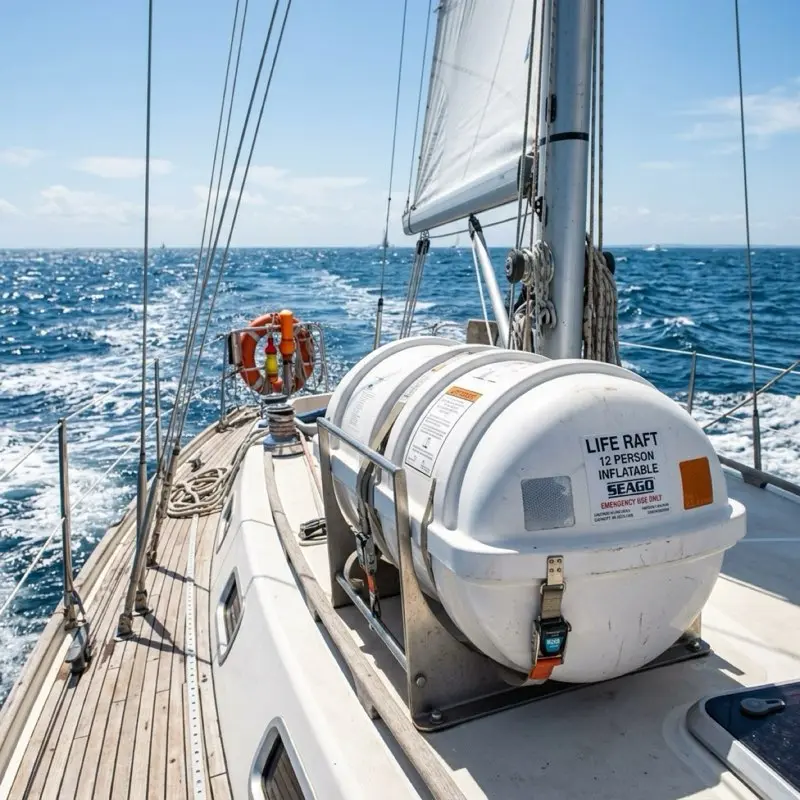
The raft is packed into a rigid fibreglass canister typically mounted externally on the pushpit, stern rail, or a dedicated cradle. It is always on deck, always ready, and can be fitted with a Hammar H20 Hydrostatic Release Unit.
The Hydrostatic Release: If the boat sinks and reaches approximately 2–4 metres depth, water pressure collapses a glass ampoule inside the Hammar unit. A spring-loaded knife cuts the weak link holding the canister to the cradle. The raft floats free, the painter line, still attached to the sinking boat, pulls taut and automatically inflates the raft at the surface.
If you are below decks and unconscious when the vessel sinks, a canister raft with a correctly maintained hydrostatic release might be the only thing that saves your life. A valise raft will go down with the boat.
The Hammar HRU expires every two years. This is marked on the unit. I find expired HRUs on roughly one in four offshore yachts I inspect. Replacement costs approximately £80. The cost of not replacing it is not worth computing.
Life Raft Service Intervals: The Trap Most Sailors Fall Into
Life rafts are not fit-and-forget equipment. They require annual or biennial servicing at an approved service station. During a service, the raft is fully inflated, every component of the inflation system is tested, the CO2 cylinder charge is verified, the buoyancy tubes are pressure-tested, the canopy and floor are checked for deterioration, and the survival pack is inventoried and replaced item by item as items expire.
What Most Sailors Get Wrong: They buy a second-hand raft with a service sticker dated 18 months ago and assume it is fine. Service intervals are not arbitrary. Here is what degrades between service dates:
- CO2 cylinders leak slowly. A cylinder that was full at the last service may have lost 5–10% of charge. Below a threshold charge, the raft will not fully inflate the buoyancy tubes in cold water.
- The painter line weakens. The painter (the line connecting the raft to the vessel that triggers inflation) is load-rated at sea. UV exposure, salt crystallisation, and chafe degrade it. A snapped painter means the raft inflates but remains attached to a sinking boat.
- Flares expire. Flares carried in the survival pack have a 3-year shelf life. Most service stations issue new flares with every service. A second-hand raft with a 2-year-old service pack may already have expired flares.
The practical rule: Know your raft's service date. Budget for it annually as a fixed cost. A quality 6-person offshore raft service at a Survitec or RFD-approved facility runs £150–250. That is the cost of not dying because your raft deployed at 60% inflation.
The Leading Manufacturers: What to Know
The life raft market is not commodity equipment. The engineering quality between budget units and serious offshore products is measurable and real.
| Manufacturer | Key Models | Known For | Service Network |
|---|
| Survitec | Ocean ISO 9650, SOLAS Compact | Build quality, pack contents depth | Extensive (UK, EU, US) |
| Viking | RescYou Ocean, RescYou Coastal | Lightest offshore units, excellent canopy | Excellent globally |
| Revere | Offshore Commander, Coastal Commander | North American distribution, SOLAS compliant | Strong US / Caribbean |
| Zodiac | Aeris 4/6 Offshore | Good buoyancy tube rigidity, budget-accessible | Moderate European |
What I Carry: For Category 1 offshore passages, I spec Survitec Ocean or Viking RescYou Ocean on client builds. Viking in particular produces a genuinely impressive double-tube offshore unit with a proper water ballast system. The floor insulation on the RescYou Ocean is notably better than several competitors at the same price point, which matters in the North Atlantic in May more than it does in the Mediterranean in August.
Sizing: How Many Persons?
Over-buying capacity is always better than under-buying. With a 4-person raft and 4 survivors, you are full. There is no space for injured crew to lie flat. There is no room to maneuver around someone in hypothermic shock. There is no comfort margin in a 3-metre swell.
The practical rule: Buy a raft rated for your maximum number of crew plus two. If you typically sail with three people, buy a 6-person raft. The weight penalty is small. The space dividend in a genuine emergency is substantial.
The Ditch Bag: What Goes With the Raft
The life raft is the container. The ditch bag is what keeps you alive inside it. Regardless of the survival pack included with your raft, a dedicated ditch bag should be pre-packed and clipped near the companionway for immediate deployment:
- Hand-held VHF (charged, programmed with MMSI, in a waterproof case)
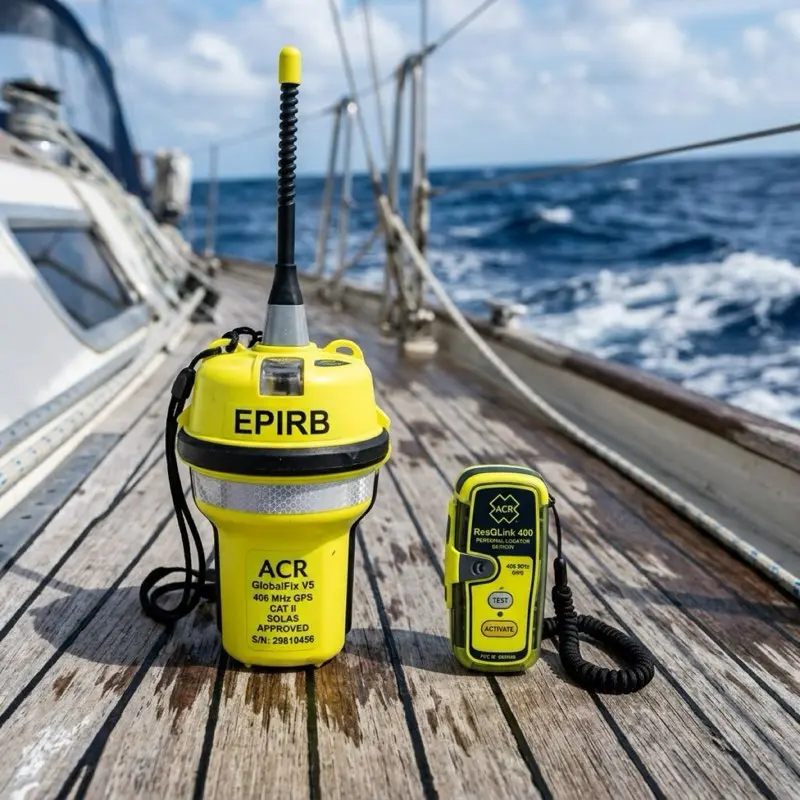
- EPIRB or PLB (registered, within battery date, see our full EPIRB vs PLB guide for exactly which to carry)
- Spare flares (check dates, carry beyond what the raft pack contains)
- Foil thermal blankets (one per crew member beyond the raft pack)
- Grab-and-go cash, passports in waterproof bag
- Prescription medications for any crew members who require them
- Waterproof torch with fresh batteries
- 3 litres of water minimum per crew
The ditch bag should weigh no more than you can lift and throw into the raft with one hand while standing on a heeling, sinking boat in the dark. Rehearse grabbing it. Time yourself.
Five Questions to Ask Before Buying Any Life Raft
- What ISO standard is it certified to? Accept only ISO 9650-1 Type I (Offshore) or Type II (Coastal) depending on your use. Do not accept ISO 9650-2 (which covers smaller recreational rafts with lower survival specifications).
- What are the full survival pack contents? Get the itemised list in writing, not the brochure description.
- What is the CO2 cylinder size and certified inflation temperature? Matters for cold-water North Atlantic or Northern Pacific passages.
- What is the service interval and who are the approved service stations near your home port?
- Does the canister configuration accept a Hammar HRU, and is one fitted as standard? If buying a valise, accept that it cannot be hydrostatic-released and plan your stowage and deployment procedure accordingly.
7. Ballast Systems: The Physics of Anti-Capsizing
One of the most dangerous moments in a life raft is not when it's sinking, but when it's floating. In high winds and steep seas, a life raft is essentially a giant, lightweight kite. Without proper ballast, a 40-knot gust can get under the bottom of the raft and flip it over (capsizing) while you are inside.
7.1 Water Pockets (The Stabilizers)
High-quality offshore rafts (like the Viking RescYou) feature large, weighted "Water Pockets" on the underside of the floor.
- The Physics: As the raft inflates, these pockets immediately fill with thousands of pounds of seawater. This massive weight provides a "Low Center of Gravity" that keeps the raft glued to the water surface.
- The Trap: Cheaper coastal rafts often have tiny, shallow pockets. In a breaking wave, these pockets can pull out of the water, allowing the wind to get under the raft and flip it. If you are buying a raft for the open ocean, look for "Deep-Well Ballast" as a non-negotiable spec.
8. The "Painter Line" Forensics: Don't Tie a "Dead Knot"
The painter line is the 30-to-50-foot rope that connects the life raft to your boat. It serves two purposes: it triggers the inflation and it keeps the raft from drifting away before you can jump in.
8.1 The "Weak Link" Installation
If you are using a Category I (Auto-Deploy) canister, you must use a Hammar Weak Link.
- The Failure Mode: If you tie the painter line directly to a heavy cleat on your boat, and the boat sinks, the boat will pull the life raft underwater with it.
- The Fix: The painter line must be tied to the Weak Link on the Hydrostatic Release Unit. This link is designed to break at a specific tension (about 500 lbs). This allows the boat to sink, the raft to inflate, and the line to snap only after the raft is safely floating at the surface.
9. The Callahan "Abandon Ship" Protocol: 6 Steps to Survival
- Issue the Mayday: Your first step is communication. Activate the EPIRB and issue a voice Mayday on Channel 16.
- Deploy the Raft: Throw the canister or valise into the water on the Leeward (downwind) side of the boat. You want the boat to act as a windbreak for the raft.
- Pull the Painter: Pull the slack out of the line until you feel resistance, then give it a sharp, heavy tug. The CO2 will hiss, and the raft will inflate in under 30 seconds.
- Board "Dry" if Possible: Try to step directly from the boat into the raft. Jumping into the water first leads to immediate cold-water shock and makes boarding the raft significantly harder.
- Cut the Painter: Once everyone is inside, use the safety knife (usually tethered near the door) to cut the painter line. You want to get away from the sinking vessel before it creates a suction or its rigging entangles the raft.
- Deploy the Sea Anchor: This is the first thing you do once clear. It slows your drift and keeps the bow of the raft pointed into the waves, preventing a capsize.
10. Summary Checklist: The Callahan Raft Audit
- ISO 9650-1 Type I certification for any offshore work.
- Verify the SOLAS A Pack contents (don't trust the brochure).
- Hydrostatic Release Unit (HRU) expiration date check (every 2 years).
- Boarding Ladder Integrity: Ensure the ladder is reinforced and won't snap under the weight of a wet crew member in full gear.
- Floor Insulation: Double-layer floors are essential for preventing hypothermia from the cold ocean below.
A life raft is the one piece of gear you hope to never use, but it is the only piece of gear that can't afford to fail. Invest in a Viking or Survitec, keep the service dates current, and rehearse your ditch bag drill until it becomes muscle memory.
I'll see you at the ramp!