On a transatlantic qualifying passage I was helping examine, the candidate's boat was otherwise immaculate. Safety gear neatly stowed, EPIRB correctly mounted, AIS transponder tested. We cleared the harbour entrance, the wind came up to 20 knots, and I asked her to demonstrate jackline rigging. She ran two flat-webbing jacklines from bow to stern along the side decks, clipped her tether in, and looked up expecting approval.
The setup would almost certainly have sent her over the side.
The jacklines were routed too far inboard. On a 42-foot yacht with a two-metre tether and a clip point at the mid-deck jackline, a sailor who trips on the windward rail will pendulum clean off the side of the boat, remain fully submerged in the water alongside the hull while the boat continues sailing, and require the remaining crew to somehow haul a 90-kilogram water-logged human back over the rail in choppy conditions. That is not a safety system. That is a drag anchor with a person attached to it.
Jacklines and tethers rank among the most purchased and least correctly configured pieces of safety equipment in offshore sailing. This guide explains exactly how to set them up so they actually work.
About this guide: The rigging configurations, tether lengths, and attachment points described below draw from Captain Jack's experience as an RYA Yachtmaster Offshore and qualified Sea Survival instructor, combined with the protocols used in RYA/ISAF Offshore Special Regulations Category 1 and 2 compliance inspections across 60+ vessels. References to World Sailing Offshore Special Regulations are linked directly to the 2024–2025 published edition.
Editorial independence: No jackline or tether manufacturer compensated BoatGuider for any recommendation in this guide.
The Central Problem: What Jacklines Actually Need to Do
Before configuring anything, understand the fundamental job of this system. It has two, and only two, purposes:
- Prevent a crew member from going overboard in the first place (the primary function)
- If they do go over, keep them physically retrievable (the secondary function)
A jackline system that keeps a crew member dangling in the water off a moving boat has failed at both objectives. The boat is dragging a sea anchor at speed. The crew member is drowning by slow degrees from exhaustion and cold shock, even if their head stays above water. And you cannot retrieve a 90-kilogram wet person over a high freeboard in a seaway without specialist equipment that almost no recreational yacht carries.
The only acceptable outcome of a jackline system is that the crew member stays on the boat. Every configuration decision flows from this principle.
The Four Most Common Jackline Mistakes
Mistake 1: Routing Jacklines Along the Side Decks
This is the single most widespread error in recreational offshore sailing and it persists because it looks logical. You run the line along the deck where people walk, so they can clip in while they move forward. Problem: if you clip to a jackline on the port side deck and fall to starboard, your tether swings you off the high side of the boat and you end up fully in the water, connected to a vessel that has no idea it's towing you.
The fix: Route jacklines down the centreline of the boat wherever possible, down the coachroof, along the sprayhood, over the boom gallows, and into the cockpit. A crew member clipped to a centreline jackline who falls over the side will, at worst, slide along the hull and remain within arm's reach of the deck. They will not pendulum off the side and remain submerged.
On narrow-coachroofed boats where centreline routing isn't feasible, run jacklines as far inboard as the deck geometry allows. Measure the swing arc carefully: with your tether at full extension from the jackline clip point, draw the arc where a crew member would end up if they fell off the high side. If that arc ends up in the water, move the jackline inboard until it doesn't.
Mistake 2: Using a Single Fixed-Length Tether
The two-metre tether is the standard choice because it's the length required by offshore racing regulations. But it was designed for a racing yacht where crew are moving constantly along defined routes, not for a cruising boat where crew sometimes need to be static at a working position for extended periods.
A static crew member on a two-metre tether has two metres of movement in all directions. At the end of a night watch when they're tired, clipping to a cleat or stanchion base rather than to the jackline is tempting, and creates an unrelated hazard entirely.
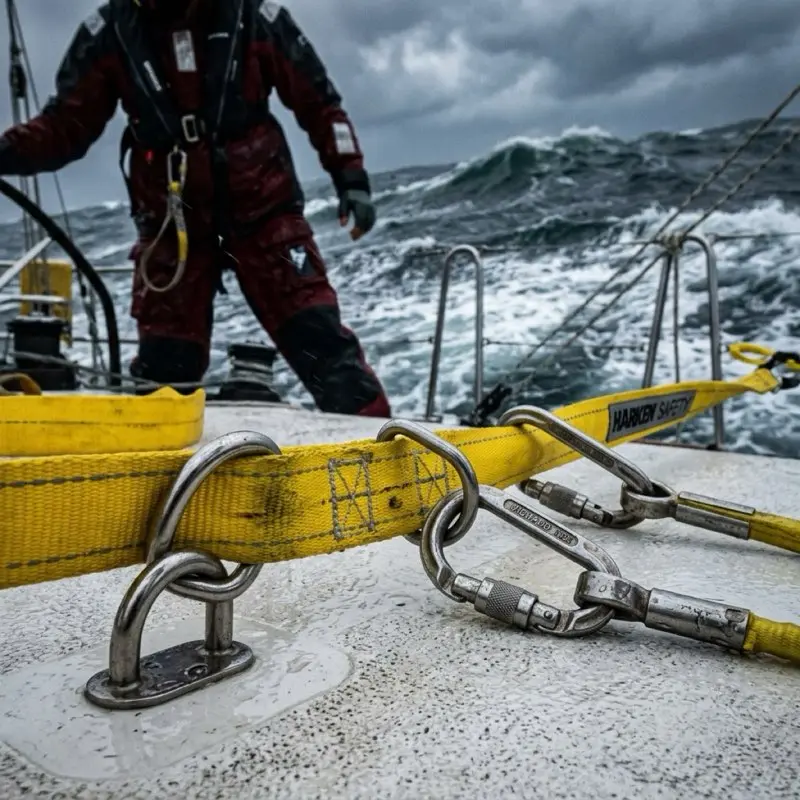
The fix: Use a Y-tether (sometimes called a "cow hitch" tether) with two arms: a short 40-centimetre arm for working positions where you need to be stationary and secure, and a longer one-metre arm for movement. Many modern tethers incorporate a mid-point clip to achieve this without separate pieces of equipment. The short arm clipped to a strong attachment point near your working position eliminates the pendulum problem entirely. The longer arm clips to the jackline when transiting the deck.
Mistake 3: Clipping to Stanchions and Lifelines
I inspect this on almost every offshore boat I step aboard. A crew member has clipped their tether to a stanchion base or, worse, directly to the wire lifeline. Both are catastrophically weak attachment points.
Stanchion bases on GRP production yachts are typically bolted into the deck with through-bolts into a fibreglass laminate that sees limited lateral load under normal conditions. A dynamic shock load from a 90-kilogram crew member falling off the side and jerking the tether taut at the limit of two metres represents forces likely exceeding 1,000 kg-force. Most production stanchion bases are not engineered to withstand that.
Lifelines are even worse. Wire lifelines on most cruising yachts are 5mm or 6mm 1x19 stainless wire. They are strong in tension along their length. They are not strong against a sudden sideways jerk load from a falling body.
The fix: Clip tethers only to dedicated jacklines, U-bolts, padeyes, or through-bolted strong points rated for the purpose. In the cockpit, the primary sheet turning blocks and mainsheet traveller cars are frequently mounted on solid structural backing plates, these are usually acceptable tether attachment points. On deck, only attach to jacklines or specifically marked hard attachment rings.
Mistake 4: Not Testing Tether Clips Before Offshore Departures
Kong, Wichard, and Tylaska are the three most reputable marine tether clip manufacturers. Their double-action gate clips are engineered to require deliberate two-stage operation to open: pull the gate release and then push the clip open, or rotate and pull depending on design. They wear.
On passage two years ago I found a tether aboard a boat heading for the Caribbean with a single-action clip gate that had worn to the point where it was releasing under moderate outward pressure. The owner had owned the tether for six years and never tested the gate function properly. It would have opened when it mattered most.
The fix: Before every offshore departure, inspect every clip. Load the clip against a fixed point, pull outward, and verify that the double-action gate does not release from pulling force alone. Rotate the clip under load. If there is any stiffness suggesting corrosion in the gate mechanism, replace the tether. Tethers are consumable safety equipment rated for a finite service life, most manufacturers specify five years from date of manufacture, not first use.
Jackline Material: Webbing vs Wire vs Dyneema
The market currently offers three primary jackline materials and they perform very differently.
| Material | Weight | Stretch | UV Degradation | Trip Hazard | Expected Service Life |
|---|
| Flat Polyester Webbing | Light | High | Moderate | High | 3–5 years |
| Stainless Wire (6mm) | Heavy | Minimal | None | Moderate | 8–10 years |
| Dyneema / HMPE | Very Light | Minimal | Low | Low | 5–7 years |
What Most Sailors Miss: Flat polyester webbing jacklines are the most common choice because they are inexpensive and widely available. But high stretch under load means that under the dynamic shock load of a falling body, a webbing jackline can extend significantly before arresting the fall, potentially adding 0.3 to 0.5 metres of extra run to the tether arc. On a boat where your arc calculation assumed zero jackline stretch, that extra half-metre could be the difference between deck and water.
My personal choice after years of offshore passages is 6mm stainless wire jacklines, set up with a tensioner at one end to keep them drum-tight, combined with Dyneema jacklines for the coachroof centreline where a crew member falling onto wire creates a secondary injury risk. Wire at the sides, Dyneema overhead. It costs more to set up. It doesn't stretch.
Harness Integration: The Lifejacket Question
A tether that is not connected to a correctly fitted harness is irrelevant. At the moment of maximum load, when the tether arrests a fall, the harness takes the full shock. A harness that rides up, slips off a shoulder, or is worn over a thick offshore jacket rather than close to the body can injure the crew member even while technically "saving" them.
Key checks before offshore departure:
- The harness should be fitted directly under the outer layer or integrated into the lifejacket. Never over thick foul-weather gear.
- The primary attachment point (the stainless D-ring the tether clips to) should sit centrally on the chest, not the shoulder. A shoulder attachment creates an asymmetrical load that can rotate the crew member underwater into a face-down position.
- For offshore, choose a lifejacket/harness combination with a minimum 150N buoyancy rating, not the minimum 100N required for coastal sailing. In offshore conditions with waterlogged clothing, 150N is what keeps an unconscious person face-up in breaking seas.
The Spinlock Deckvest 6D is the system I fit to my own crew as standard. The integrated harness, the chest D-ring position, and the spray hood activation all reflect genuine offshore engineering rather than marketing.
Night Watch Protocol: The Non-Negotiable Rules
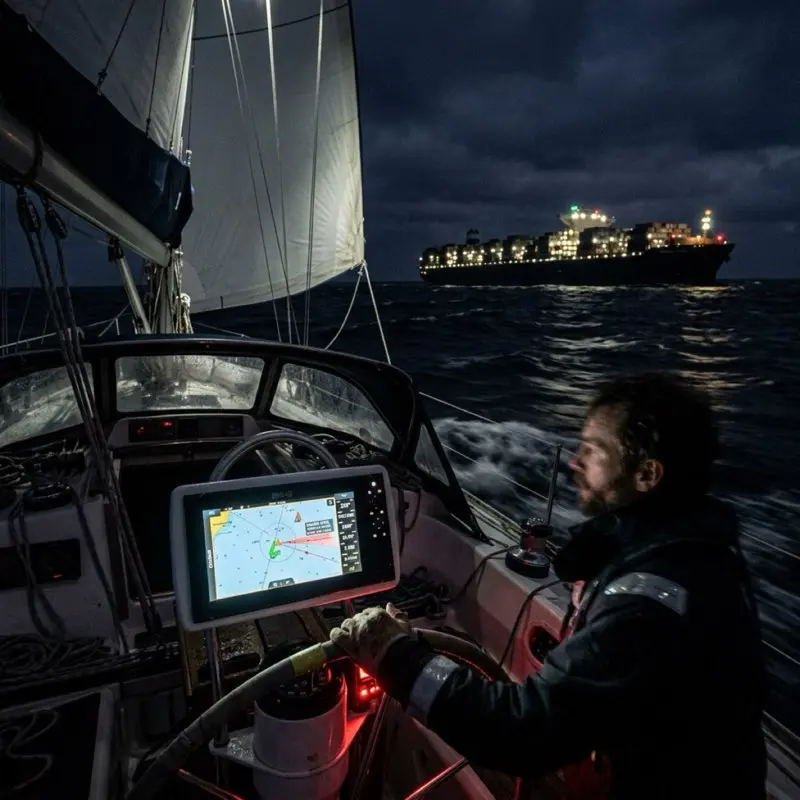
Jacklines are theoretical safety during the day. They are the difference between life and death at night. The following are non-negotiable for any passage with a night watch:
- Clip in before leaving the companionway. Not after stepping onto the side deck. Before the hatch opens. In the companionway, before you commit to the deck.
- Never unclip both tether arms simultaneously. If using a Y-tether, maintain at least one clip attached at all times when on deck. Transfer, not remove.
- One hand for the boat, one hand for yourself. Always. Without exception. Not most of the time.
- Brief every new crew member on the jackline route and the attachment points. Not just "the jacklines are rigged." Walk them through the clip procedure, test the gate function in front of them, show them the short-arm attachment points for the helm position, the mast base, and the forestay.
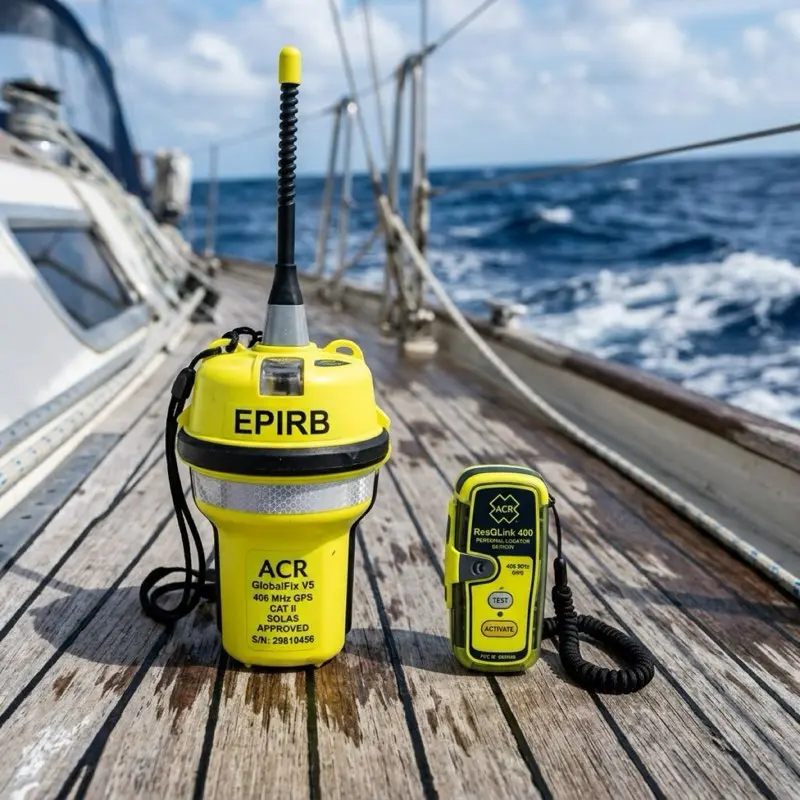
- Wear your PLB on your harness, not in your jacket pocket. If you do go over, the boat may not notice for minutes. The PLB on your harness harness is the only thing that will bring a vessel back to your exact position. Our detailed guide on EPIRB vs PLB selection has the full breakdown of which integrated units are worth carrying.
The Five-Minute Pre-Offshore Check
Run through this before every departure for a passage of more than 12 hours:
- Lay jacklines out on deck, inspect full length for chafe, UV cracking, broken strands (wire), or loose end terminations
- Test every tether clip gate: load against a fixed point, pull, rotate, verify no false release
- Check all harness D-ring stitching for fraying under the metal loop
- Confirm every crew member has a serviceable harness fitted correctly to their body
- Confirm PLB batteries are within date, attached to harness or lifejacket
Total time: four minutes. It has saved lives.
6. Breaking Strength and UV Degradation: The Invisible Weakness
One of the most dangerous aspects of a jackline is that it can look perfectly fine while being structurally compromised.
6.1 The Chemistry of Sunlight
Most jacklines are made of Polyester Webbing. While polyester is strong, it is highly susceptible to UV degradation.
- The Loss of Strength: After just one season in the tropical sun (Caribbean or Mediterranean), a polyester jackline can lose up to 30% of its breaking strength. By the end of year three, that line might look clean, but it could snap under the dynamic shock load of a falling adult.
- The Callahan Rule: Replace your webbing jacklines every three years, regardless of how they look. If the webbing feels "stiff" or "crunchy" to the touch, it is already dangerously degraded.
6.2 The Dyneema Alternative
For serious offshore work, many professionals are moving to Dyneema (SK78 or SK99) jacklines.
- The Benefit: Dyneema has nearly zero stretch and a much higher resistance to UV. It is also significantly stronger for the same diameter. However, because Dyneema is "slippery," you must use specialized knots (like the Brummel Splice) to ensure the ends don't pull out under load.
7. Attachment Points: The Engineering of Through-Bolting
A jackline is only as strong as the metal it is tied to.
7.1 Cleats vs. Padeyes
I often see jacklines tied to the base of a standard deck cleat.
- The Risk: Most cleats are designed for Horizontal Load (pulling parallel to the deck). A tether arrest creates a Vertical and Lateral Load (pulling up and away from the deck). This can actually rip the cleat out of the fiberglass if it doesn't have a massive backing plate.
- The Pro Move: Install dedicated Wichard Folding Padeyes. These are through-bolted with a 316 stainless steel backing plate that is at least 3x the size of the padeye base. This ensures that the shock load is distributed across a wide area of the deck laminate, preventing a catastrophic structural failure.
8. The "Double-Clip" Protocol: Mastering the Mast Base
The most dangerous part of moving on deck is at the Mast Base, where the jackline usually ends or passes through a lead.
8.1 The "Transfer of Risk"
When you reach the mast, you must unclip from the cockpit jackline and clip onto the foredeck jackline.
- The Short Arm First: While still clipped to the cockpit line, clip your short tether arm to a dedicated hard-point at the mast (like the mast collar or a shroud u-bolt).
- Verify the Connection: Visually check that the gate is closed and locked.
- Unclip the Cockpit Line: Only now do you release your long tether arm from the cockpit jackline.
- Attach to the Foredeck Line: Clip the long arm to the next section of jackline.
- The Golden Rule: You are never, not for a single second, unattached to the boat.
9. The Callahan "Safety Arc" Audit: The Tape Measure Test
Before you head offshore, perform this simple audit:
- Rig your jacklines in their permanent positions.
- Clip your longest tether (usually 2 meters) to the jackline.
- Stretch the tether as far as it will go toward the edge of the boat.
- The Pass/Fail: If the clip reaches beyond the lifeline or into the water, your jackline is too far outboard.
- The Correction: Move the jackline inboard (closer to the center of the boat) until the clip stops at least 12 inches inside the rail. This ensures that if you fall, you will land on the deck, not in the ocean.
10. Summary Checklist: The Callahan Rigging Protocol
- Route Centerline whenever possible (coachroof/sprayhood).
- Use 3dB Stainless or Dyneema for zero-stretch performance.
- Through-Bolt All Padeyes with oversized backing plates.
- Inspect for UV "Crunch" and replace every 3 years.
- Rehearse the "Double-Clip" transfer at the mast base.
Jacklines are not just ropes on a deck; they are the umbilical cord of your vessel. Rig them correctly, test them with a tape measure, and never trust a stanchion with your life.
I'll see you at the ramp!