Outboard Motor Alarm Beeping: What Every Horn Pattern Actually Means
AuthorMike Callahan
PublishedMay 3, 2026
Read Time20 min
UpdatedMay 3, 2026
Quick Brief
TL;DR Protocol
Your outboard just started beeping. Don't guess, this complete diagnostic guide decodes warning horn patterns for Mercury, Yamaha, Honda, Suzuki, and Evinrude E-TEC engines, with step-by-step action protocols for every alarm type.
You're running at 4,200 RPM on a perfect afternoon when it starts. Beep. Beep. Beep.
Your throttle hand hesitates. Is this serious? Is the engine about to destroy itself? Should you kill the throttle right now and drift to a stop two miles from the ramp?
I've watched hundreds of people in this exact moment make one of two mistakes. The first group panics, shuts down immediately, and gets a tow for a problem that required nothing more than draining a fuel filter. The second group ignores the alarm, keeps running, and texts me from the dock asking why their engine "locked up."
Both outcomes are avoidable. The alarm is your engine talking to you. You just need to know the language.
This guide decodes every major warning horn pattern across the five most common outboard brands on the water today, Mercury, Yamaha, Honda, Suzuki, and Evinrude E-TEC, and tells you exactly what to do in the first 90 seconds after each one triggers.
Mike Callahan's Field Note: "The single most important thing I can tell you is this: a continuous alarm is never the same as an intermittent one. Continuous means stop. Intermittent means watch and proceed carefully. That distinction alone will save your engine."
Brand
Alarm System Name
Diagnostic Display Option
Mercury
Engine Guardian System
SmartCraft / VesselView display
Yamaha
Engine Warning System
Command Link / Command Link Plus gauge
Honda BF Series
Power Reduction System
Multi-function gauge / indicator lights
Suzuki DF Series
ECU Fail-Safe System
Suzuki Diagnostic System (SDS) / gauge codes
Evinrude E-TEC
S.A.F.E. System
SystemCheck gauge / EMM LED codes
Before You Interpret Any Beep: The Self-Test Confirmation
Every modern outboard performs a self-test sequence when you turn the key to ON (before starting). In this test, your warning horn should produce one short beep and all warning indicator lights should illuminate briefly. This is the system confirming its own wiring and horn are functional.
If this self-test beep does not happen, your warning system may be compromised, meaning alarms cannot reach you. This is actually a more dangerous condition than an alarm itself. Check your helm buzzer connections and fuse before your next departure.
PRE-DEPARTURE CHECK
Always verify your warning horn self-test fires when you turn the key to ON. A silent self-test means a silent alarm, and that means no warning when your engine overheats offshore.
The Universal Alarm Framework: Two Categories That Cross Every Brand
Before going brand-specific, understand that all outboard alarm systems organize their signals into two fundamental categories. These categories are consistent across every major manufacturer:
Category 1: Critical Fault (Continuous Alarm)
A continuous, unbroken tone is the marine equivalent of a red traffic light. There is no ambiguity here.
Immediate action: Reduce throttle to idle. Get the bow into the wind if possible. Assess whether you can safely reach shore under reduced power or need to anchor and call for assistance.
Do not continue running at speed. The Engine Guardian / Power Reduction / S.A.F.E. system has already limited your RPM to protect the powerhead, fighting that limit by pushing the throttle is how you turn a $300 repair into a $4,000 one.
Most common causes across all brands:
Severe engine overheat (cooling system failure)
Critically low oil pressure (4-stroke engines)
Oil injection pump failure (2-stroke engines)
Engine overspeed event
Category 2: Advisory Warning (Intermittent Alarm)
A repeating pattern, whether it's 4 beeps every two minutes or a rhythmic double-pulse, is the system flagging a condition that needs attention but does not (yet) require emergency shutdown.
Immediate action: Reduce speed. Check your gauges for a specific text warning or fault indicator. Identify the cause. In most cases you can return to the dock under reduced power to address it.
Most common causes across all brands:
Low oil level in reservoir (2-stroke)
Water in the fuel/water separator filter
Minor sensor fault
Mercury Outboard Alarm Codes
Mercury uses the Engine Guardian System across its FourStroke, OptiMax (2-stroke direct injection), and Verado product lines. The system monitors sensor data continuously and will both alarm and actively reduce engine power when critical thresholds are crossed.
Mercury Alarm Pattern Reference
Horn Pattern
Severity
Most Likely Cause
Immediate Action
1 short beep at key-ON
None, normal
System self-test
No action needed
4 beeps, repeating every ~2 minutes
Advisory
Low oil in engine reservoir (2-stroke) OR water in fuel filter
Check oil reservoir & fuel filter; return to dock
Continuous tone
Critical
Overheat, critically low oil, oil pump failure, or overspeed
The "4 Beeps Every 2 Minutes" on Mercury: What It Actually Is
This is the most frequently misidentified alarm in the Mercury world. Many owners hear it and assume the worst. In reality, it is a non-critical advisory, the engine is not yet in danger, but it's asking you to look at one of two things:
Engine-mounted oil reservoir level (on OptiMax 2-stroke engines): The small reservoir under the cowling that feeds the injection system has dropped below its minimum threshold. Check and fill both the remote tank and the engine-mounted reservoir. If the reservoir won't fill from the remote tank, you may have an air lock in the oil delivery line, a common issue after running the remote tank dry.
Water in the fuel/water separator filter: The filter bowl has accumulated enough water to trigger the sensor. Drain the filter bowl at the dock before your next departure.
MERCURY 2-STROKE NOTE
If the 4-beep advisory is followed within minutes by a continuous alarm, the oil level has crossed from "advisory low" to "critically low." At that point, Guardian Mode activates and will limit engine RPM significantly. Do not attempt to run through it, the ECU is protecting your reed valves and crankshaft bearings.
Mercury Guardian Mode: What Happens to Your Engine
When a continuous alarm triggers, Mercury's Guardian Mode doesn't just warn you, it actively dethrottles the engine to a self-protective RPM ceiling. On most FourStroke models, this is approximately 3,000 RPM. On OptiMax engines, it varies by the severity of the fault.
Resetting Guardian Mode after correcting the underlying issue:
Turn the key to OFF and leave it off for a minimum of 30 seconds
Turn to ON (do not start)
Start the engine and let it idle for 2 minutes
If the alarm does not return at idle, cautiously advance throttle
If Guardian re-engages immediately after restart, the underlying fault has not been resolved, or a sensor is faulty. A Mercury CDS G3 diagnostic tool (or a VesselView mobile with the correct harness) is required to read the specific stored fault code.
Yamaha Outboard Alarm Codes
Yamaha's warning system has evolved significantly across generations. Older cable-throttle engines typically have a simpler warning horn with indicator lights; newer EFI engines with Command Link or Command Link Plus gauges will display specific text warnings that remove the need for pattern interpretation.
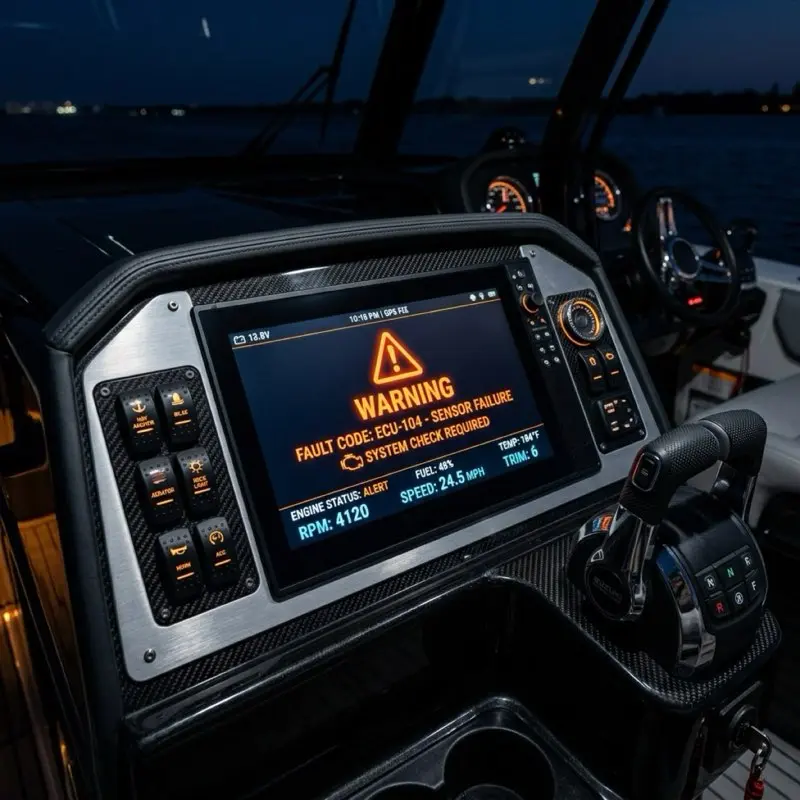
If you have a digital Yamaha gauge: read the screen first. The display will show text like "Overheat," "Low Oil," or "Water in Fuel" directly. The beep is secondary confirmation.
Yamaha Alarm Pattern Reference
Horn Pattern
Severity
Most Likely Cause
Immediate Action
1 short beep at key-ON
None, normal
System self-test
No action needed
Repeating intermittent beeps
Advisory
Water in fuel separator OR low oil (2-stroke)
Check fuel filter and oil; proceed at reduced speed
This is a Yamaha-specific quirk that confuses a lot of boaters. On many four-stroke Yamaha EFI models, the water-in-fuel sensor is wired to only trigger the audible alarm while the engine is in neutral gear. The result: everything seems fine underway, but the horn starts beeping the moment you drop into neutral to idle into the dock.
The cause is water accumulated in the VST (Vapor Separator Tank) or fuel filter bowl. It's a low-urgency issue, the engine will run, but do not ignore it. Water in the fuel system corrodes injector tips over time and can eventually cause the engine to stumble under load.
Fix: Drain and inspect the fuel filter bowl. If you repeatedly see water accumulation, investigate the primary tank for phase-separated ethanol fuel (especially if the boat sat over winter with E10 fuel aboard).
Yamaha Guardian Mode and S.A.F.E. Equivalent
Yamaha's engine protection system limits RPM during a critical alarm event on most EFI four-stroke models. The specific RPM cap varies by engine series, but expect a ceiling in the 2,500–3,000 RPM range.
On older non-EFI two-stroke Yamaha engines, there is no ECU-controlled RPM limiting, the alarm is advisory only, and the engine will continue to run at full throttle even during a critical fault. If you own a pre-2000 Yamaha two-stroke: that alarm is the only protection you have. Treat every continuous alarm as a mandatory stop.
Honda BF Series Alarm Codes
Honda's BF series (the dominant 4-stroke family) uses a combination of indicator lights and a helm buzzer. The pattern logic is straightforward compared to some competitors, but knowing which light accompanies which sound is key.
Honda BF Alarm Pattern Reference
Horn Pattern
Indicator Light
Cause
Immediate Action
Brief tone at key-ON
All lights illuminate momentarily
System self-test
No action needed
Continuous tone
Oil pressure light (red)
Critically low oil pressure
Stop engine immediately; check oil level
Continuous tone
Overheat light (red)
Engine overheat
Stop engine; check tell-tale stream; check intake
Short intermittent pulses
No specific light OR fuel indicator
Water in fuel separator
Drain water separator; check fuel source
Honda's Power Reduction System
On modern Honda BF models equipped with PGM-FI (fuel injection), the ECM will enforce a power reduction when a critical fault is detected. In severe overheat cases, Honda's system is designed to progressively reduce power and, if the overheat condition continues uncorrected, shut the engine down entirely to prevent seizure.
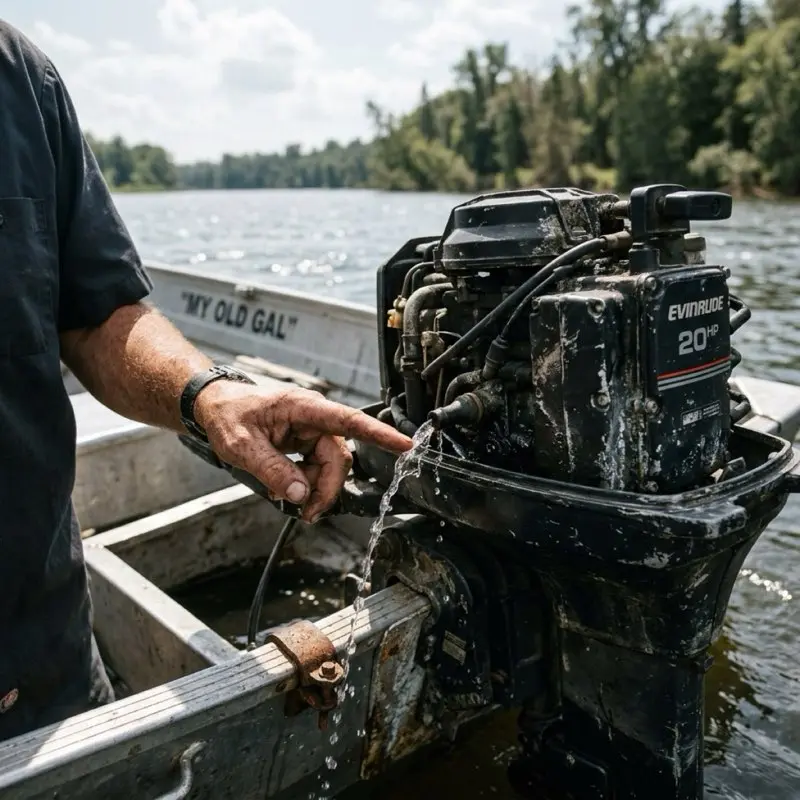
The tell-tale is your fastest diagnostic tool on Honda. Before anything else, look at the stream of water exiting the engine's cooling outlet (typically near the propeller shaft area or the upper cowling depending on model). No stream, or a thin dribble, is a clear indication of cooling failure. Common causes: blocked water intake (weeds, mud, plastic bag), failed water pump impeller, or stuck thermostat.
HONDA OVERHEAT PROTOCOL
If the overheat alarm sounds and there is no tell-tale stream: shut down the engine immediately. Do not attempt to restart. Tow to shore. Running a Honda BF with blocked cooling, even for two minutes at idle, can warp the cylinder head, a repair that costs more than the engine is worth on older motors.
Honda Gear/Tilt Safety Alarm
Some Honda BF models include a safety interlock alarm that sounds if the engine is shifted into gear while the motor is trimmed beyond a safe operating angle. This is a navigation/safety warning, not an engine fault. The alarm stops as soon as the engine is returned to a normal trim position. New owners frequently confuse this with an engine problem, it isn't.
Suzuki DF Series Alarm Codes
Suzuki's alarm architecture has one distinctive feature that separates it from the competition: a maintenance reminder system built around the oil change interval. This timer-based reminder is the source of enormous confusion, thousands of boaters have Googled "Suzuki outboard alarm beeping" because of this single, perfectly normal feature.
Suzuki DF Alarm Pattern Reference
Horn Pattern
Severity
Cause
Immediate Action
Brief tone at key-ON
None, normal
System self-test
No action needed
Double beep, repeating
Maintenance reminder
100-hour oil change interval reached
Reset the maintenance counter; perform oil change
Continuous tone
Critical
Overheat OR low oil pressure
Reduce throttle immediately
Engine limited to ~3,000 RPM
Critical / Fail-Safe
ECU fault detected
Diagnose with SDS or authorized technician
The Suzuki Double Beep: The Maintenance Reminder Nobody Warns You About
If your Suzuki DF engine has been running for approximately 100 hours since the last reset and you start hearing a repeating double-beep pattern, this is almost certainly the oil change reminder timer, not a mechanical fault.
The reminder fires at regular intervals (often every 50 hours after the first trigger) until manually reset.
How to reset the Suzuki oil change reminder:
For engines with a conventional key ignition and cable throttle:
Turn the ignition key to ON (do not start the engine)
Remove the safety lanyard from the kill switch
Pull the kill switch button out and push it back in 3 times within 10 seconds
You should hear a confirmation beep
Turn key to OFF and reinstall the lanyard
For fly-by-wire (electronic throttle) Suzuki DF engines:
Turn the ignition key to ON (do not start the engine)
Remove the safety lanyard from the kill switch
Press the Engine Start/Stop button 3 times consecutively
You should hear a confirmation beep
Turn key to OFF and reinstall the lanyard
SUZUKI RESET NOTE
The reset procedure resets the timer only. If you haven't actually changed the oil, the reminder will return at the next interval. The reminder system is on your side, it's tracking hours that your analog memory might miss.
Suzuki Fail-Safe Mode (3,000 RPM Limiter)
When Suzuki's ECU detects a significant sensor fault or system anomaly, the engine enters fail-safe mode and caps RPM at approximately 3,000 RPM. Unlike the maintenance reminder, this is an actual fault condition.
Suzuki's ECU stores diagnostic codes that can be read either through:
A Suzuki Digital Gauge (if equipped), which can display fault codes in its diagnostics menu
The Suzuki Diagnostic System (SDS) software connected by an authorized technician
Suzuki's fault code structure uses a two-digit format readable via Check Engine light flash patterns: count the long flashes (each = 10), then the short flashes (each = 1). Example: 2 long + 3 short = Code 23. Cross-reference with your service manual.
Evinrude E-TEC Alarm Codes
Evinrude ceased outboard motor production in 2020, but hundreds of thousands of E-TEC engines remain on the water. The E-TEC warning system is distinctive because it includes four internal LEDs on the Engine Management Module (EMM) that provide diagnostic information even without a connected gauge.
Evinrude E-TEC Alarm Pattern Reference
Horn Pattern / LED
Severity
Cause
Immediate Action
1/2-second tone at key-ON, all lights flash
None, normal
SystemCheck self-test
No action needed
Continuous tone
Critical
Overheat, critical oil fault, or S.A.F.E. activation
Reduce throttle immediately
Repeating intermittent beeps
Advisory
Low oil, water in fuel
Check oil and fuel filter
EMM LED 4 illuminated
Advisory/Critical
Overheat sensor OR oil pressure fault
Diagnose immediately
The Evinrude EMM LED Diagnostic System
This is unique to E-TEC and is genuinely useful for owners without a connected SystemCheck gauge:
LED 1 (Charging System): If lit, investigate battery terminals, charging cable connections, stator output, and rectifier. The E-TEC stator operates at 55V AC, connector corrosion at the rectifier is the single most common charging system fault on these engines.
LED 2 (Injector/Ignition): If lit, an injector circuit or ignition coil primary circuit fault is stored. Note which LED is lit and in what pattern (steady vs. blinking), the pattern encodes which cylinder bank is affected on multi-cylinder models.
LED 3 (5V Sensor Circuits): If lit, a sensor on the 5V reference circuit has failed or gone out of range. This includes the Throttle Position Sensor (TPS), manifold air temperature, and barometric pressure sensor.
LED 4 (Temperature/Oil): If lit, investigate the engine temperature sensor circuit and the oil pressure switch. This LED being active with a continuous alarm almost always means an overheat event or oil system fault is in progress or has been stored.
S.A.F.E. mode is the E-TEC equivalent of Guardian Mode. When activated, the EMM limits engine RPM based on the severity of the fault detected. Unlike some competitors, S.A.F.E. mode can produce a range of RPM caps rather than a fixed ceiling, a minor sensor fault might limit the engine to 4,500 RPM, while an overheat event might cap it at 1,500 RPM.
Stored E-TEC diagnostic codes require Evinrude Diagnostic Software (EDS) to read precisely. However, the EMM LED pattern provides a useful first triage even dockside without a laptop.
The 90-Second Protocol: What to Do the Moment Any Alarm Fires
Regardless of brand, run through this sequence every time your alarm triggers:
Step 1, Throttle (0–10 seconds): Reduce to idle immediately. Do not kill the engine unless the alarm is continuous and accompanied by visible smoke, steam, or burning smell.
Step 2, Tell-Tale (10–20 seconds): Look at the water stream exiting your engine's cooling indicator. Strong and steady = cooling system functional. Weak, absent, or intermittent = cooling failure. A cooling failure with a continuous alarm means stop the engine now.
Step 3, Gauge (20–40 seconds): If you have a digital display, read it. Every brand that offers a digital gauge system will display a text message or code that removes all ambiguity. Trust the display over pattern counting.
Step 4, Oil (40–60 seconds): If no gauge display, check the accessible oil level. On 2-stroke engines, check the reservoir under the cowling. On 4-stroke engines, the oil dipstick (not possible underway, but note if any oil pressure light is active).
Step 5, Decide (60–90 seconds):
Continuous alarm + no tell-tale stream: Stop engine. Anchor or drift. Call for tow.
Continuous alarm + tell-tale flowing normally: Idle to dock. Investigate on land.
Intermittent alarm + all visuals normal: Reduce speed. Return to dock. Investigate before next departure.
Why Alarms Are Sometimes Sensor Failures, Not Engine Failures
The most frustrating scenario in marine diagnosis: the alarm fires, you check everything, all levels are correct, the tell-tale is strong, and the engine runs fine.
This happens. Sensors fail. And in the marine environment, salt, vibration, moisture, UV, they fail faster than in any automotive application.
The most common sensor false alarms, by brand:
Brand
Common False Alarm Source
Quick Field Test
Mercury
Oil level float sensor (sinking/stuck float)
Jump the sensor connector; if alarm clears, sensor is faulty
Yamaha
Water-in-fuel sensor corrosion
Remove and inspect sensor; rinse with fresh water
Honda
Overheat sensor open circuit
Check sensor resistance with multimeter (spec in service manual)
Suzuki
Temp sensor harness chafing at cowling edge
Inspect harness routing under cowling for wear
Evinrude E-TEC
EMM connector water intrusion
Inspect and dielectric grease all EMM multi-pin connectors
The key rule: if the alarm fires but the tell-tale is strong and no visual symptoms are present, suspect the sensor before suspecting the engine. A false alarm from a corroded sensor is a $40 repair. A genuine overheat that was ignored is a $3,000 cylinder head.
When You Need a Scan Tool, Not a Guess
Every modern EFI outboard, Mercury FourStroke, Yamaha F-series, Honda BF-TI, Suzuki DF EFI, Evinrude E-TEC, stores fault codes in the ECU. These codes are specific: instead of "overheat," they tell you which temperature sensor circuit is out of range, and on which cylinder bank.
Pattern-counting and tell-tale observation are first-aid. If the alarm returns after following the 90-second protocol, you need:
Mercury: CDS G3 Diagnostic Tool or VesselView Mobile with correct adapter harness
Yamaha: YDS (Yamaha Diagnostic System) or compatible aftermarket scanner
Honda: Honda Marine HDS-G3 diagnostic interface
Suzuki: SDS (Suzuki Diagnostic System) via authorized dealer
Evinrude E-TEC: EDS (Evinrude Diagnostic Software), available through dealers and some independent shops that supported E-TEC before production ended
Many independent marine mechanics have invested in multi-brand scan tools. If you're troubleshooting a persistent alarm and your brand's dealer has a long wait, call independent shops and ask specifically if they have diagnostic capability for your engine brand.
Frequently Asked Questions
My outboard is beeping and I don't have the owner's manual, how do I know if it's serious?
Use the universal rule: continuous tone = serious, stop now. Intermittent pattern = advisory, reduce speed and investigate. Then check the tell-tale stream. If water is flowing strongly, the engine is cooling. If it isn't, stop the engine immediately regardless of what pattern you're hearing.
Can I silence the alarm and keep running?
Technically, some systems can be bypassed. Practically, this is one of the worst decisions you can make on the water. The alarm is protecting a $5,000–$30,000 engine. The 30-minute run home is not worth it.
My Suzuki keeps beeping every time I start it, I've checked everything.
If it's a double-beep pattern, this is almost certainly the 100-hour oil change maintenance reminder, not a fault. Follow the reset procedure in the Suzuki section above.
The alarm fired once, then stopped. Do I need to worry?
Yes. An alarm that fires and clears on its own still generated a stored fault code in the ECU. Have the engine scanned at your next service visit. Transient alarms often indicate an intermittent sensor fault or a developing cooling system issue, catching it early is dramatically cheaper than waiting for it to become continuous.
My outboard has an alarm but no digital gauge, how do I read codes?
On non-digital systems, fault codes are typically read via the flash pattern of the Check Engine light. The procedure varies by brand. Honda, Suzuki, and older Yamahas all have a flash-code reading procedure documented in the service manual. Look for "Self-Diagnosis" or "Flash Code" in the index. Without the service manual, an authorized dealer is your fastest path to a precise diagnosis.
All alarm behavior documented in this guide reflects generally reported behavior for each brand's EFI outboard product line. Because alarm patterns vary by model year, horsepower rating, and installed gauge system, always cross-reference with the owner's manual specific to your engine's serial number. This guide is a diagnostic aid, it does not replace manufacturer documentation or the judgment of a certified marine technician.