The sound of an outboard motor temperature alarm is a specific, piercing tone designed to cut through engine noise and wind. When it goes off, your heart drops. It happened to me on the Ranger last summer, running flat out across a lake trying to beat a thunderstorm. The alarm shrieked, the engine went into "limp mode" (automatically dropping RPMs to protect itself), and suddenly I was doing six knots in building chop.
You have about ten seconds to make a decision when that alarm sounds. The wrong decision, pushing it "just a little further" to get to the dock, can warp the cylinder head, blow the head gasket, and turn a $60 repair into a $3,000 engine rebuild.
The right decision is to pull the throttle back to idle immediately, shut the engine down if you are in safe water, and start diagnosing.
Outboard cooling systems are actually quite simple. They draw raw water in through the lower unit, pump it up through the engine block via a rubber impeller, regulate its flow with a thermostat, and push it out the exhaust and the "telltale" hole. When the engine overheats, one of those four steps has failed. Here is how to figure out which one.
About this guide: Mike Callahan has twenty-two years of experience running outboard motors and spent four years as a service advisor at a Yamaha-certified marine dealership. He has diagnosed hundreds of overheating outboards, from simple plastic bags sucked over water intakes to complete water pump failures. The diagnostic sequence below is the standard procedure used by marine technicians to isolate cooling system faults without unnecessary parts replacement. Warning: Never remove the radiator cap on a closed-cooling inboard/sterndrive engine while hot. This guide focuses primarily on raw-water-cooled outboard motors.
- Drop to idle immediately. Do not shut the engine off instantly unless it is smoking or making metallic noises. Letting it idle for 15-30 seconds allows any remaining cooling water to pull the worst of the heat soak out of the block.
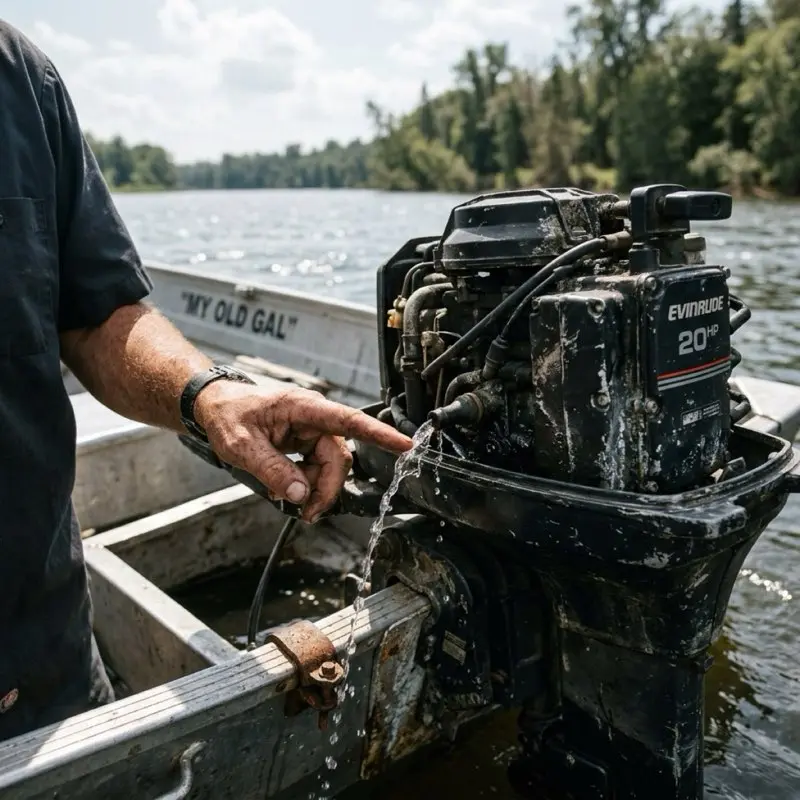
- Look back at the motor. Specifically, look for the "telltale" (or "pee stream"), the small stream of water shooting out the back or side of the motor.
- Shut the engine off.
- Trim the motor up and look at the water intakes on the sides of the lower unit.
Your diagnosis starts with what you saw in steps 2 and 4.
Diagnostic Step 1: Check the Water Intakes
Before assuming mechanical failure, check for environmental blockage. Outboards pull cooling water through small vents on the sides (or sometimes the nose) of the lower unit bullet, just above the propeller.
The "Plastic Bag" Syndrome:
I have been towed in once in my life, and it was because I sucked a clear plastic grocery bag over the water intakes on my center console. At speed, the suction holds the bag tightly against the vents, instantly starving the engine of water. The alarm goes off, you pull back the throttle, and the lack of forward pressure sometimes lets the bag float away before you even tilt the motor up to look.
What to look for:
Trim the motor entirely out of the water. Inspect the slotted vents.
- Weeds/Eelgrass: Very common in shallow lakes or coastal flats. Pull them off.
- Mud/Sand: If you recently bumped bottom or idled through a mud flat, the intakes may be packed with sediment.
- Plastic bags/debris: Even a small piece of plastic can cover enough intake area to cause a high-RPM overheat.
The Fix: Clear the debris. Lower the motor, restart, and watch the telltale stream. If the stream is strong and the alarm stays off, you are good to go. If the stream is weak or the alarm returns, the blockage may have damaged the impeller (running an impeller dry for even 30 seconds can melt the rubber vanes).
Diagnostic Step 2: Read the Telltale Stream
The telltale is your primary diagnostic tool. It is a small bypass stream of cooling water designed specifically to show the operator that the water pump is working.
Restart the engine (only let it run for a few seconds if the alarm sounds). Look at the stream.
Scenario A: No Stream or Very Weak Stream
If there is no water coming out, or just a sputtering dribble, you have a water flow problem.
1. Check for a clogged telltale port (The "Mud Dauber" Check)
This is incredibly common on boats stored on trailers or lifts. Insects (like mud daubers) build nests in the telltale hole. Or, salt and calcium deposits crust over the opening.
The Fix: Take a piece of stiff monofilament fishing line (80lb test is perfect) or a thin piece of wire, and carefully poke it up into the telltale hole while the engine is idling. Do not use a drill or force it deeply. Usually, within an inch or two, you will dislodge the blockage, and a strong stream of water will suddenly shoot out. If it does, your pump is fine; the indicator was just clogged.
2. The Impeller has Failed
If the intakes are clear and the telltale hole is clear, but there is still no stream, your water pump impeller has failed. The impeller is a rubber star-shaped wheel inside the lower unit that acts as the heart of the cooling system.
- Age: Impellers harden and take a "set" over time. They should be replaced every 2-3 years or 200 hours, regardless of how they look.
- Dry Running: Starting the motor on the trailer without ear muffs (water supply) destroys an impeller in under a minute. The friction melts the rubber vanes off the metal hub.
The Fix: You need a water pump repair kit. This involves dropping the lower unit.
Scenario B: Strong Stream, But Engine is Overheating
This is a crucial distinction. If the telltale stream is strong and steady, your water pump (impeller) is working fine. Do not drop the lower unit to replace the impeller. The pump is pushing water up to the engine block, but the engine is still getting too hot.
This almost always points to a restriction inside the engine block.
1. The Thermostat is Stuck Closed
Outboards have thermostats just like cars. They stay closed when the engine is cold to allow it to reach operating temperature quickly, then open to let cooling water flow through the water jackets around the cylinders.
If the thermostat gets corroded by salt or stuck shut by debris, the water pump pushes water up, the telltale streams (because the telltale often bypasses the thermostat on many models), but no water circulates around the hot cylinders. The engine overheats rapidly.
The Fix: Replace the thermostat. On most outboards, this is a 15-minute job requiring only a socket wrench. The thermostat housing is usually located at the top or back of the cylinder head.
2. Poppet Valve (Pressure Relief Valve) Issue
Larger outboards (V4, V6) have a pressure relief valve (poppet valve) in addition to thermostats. At low RPMs, cooling relies on the thermostats. At high RPMs, the water pump pressure forces the poppet valve open to dump large volumes of water through the block.
- Symptom: The engine runs fine at idle and trolling speeds, but overheats when you get up on plane.
- The Fix: The poppet valve spring may be weak, or the valve is stuck closed by salt/sand. It needs to be removed, cleaned, or replaced.
3. Internal Salt/Scale Buildup
If you run in saltwater and do not flush the motor after every use, salt and scale build up inside the narrow cooling passages of the engine block. Over years, this acts like plaque in an artery, reducing water flow and insulating the metal so heat cannot transfer to the water.
The Fix: A descaling flush. You cannot fix this with a standard freshwater flush on a hose. You need to circulate a descaling acid (like Star brite Descaling Motor Flush or Rydlyme) through the engine using a submersible pump in a bucket.
Impeller vs. Thermostat: The Quick Guide
If you are trying to decide which part to buy, use this simple rule of thumb:
| Symptom | Impeller Status | Thermostat Status | Action Required |
|---|
| No telltale stream, alarm sounds | Likely Failed | Unknown | Check for clogged port, then replace impeller. |
| Strong telltale stream, alarm sounds | Working Fine | Likely Stuck Closed | Replace thermostat. |
| Overheats only at idle, cools down at high RPM | Weak/Worn | Working | Replace impeller (cannot generate enough pressure at low RPM). |
| Overheats only at high RPM, fine at idle | Working | Poppet Valve stuck | Clean/replace poppet valve (or clear water intakes). |
How to Check and Replace a Thermostat
Replacing a thermostat is one of the easiest DIY marine maintenance tasks. If your engine has a strong telltale but is overheating, do this first.
- Locate the housing: Consult your manual. It is usually a small metal dome on the top or back of the cylinder head, held on by two or three bolts. (V-block engines will have two thermostats, one for each bank of cylinders).
- Remove the bolts and cover: Be careful not to snap the bolts if they are corroded. Spray with penetrating oil first if necessary.
- Remove the thermostat: Note its orientation. It may be stuck; pry it gently.
- Test the thermostat (Optional): Drop the thermostat into a pot of water on your stove with a meat thermometer. Most marine thermostats are stamped with their opening temperature (usually between 120°F and 140°F). As the water hits that temperature, you should see the spring compress and the valve open. If the water boils and the valve hasn't moved, it is dead.
- Clean the housing: Scrape away the old gasket material and any salt crust.
- Install the new thermostat: Insert the new thermostat, place a new gasket, and tighten the bolts snugly (do not overtighten, the housing can crack).
Cost: A new OEM thermostat and gasket typically costs $25-$45.
When to Replace the Water Pump Impeller
The water pump impeller is a maintenance item, not a "run to failure" part. You do not wait for the engine to overheat to replace it.
The Replacement Interval:
- Standard Use: Every 2 to 3 years, or 200 hours of operation.
- Heavy Sand/Silt Use: Annually. Sand acts like sandpaper on the rubber vanes and the metal housing.
- After Dry Running: Immediately. If you started the motor on the trailer without water for more than 10 seconds, replace the impeller.
When you replace the impeller, buy the complete water pump kit, not just the rubber impeller alone. A full kit includes the impeller, the metal cup housing, the wear plate, the woodruff key, and all necessary o-rings and gaskets. If you put a new rubber impeller inside a scored or worn metal cup, it will not pump effectively.
Recommended Water Pump Kits:
- Sierra International Water Pump Kits, High-quality aftermarket kits that meet or exceed OEM specs for most Yamaha, Mercury, and Evinrude motors.
- OEM (Original Equipment Manufacturer) kits from your dealer are always the safest bet, though slightly more expensive.
The Danger of Ignoring the Alarm
Outboard motors are constructed largely of aluminum to save weight. Aluminum dissipates heat quickly, but it also warps easily when overheated.
If you continue to run an engine while the high-temperature alarm is sounding:
- The heat expands the cylinder head disproportionately to the engine block.
- The head gasket, the seal between the block and the head, is crushed or blown out.
- Once the head gasket blows, cooling water enters the combustion chamber.
- You will see milky, white oil (on a four-stroke) and the engine will lose compression and die.
A $40 impeller replacement just became a major engine teardown requiring the cylinder head to be sent to a machine shop to be milled flat again. Never push an overheating engine.
Quick Reference Diagnostic Checklist
Keep this mental checklist for the next time the alarm sounds:
- Pull throttle to idle, shut off if safe.
- Tilt motor, check intakes for bags/weeds.
- Restart briefly, check telltale stream.
- No stream = clear telltale hole with wire.
- Still no stream = Impeller failure.
- Strong stream = Thermostat or internal blockage.
- If you must get home: Do not run the motor. Use a kicker motor, a trolling motor, call a tow service (like Sea Tow or VesselAssist), or drop the anchor and wait for a tow from a fellow boater.
7. The Engineering of "Limp Mode": How Your ECM Saves Your Engine
Modern outboards (built after 2000) are equipped with an Engine Control Module (ECM) that acts as a digital bodyguard. When the temperature sensor on the cylinder head reaches a critical threshold (typically around 190°F to 205°F), the ECM triggers "Limp Mode" or "Guardian Mode."
7.1 The Rev-Limiter Protection
The ECM doesn't just sound an alarm; it physically cuts the ignition or fuel pulses to the cylinders. This limits your RPM to around 2,000 to 2,500.
- The Goal: To reduce the "Thermal Load." By preventing high-speed operation, the engine generates less friction and combustion heat, potentially slowing down the catastrophic warping of the aluminum block.
- The Warning: Just because the boat is in Limp Mode doesn't mean it is safe to keep driving. You are still operating at a temperature that is melting rubber seals and gaskets. Limp Mode is designed to give you just enough power to reach a nearby dock or steer out of a shipping channel, not to drive five miles home.
8. The "Pressure vs. Flow" Paradox: The Poppet Valve Deep Dive
One of the most confusing diagnostics for a new boater is when the boat overheats only at high speeds. This is the Pressure vs. Flow Paradox.
8.1 Low-Speed Cooling (Thermostat-Driven)
At idle, the water pump generates low pressure. The cooling water relies on the thermostats being open to allow flow. If you overheat at idle but cool down when you accelerate, your water pump is likely weak or the thermostats are stuck.
8.2 High-Speed Cooling (Poppet-Driven)
At high RPMs, the water pump is spinning at 5,000+ RPM and generating massive pressure. The small passages through the thermostats cannot handle this volume of water.
- The Poppet Valve: This is a spring-loaded pressure relief valve. Once the water pressure reaches a certain PSI (usually around 15-20 PSI), the poppet valve is forced open, bypassing the thermostats and dumping a massive "firehose" of water through the block.
- The Failure Mode: If the poppet valve is stuck closed (due to salt buildup or sand), the engine will be fine at low speeds. But as soon as you get on plane, the water pressure "dead-heads" against the closed valve, water flow stalls, and the engine overheats in seconds.
- The Callahan Diagnostic: If you overheat only when the boat is on plane, ignore the impeller. Remove the poppet valve (usually located near the base of the powerhead) and look for sand or a broken spring.
9. Saltwater Crystallization: The Chemistry of the "Salt Bridge"
If you boat in saltwater, your engine is essentially a laboratory for mineral crystallization.
9.1 The "Hot Spot" Effect
When you shut off a hot engine after running in salt water, the water trapped inside the cooling passages stops moving. The residual heat of the aluminum block (Heat Soak) causes this water to boil or evaporate rapidly.
- The Result: The salt held in suspension falls out and forms a hard crust. Over hundreds of cycles, these crusts grow into "Salt Bridges" that can completely block a cooling passage.
9.2 The "Dry Salt" Trap
Once salt has crystallized and dried, a standard freshwater flush has a very hard time dissolving it. Freshwater follows the path of least resistance, meaning it flows around the salt bridge rather than through it.
- The Masterclass Solution: You must use a chemical descaler. Products like Rydlyme Marine or Barnacle Buster use a mild acid that chemically reacts with the calcium and salt to turn it back into a liquid that can be flushed out.
10. The "Callahan Flush" Protocol: 3-Year Master Maintenance
If your engine is more than five years old, a standard hose flush is no longer sufficient. I recommend the "Callahan Flush" every three years.
- Remove the Thermostats: Don't descale through closed thermostats. Remove them and reinstall the covers.
- The Recirculation Loop: Place a 20-gallon tub under the lower unit. Fill it with a mixture of water and descaling solution.
- The Submersible Pump: Use a small 110V submersible pump to push the solution into the motor's flush port.
- The 2-Hour Soak: Let the solution circulate (with the engine OFF) for two hours. You will see white foam and grit coming out of the exhaust, that is the "plaque" being stripped from your engine's arteries.
- The Freshwater Rinse: Flush with clean water for 20 minutes, then reinstall new thermostats and gaskets.
11. Summary: The Temperature of Your Investment
An outboard motor is a high-performance machine that operates in a hostile environment. It is the only engine you own that uses "raw" unfiltered water as its primary coolant.
By understanding the difference between Impeller Failure (no pressure) and Thermostat/Poppet Failure (no flow), you can save yourself thousands of dollars in "diagnostic labor" at the dealership. Treat your cooling system as a preventive maintenance priority, not a repair-on-failure system.
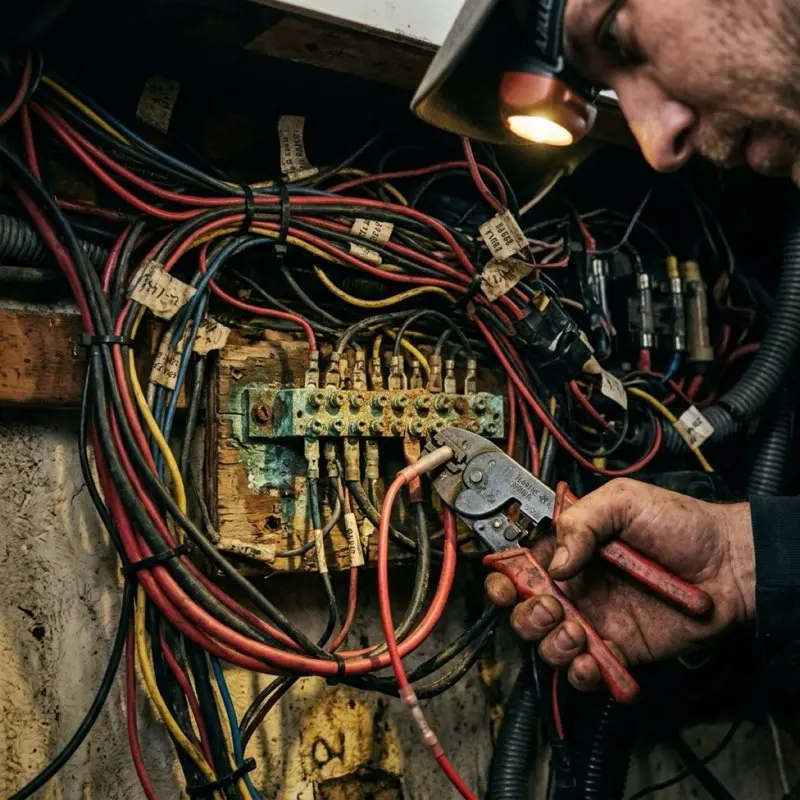
Wire it right, flush it often, and I'll see you on the water.