You're at the helm, the engine is off, and the anchorage is perfectly quiet. Then you hear it: the low, vibrating hum of the bilge pump kicking on. Five seconds later, it shuts off. Two minutes later, it kicks on again. Or perhaps you hit the manual override switch, and instead of a hum, you hear a single, sharp click.
The water is rising past the floorboards, and the only piece of equipment designed to save your boat is failing.
A bilge pump problem typically falls into two categories: mechanical/electrical failure (clicking/not starting) or sensor/plumbing failure (running constantly). Clicking is usually caused by a physical jam in the impeller or a voltage drop in the wiring. Constant running is almost always a stuck mechanical float switch or a 'Backflow' issue where water in the discharge hose falls back into the bilge, creating an infinite cycling loop.
The good news is that 90% of bilge pump issues can be resolved with a rubber mallet, a cleaning rag, and a basic understanding of marine plumbing. This masterclass will take you from "Panic Mode" to a "Zero-Failure" bilge architecture.
Mike Callahan's Masterclass Note: "I’ve seen $500,000 yachts sitting on the bottom of their slips because of a $20 plastic float switch. The bilge pump is the most ignored safety component on a boat until the moment you see your batteries submerged. In this guide, I’m teaching you the 'Callahan Three-Pump Standard', because a single pump is not a safety system; it’s a single point of failure."
| The Bilge Diagnostic Matrix | The Symptom | The Likely Culprit | Immediate Action |
|---|
| The Sharp Click | Hit switch, single click, no spin | Physical jam or low voltage | Snap motor out of base; clear debris |
| The Endless Hum | Pump runs, bilge is dry | Stuck/Failed float switch | Lift and drop the float arm manually |
| The "Heartbeat" Cycle | Runs for 5s, off for 2m, repeats | Discharge backflow | Install a vented loop or reroute hose |
| The High-Pitch Whine | Running loud, no water moving | Airlock in the housing | Tilt the pump 45° while submerged |
| The Dead Silence | No click, no hum, no light | Blown fuse or total corrosion | Check main breaker; jump to battery |
Scenario A: The Sharp Click (Mechanical Jam or Voltage Drop)
When you hear a click, it means the electrical "request" reached the pump, but the motor couldn't execute the command.
1. The "Snap-Off" Mechanical Audit
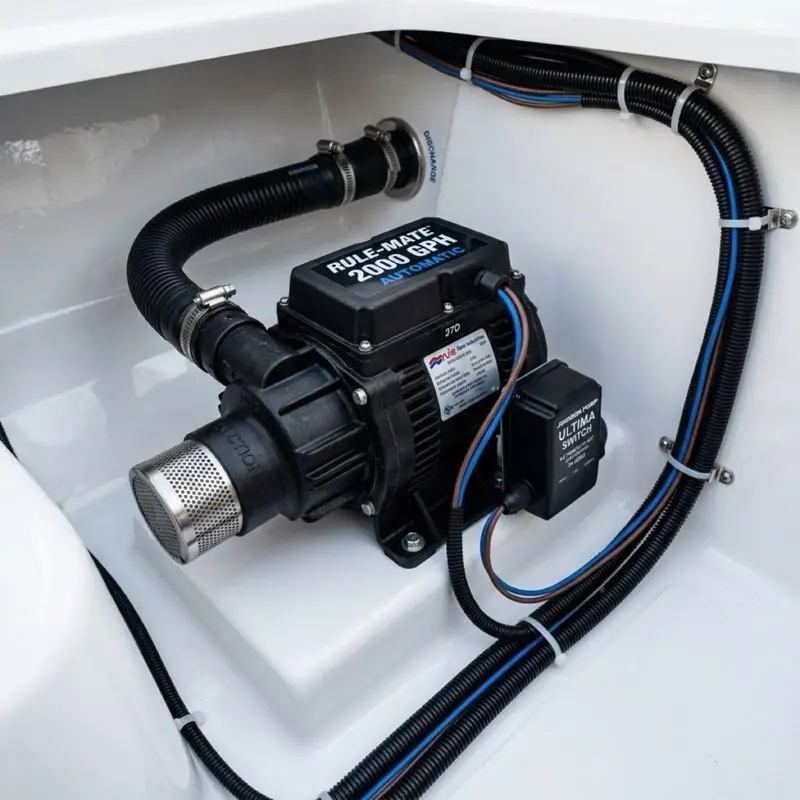
Most modern pumps (Rule, Johnson, Attwood) use a cartridge system. Reach down and press the two plastic tabs on the side of the pump body. Lift the motor cartridge out of the strainer base.
- The Finger Test: Try to spin the plastic impeller with your finger. It should spin freely with slight magnetic resistance.
- The Debris Trap: If it won't budge, look for fishing line, zip-tie tails, or gravel. Pontoons and center consoles are notorious for collecting "bilge gravel" that wedges perfectly between the impeller blade and the housing.
2. The "Green Wire" Voltage Drop
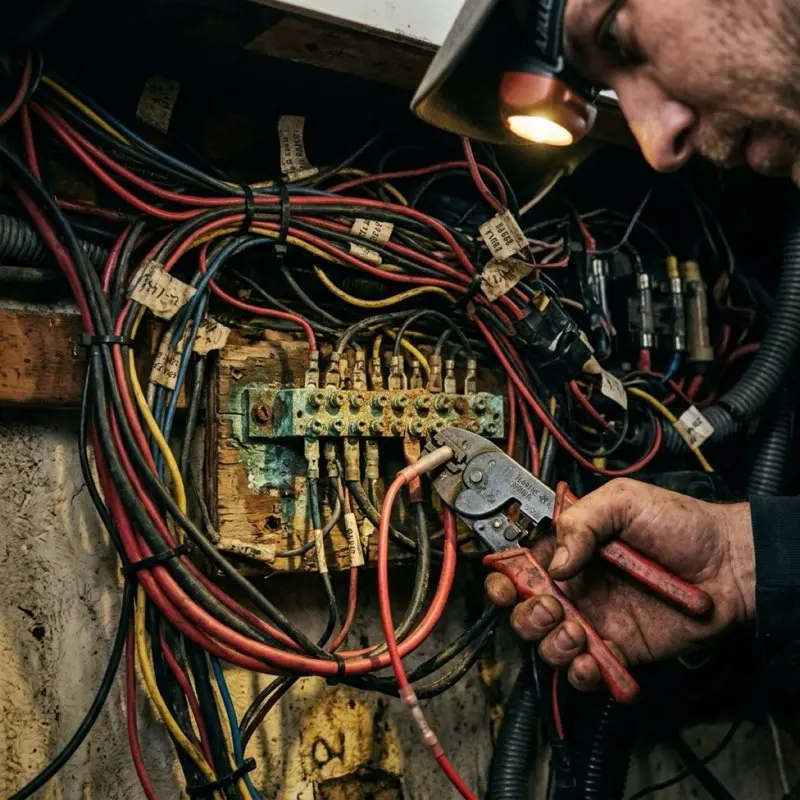
If the impeller spins freely but the pump only "clicks" when powered, it is likely starving for amperage. Marine wire lives in a salt-mist environment. If your crimp connectors aren't heat-shrunk, the copper inside turns into a green powder.
- The Jump Test: Use a spare 12V battery and two jumper wires. Touch the pump wires directly to the battery. If it screams to life, your boat's wiring is the problem. If it still just clicks, the internal motor windings have shorted.
Scenario B: The Endless Hum (Sensor Failure vs. Active Leak)
If the pump is running non-stop, you have an emergency until you prove otherwise.
1. The 5-Second Visual Check
Open the hatch.
- Is the bilge dry? If yes, your Float Switch is stuck "up" by sludge or debris.
- Is the bilge full? If the water is dropping, let it finish. If the water is NOT dropping while the pump runs, you have an Airlock or a Clogged Strainer.
2. The "Airlock" Burp
Airlocks happen when an air bubble gets trapped under the impeller. The pump spins in air, creating no suction.
- The Fix: While the pump is running, lift it slightly and tilt it 45 degrees. You will hear a "burp" of air, and water will immediately surge up the discharge hose.
Technical Deep Dive: Why 500 GPH is a Lie (Static Head)
When you buy a "500 GPH" pump, you are reading a laboratory rating with 0 feet of vertical lift. In the real world, physics takes a massive cut.
1. Static Head Height
Every foot the pump has to push water up reduces its effectiveness. A standard 500 GPH pump pushing water up a 3-foot rise to a hull fitting loses nearly 40% of its capacity.
2. Friction Loss
Corrugated (ribbed) bilge hose is the enemy of flow. The "valleys" in the hose create turbulence that slows the water down.
- The Masterclass Spec: If you have a deep-draft boat, always buy a pump rated for 2x the capacity you think you need. A 1,000 GPH pump is the bare minimum for any boat with a cabin.
The "Heartbeat" Cycle: Backflow and the Hartford Loop
If your pump cycles on and off every few minutes even when it’s not raining, you are a victim of gravity.
1. The Backflow Problem
The pump pushes water up the hose. When the pump shuts off, the water remaining in that hose (which can be several gallons) falls back down into the bilge. This water triggers the float switch again.
2. The Fix: The Vented Loop (Siphon Break)
You must install a Vented Loop in the discharge line. This is a U-shaped fitting with a small air valve at the top. It breaks the vacuum when the pump stops, ensuring that water cannot "siphon" back into the boat from the outside or fall back from the hose.
The "Callahan Gold Standard": The Three-Pump Architecture
If you store your boat in the water, a single bilge pump is a single point of failure. I recommend the Three-Pump Standard:
- The Nuisance Pump (Primary): A small 500-800 GPH pump mounted at the absolute lowest point. Use a solid-state electronic switch. This handles rain and minor drips.
- The Emergency Pump (Secondary): A massive 2,000+ GPH pump mounted 3 inches higher than the primary. It should be wired to a completely separate battery. If this pump kicks on, it triggers a loud high-water alarm at the helm.
- The Manual Backup: A high-capacity manual diaphragm pump (like a Whale Gusher) that you can operate if your batteries are underwater and the electrical system is dead.
Frequently Asked Questions
Can I use a check valve to stop backflow?
I don't recommend it. Check valves reduce flow by up to 30% and frequently get propped open by a single piece of debris. A vented loop or proper hose routing is a much safer solution.
What is the difference between a mechanical float and an electronic switch?
Mechanical floats use a physical arm that can be jammed by debris. Electronic switches (Capacitance) have no moving parts and can "see" the difference between water and oil, preventing you from accidentally pumping oil overboard.
Is it legal to pump my bilge if there is oil in it?
No. Under the Clean Water Act, discharging oil can lead to massive fines. Use "Bilge Pigs" (oil-absorbent socks) to soak up hydrocarbons before the pump ever touches them.
Why does my pump run but the water only 'trickles' out?
This is usually Voltage Drop. The pump is spinning, but at half the required RPM. Check your ground connections and the gauge of your battery cables.