You're running back to the ramp at dusk. The navigation lights are on, the chartplotter is guiding you through the channel, and everything feels under control. Then, you hit a moderate wake. For a split second, the dashboard goes dark. The GPS screen reboots, the radio resets, and your fuel gauge needles bounce to empty before slowly climbing back up.
It’s called a "Ghost in the Machine," and in the marine world, it’s enough to make even a seasoned captain want to sell the boat. Intermittent electrical faults are the most frustrating problems on the water because they always seem to happen when you need the electronics most.
A boat's dashboard lights flicker because of high resistance in the electrical signal path, usually at a common ground point. In a 12V system, even a tiny amount of corrosion on a terminal creates 'Voltage Drop.' When a high-draw device (like a trim motor or VHF radio) kicks on, it 'steals' the available voltage from the lower-draw lights and gauges, causing them to dim, flicker, or reboot.
The good news: 90% of these "ghosts" live in the same three locations: the battery terminals, the main ground bus bar, or the ignition switch. You don't need an engineering degree to find them; you just need a systematic signal-trace approach.
Mike Callahan's Masterclass Note: "People think 12-volt systems are 'safe' because they won't shock you. But they are actually more finicky than your house's 120V wiring. In a boat, a single Ohm of resistance caused by a salty terminal can drop your voltage by 10%. That’s the difference between a bright, stable dashboard and a GPS that reboots every time you key the mic."
| The Flicker Diagnostic Matrix | The Symptom | The Likely Culprit | Immediate Action |
|---|
| The "Wave Bumper" | Everything flickers when you hit a wave | Loose battery nut or main ground | Replace wing nuts with nyloc hex nuts |
| The "Radio Reset" | GPS reboots when you transmit on VHF | Corroded Ground Bus Bar | Scrub bus bar metal to shiny copper |
| The "Key Jiggle" | Dash flickers when you touch the key | Failing Ignition Switch | Replace ignition switch assembly |
| The "Single Bouncer" | Only one gauge is activing erratically | Individual spade connector | Tighten female spade with pliers |
| The "Trim Dip" | Lights dim when you trim the motor | Voltage Drop / Undersized Wire | Check main 8AWG feed from battery |
Scenario A: The "Wave-Induced" Dropout (The Loose Main)
If the flicker is tied to the physical movement of the boat, hitting a wave or turning sharply, you have a Mechanical Looseness issue.
In a house, wires are static. In a boat, they are in a constant state of high-frequency vibration.
- The Battery Wing Nut Trap: If your battery has wing nuts, throw them away immediately. You cannot get enough torque on a wing nut with your fingers to withstand a day of boat vibration. As the nut backs off, the connection "arcs," causing a system-wide flicker. Replace them with stainless steel lock nuts.
- The 2nd Point of Failure (The Engine Block): Most people check the battery, but they forget to check where the thick negative cable attaches to the Engine Block. If that bolt is loose or corroded, the entire boat's electrical return path is compromised.
Scenario B: The "High-Draw" Fade (Resistance & Voltage Drop)
This is the most common "technical" flicker. It happens when you turn on one thing (like your navigation lights) and something else (like your fuel gauge) reacts.
This is caused by Resistance. Think of your wires like water pipes. Corrosion is like "clogging" the pipe. When you turn on a high-draw device, it tries to pull all the "water" (current) through that clogged pipe. The devices "downstream" are suddenly left with no pressure, so they dim or flicker.
The Ground Bus Bar: The Common Enemy
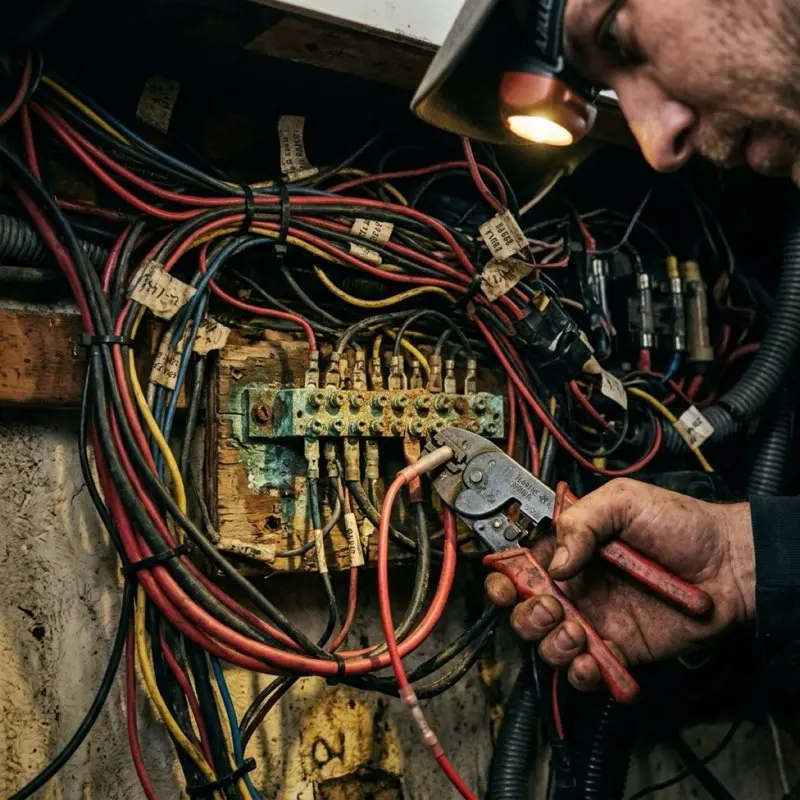
Under your helm, there is a metal strip where all the black (ground) wires meet. This is the Common Ground Bus Bar. Because every device on the dash shares this one piece of metal to get back to the battery, it is the #1 failure point.
- The Fix: If the bar looks green, brown, or dull, you must disassemble it. Sand the metal until it is bright and shiny. Reconnect the wires and spray them with a corrosion inhibitor like Boeshield T-9.
If you cut open a wire on your boat and the copper strands inside are black instead of shiny orange, you have found the "Quiet Killer" of marine electronics.
Why it happens:
Standard automotive wire is "bare copper." In a salt-air environment, moisture wicks up inside the plastic insulation through capillary action. The copper oxidizes, turning into a black, non-conductive crust.
Why it causes flickering:
Black copper has massive electrical resistance. It might carry enough current to light a tiny LED, but the moment your chartplotter tries to pull 2 amps, the black copper creates a "bottleneck," causing the device to starve for power and reboot.
- The Solution: You cannot clean the inside of a wire. You must replace the run with UL-1426 Tinned Marine Wire (like Ancor). Each strand is coated in tin, making it immune to the black-oxide rot.
Scenario C: The "Digital Reboot" (Why Chartplotters are Sensitive)
Modern electronics like Garmin, Simrad, and Lowrance are essentially small computers. Unlike an old-school light bulb, which just gets dimmer when voltage drops, a computer will "Protect" itself.
Most chartplotters are programmed to shut down if they see voltage drop below 10.5V. If your wiring is old and has high resistance, you might have 12.6V at the battery, but the moment you start the engine or key the radio, the resistance causes the voltage at the dash to momentarily dip to 10.4V.
The result: The unit reboots, taking 60 seconds to get your maps back up, exactly when you are navigating a tricky inlet.
Frequently Asked Questions
Why does my radio reset every time I start the engine?
This is a classic case of a Battery Under Load. When the starter motor kicks in, it draws massive amperage, causing the battery voltage to dip. If your radio is wired to the same battery and your wiring is thin, the voltage at the radio drops low enough to trigger a reset. The fix is often a dedicated "Electronics Battery" or an Automatic Charging Relay (ACR).
Can I use WD-40 on my electrical connections?
No. WD-40 is a solvent, not a long-term corrosion inhibitor. It will evaporate and leave the metal exposed to salt air again. Use a dedicated marine product like CorrosionX or Boeshield T-9, which leaves a waxy, waterproof film.
Everything on my dash flickers when I jiggle the key. Is that the battery?
No, that is a failing Ignition Switch. The internal copper contacts in the key switch wear out over 10-15 years. If the "Accessory" circuit inside the switch is loose, everything on the dash will flicker in sync with the key's movement.
How do I know if my ground is 'Floating'?
If you turn on your headlights and your temperature gauge moves, you have a Floating Ground. The current from the lights is trying to find a way back to the battery, and because the main ground is bad, it's "back-feeding" through the gauge circuit.