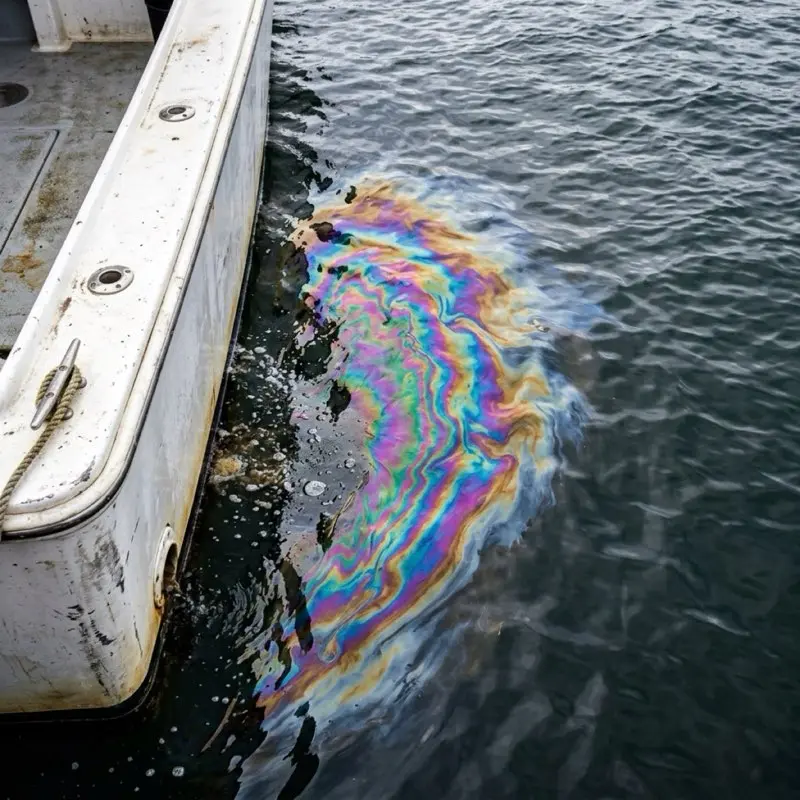
You’re sitting at the dock, looking over the transom, and you see it: a sprawling, iridescent rainbow slick floating on the water's surface, slowly radiating outward from your boat's hull. It induces a specific type of maritime panic. It means a mechanical seal has failed somewhere, and worst case, it means you are actively violating environmental regulations.
Seeing an oil slick induction doesn't always mean your engine is destroyed, but it does mean you need to act methodically to avoid a staggering Coast Guard fine.
To diagnose oil in the water, you must first identify the fluid's color and smell: a thin, pungent rainbow that evaporates quickly is likely unburned fuel (normal for 2-strokes); a thick, milky green or blue blob is Lower Unit gear lube (blown seal); and dark brown or black oil usually indicates an internal leak in the bilge being discharged overboard. Never use dish soap to disperse the slick, as this is a punishable federal offense, use oil-only absorbent pads instead.
The good news: Sometimes the "leak" isn't a leak at all, but rather the result of physics and older engine technology. Let’s find out if you need a mechanic or just a cleaning rag.
Mike Callahan's Masterclass Note: "I’ve seen boaters try to 'hide' a spill by squirting Dawn dish soap into the water. Don't do it. Soap doesn't make oil disappear; it just makes it sink to the bottom, where it poisons the ecosystem. If a harbormaster or the Coast Guard sees you using soap, your 'small problem' just became a $10,000 legal nightmare. Stick to the white pads."
| The Marine Fluid ID Chart | Fluid Color | Texture/Smell | Likely Source | Danger Level |
|---|
| Unburned Fuel | Multi-colored Sheen | Thin / Gas Smell | 2-Stroke Exhaust | Low (Normal) |
| Gear Lube | Milky Green/Blue | Thick / Sulfur Smell | Lower Unit Seals | CRITICAL |
| Engine Oil | Dark Brown/Black | Greasy / Burnt Smell | Bilge Discharge | High |
| Power Trim | Pink or Red | Thin / Hydraulic | Tilt/Trim Rams | Medium |
Scenario A: The "Milky Milkshake" (Lower Unit Seal Failure)
If you see thick, heavy blobs of green or blue oil that look "milky" or cloudy, your lower unit seals have failed.
This is a critical mechanical emergency. The "milkiness" means water has already entered the gearcase. Water is a terrible lubricant; within a few miles of operation, it will overheat and shatter the internal gears, turning a $300 seal replacement into a $4,000 total lower unit replacement.
The Hidden Killer: Fishing Line
90% of seal failures are caused by fishing line. Braided or monofilament line gets wrapped around the propeller shaft behind the prop. As the shaft spins, the line is pulled into the rubber seal, acting like a saw until it breaches the casing.
- The Diagnostic: Remove the propeller. If you see line tangled around the shaft, your seals are likely compromised.
Scenario B: The "Rainbow Exhaust" (The 2-Stroke Dilemma)
If you own a carbureted 2-stroke outboard (pre-2005), it is entirely normal to see a small, thin rainbow sheen on the water behind the engine.
The Physics:
Older 2-stroke engines are "loopy" scavengers. They mix oil with gas, and up to 20% of that mixture passes through the engine unburned, exiting directly through the propeller hub.
- How to tell: If the sheen is very thin, smells like raw gasoline, and only appears right after you shut down or at idle, it’s just 2-stroke residue.
Scenario C: The "Bilge Pump Betrayal" (Internal Leaks)
Sometimes the oil isn't coming from the engine; it's coming from inside the boat.
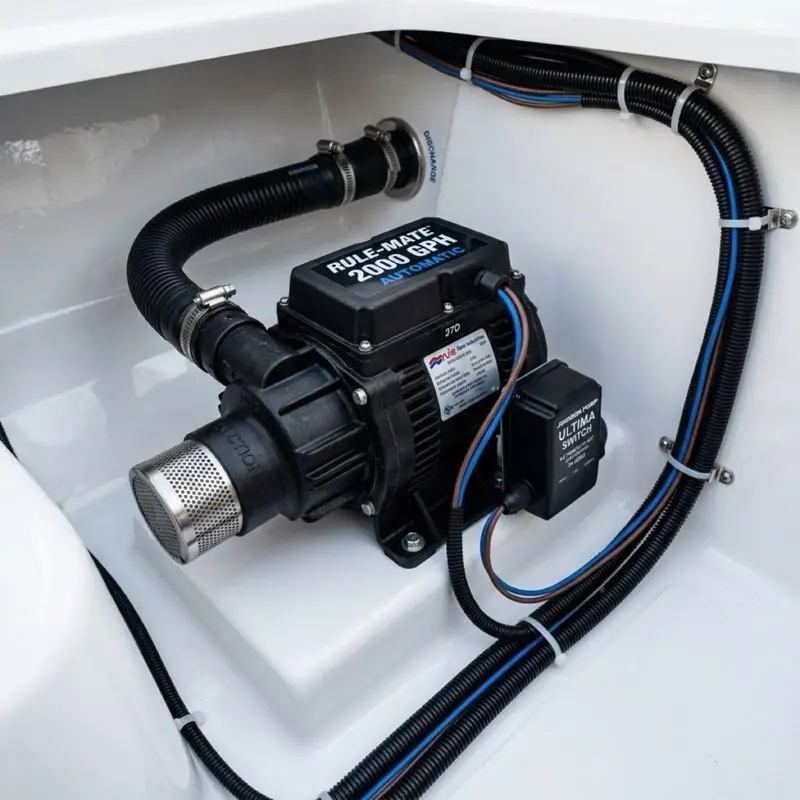
If you see oil discharging from the through-hull fitting on the side of the boat, your bilge is contaminated. Your automatic bilge pump is simply doing its job, taking the oily water from your floorboards and shooting it into the marina.
- The Diagnostic: Open your engine hatch. If the water in the bilge has an oily sheen, you have an internal leak.
- Common Culprits: A loose oil filter, a leaking oil pan gasket (inboards), or a tipped-over jug of spare oil rolling around in the storage locker.
Technical Deep Dive: The "Sheen Test" (Gas vs. Oil)
To properly diagnose the leak, you need to understand how different petroleum products interact with water.
1. Gasoline (High Volatility)
Gasoline has high "Hydrogen Bonding" disruption but evaporates quickly. If you have a fuel leak, the rainbow will be vibrant but will "flash" and disappear if you blow on it or wait 60 seconds.
2. Lubricating Oil (Low Volatility)
Engine and gear oil are heavy. They create "Globules" that will stay in the water for days. If you touch the slick and it feels slippery on your fingers, it is a lubricant, not fuel.
3. Emulsification (The Milky Sign)
When oil and water are churned together by gears, they create an "emulsion", a stable mixture that looks like a milkshake. If you see white or milky oil, it means the oil has been inside a moving gearcase (lower unit or transmission) and is now leaking out.
Frequently Asked Questions
Is it legal to use Dawn dish soap to clear an oil slick?
No. It is a violation of the Clean Water Act (33 CFR 110.4). Soap just emulsifies the oil and makes it sink, causing more environmental damage to the seabed. Use absorbent pads that only soak up oil and leave the water.
How do I find a microscopic lower unit leak?
A mechanic will perform a Pressure and Vacuum Test. They pump 15 PSI of air into the gearcase and watch the gauge. If it drops, they spray soapy water on the seals to find the bubbles. Then they apply a vacuum to ensure the seals can keep water out as well.
Can I drive the boat if I see gear oil?
No. If oil is coming out, water is going in. Within minutes, the water will boil inside the gearcase, causing a catastrophic "grenade" failure of the gears. Tow the boat or put it on the trailer immediately.
Does a 4-stroke engine ever have 'normal' oil sheen?
Never. 4-stroke outboards do not burn oil as part of their combustion cycle. Any oil from a 4-stroke is a sign of a mechanical failure, a leak in the bilge, or a spilled container.