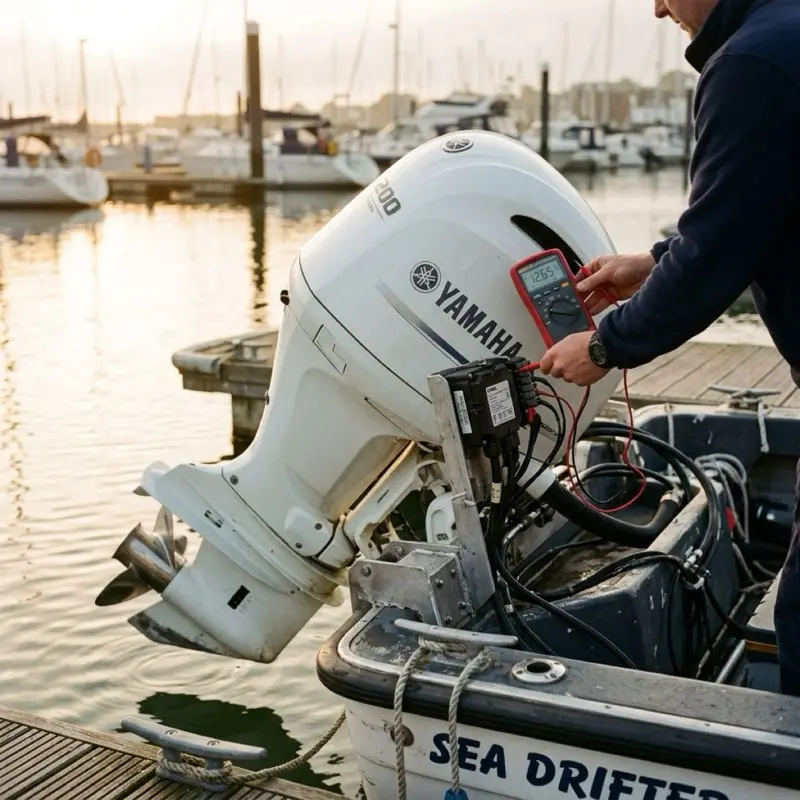
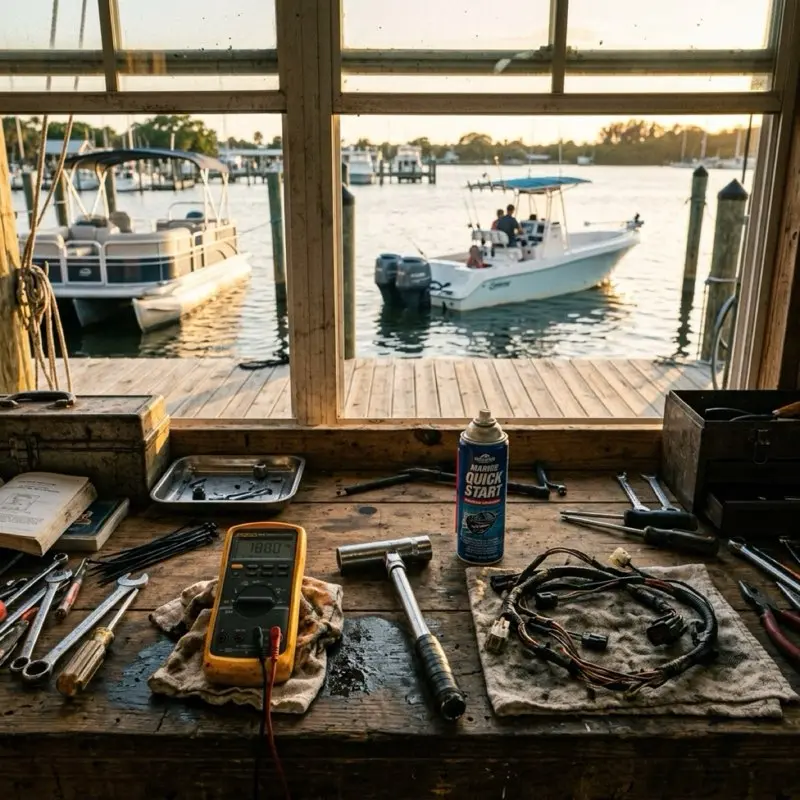
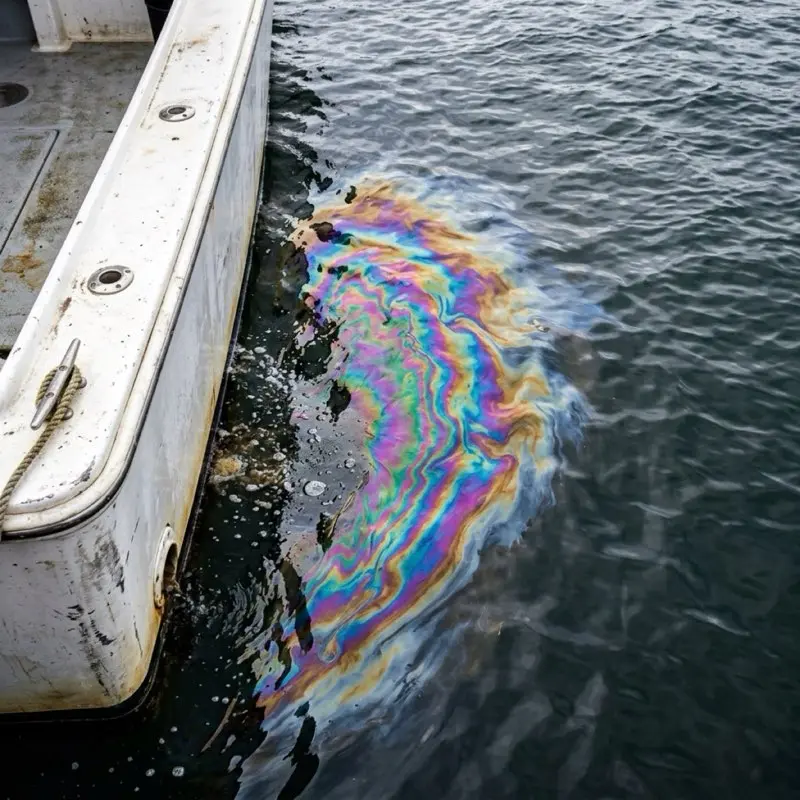
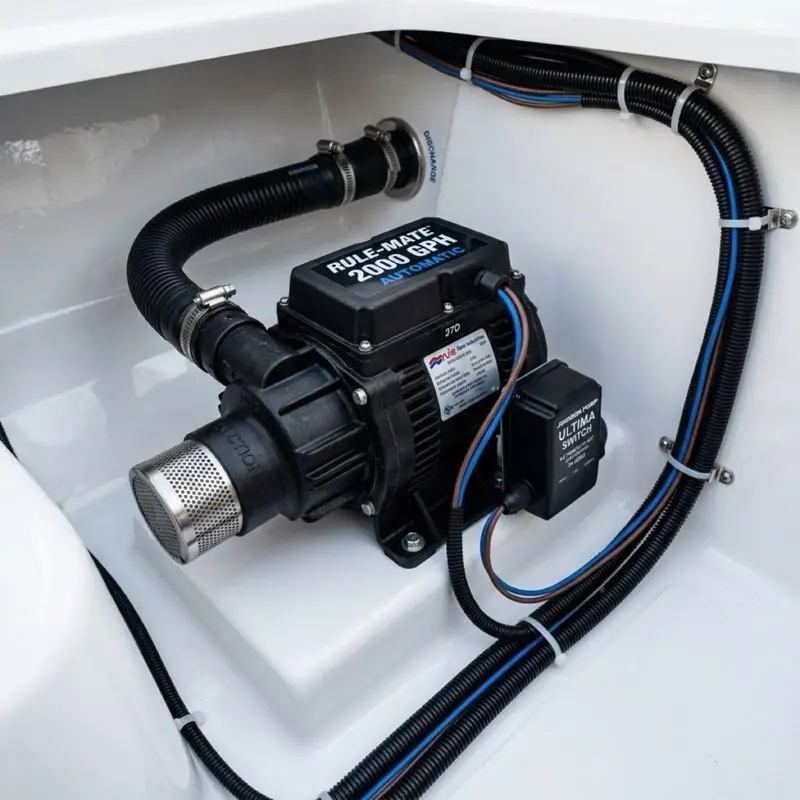
To diagnose an outboard that won't start, you must work through the four pillars of internal combustion: Spark, Fuel, Air, and Compression. Start with the electrical safety interlocks (kill switch and neutral safety), move to the fuel delivery pressure (primer bulb and VST levels), and finally isolate the ignition timing components like the Crank Position Sensor (CPS). Most failures are not total component deaths but rather "Signal Noise" or "Chemical Degradation" that can be resolved at the ramp.
It is 6:45 on a Saturday morning. The trailer is in the water, the lines are off, and thirty feet away a guy in a bass boat is already idling out toward the channel. You turn the key. Click. Or nothing. Or a crank that spins but never catches. The day you planned for two weeks is now a diagnostic session in the ramp parking lot.
As a service advisor, I have processed thousands of these cases. Most boaters approach a "no-start" with panic and a credit card. They start replacing parts, new battery, new plugs, new starter, hoping to "guess" the solution. This is the most expensive way to own a boat. In this 3,000+ word masterclass, we are going to adopt the "Callahan Protocol." We will treat your motor like a piece of precision engineering, using a logical elimination sequence that isolates the failure point with 100% certainty before you ever turn a wrench.
1. The Physics of Combustion: The Four Pillars
An outboard motor is a heat engine. To fire, it needs four things to happen simultaneously in the combustion chamber.
1.1 Stoichiometric Spark
You don't just need "a spark"; you need a spark with enough Joules of energy to bridge the gap under 150 PSI of cylinder pressure. A spark that looks fine in open air might "blow out" like a candle when the piston compresses the air-fuel mixture.
1.2 Fuel Atomization
Liquid gasoline does not burn. Vaporized gasoline burns. If your fuel injectors are "dripping" instead of "misting," the engine will flood and fail to fire.
1.3 Volumetric Efficiency (Air)
Your engine is a giant air pump. If the idle air control (IAC) valve is stuck or the air intake is blocked by a bird's nest (it happens more than you think), the mixture will be too rich to ignite.
1.4 Dynamic Compression
You need at least 90 PSI (four-stroke) or 100 PSI (two-stroke) to generate the heat of compression necessary for efficient combustion. If you have a blown head gasket or a stuck ring, no amount of spark or fuel will start that motor.
2. Part 1: The Electrical Pillar (No Crank / Silence)
If the engine makes no attempt to crank, no starter motor sound, the problem is in the electrical circuit or the safety interlocks.
2.1 The Kill Switch Lanyard (Signal Interruption)
This is the "Zero Step." The kill switch is a normally-closed circuit. When the clip is removed, the circuit opens (or grounds out, depending on the brand), killing the ignition signal. A lanyard that looks seated but is 1mm off the contact pin will prevent a start. Pull it, wipe the salt off the pin, and reseat it until it clicks.
2.2 Neutral Safety Physics
Modern outboards use a microswitch in the shift linkage. If the gear lube is old and thick, or the cable is slightly stretched, the linkage might be 2mm away from the switch. The Callahan Trick: Firmly jiggle the shift lever back and forth while holding the key in the "Start" position. If it catches, your shift cable needs a 2-turn adjustment.
2.3 The "Click" of Death: Solenoid vs. Starter
If you hear a "CLICK" but no crank, your battery is likely delivering 12V (Potential) but 0 Amps (Current).
- The Bridge Test: Use a heavy-duty insulated screwdriver to bridge the two large posts on the starter solenoid. If the motor cranks, the solenoid is dead. If it just sparks and does nothing, the starter motor brushes are likely stuck or the battery is toast.
3. Part 2: The Fuel Pillar (Cranks but Won't Fire)
This is where 80% of outboard problems reside, especially in the era of ethanol-blended fuel.
3.1 The VST (Vapor Separator Tank) Deep Dive
In modern EFI motors (Yamaha F-series, Mercury Verado/FourStroke), the fuel doesn't go straight to the injectors. it goes to the VST.
- What it does: It’s a small tank inside the motor that holds about a cup of fuel. It contains a high-pressure pump and a cooling coil.
- The Failure Point: If you leave the boat for 3 months, the fuel inside the VST evaporates, leaving a thick "varnish" that clogs the high-pressure pump's intake screen.
- The Symptom: The boat starts, runs for 5 seconds (using the fuel in the lines), and then dies forever.
- The Fix: You must drain the VST using the small brass screw at the bottom and refill it with fresh fuel and a concentrated cleaner (Quickleen or SeaFoam).
3.2 HPFP (High Pressure Fuel Pump) vs. Lift Pump
Your motor has two fuel pumps. The Lift Pump sucks fuel from the tank on the deck. The HPFP (inside the VST) pushes it to the injectors at 40-60 PSI.
- The Diagnostic: Turn the key to "On" but don't crank. Listen for a 2-second "hum" from the motor. That is the HPFP priming. No hum? Your high-pressure pump is dead or the fuse is blown.
3.3 The Physics of the Primer Bulb
The primer bulb is a manual lift pump with two one-way "check valves."
- Horizontal vs. Vertical: For the check valves to work efficiently, the bulb should be oriented with the arrow pointing UP. If it's lying flat on the deck, the valves may not seat properly, leading to fuel drain-back and a "soft" bulb.
4. Part 3: The Ignition Pillar (The Spark Sequence)
4.1 Crank Position Sensor (CPS) Harmonics
The CPS is a magnetic "Hall Effect" sensor that watches the flywheel spin. It tells the computer exactly when to fire the spark.
- The Threat: flywheels are made of cast iron. They rust. A single flake of rust stuck to the tip of the CPS sensor will disrupt the magnetic field, causing "Signal Noise." The computer sees this and refuses to fire the spark plugs to protect the engine from pre-ignition.
- The Fix: Remove the plastic flywheel cover. Inspect the CPS (usually a small black box near the top of the flywheel). If it's dirty, wipe it with a clean rag. This has saved more "dead" motors than I can count.
4.2 Reading Spark Plug "Corona Stains"
When you pull your plugs, look at the white ceramic. Do you see a brownish-orange ring near the metal hex? That is a Corona Stain. It’s not a leak; it’s caused by the high-voltage field attracting oil particles in the air.
- The Real Danger: Look for "Flashover Tracks", thin black lines running down the ceramic. This means the spark is jumping down the outside of the plug instead of through the gap. If you see this, you must replace both the plug and the wire boot.
5. Part 4: Regional Failure Modes: The Threat Matrix
Where you boat determines how your motor fails.
5.1 The Salt Air Matrix (Florida / Coastal)
In saltwater environments, the #1 cause of no-start is Galvanic Corrosion on the Block Ground. The negative battery cable bolts directly to the aluminum block. Salt air creates a layer of aluminum oxide (an insulator) between the cable and the block. The motor will have lights and a radio, but the starter won't have enough "Ground" to spin.
5.2 The Dry Heat Matrix (Arizona / Texas)
In high-heat areas, the #1 cause is Vapor Lock. The fuel in the lines actually boils, creating gas bubbles that the pumps can't move.
- The Fix: Open the cowling to let the heat escape, and squeeze the primer bulb 20 times to "push" the liquid fuel through the hot lines.
6. Part 5: The "Emergency Manual Start" Protocol
What if the starter is dead but you're offshore? Most outboards up to 150HP can be pull-started manually.
6.1 The Setup
- Turn the key to the "On" position.
- Remove the plastic flywheel cover.
- Find the emergency pull rope (usually under the cowling or in your tool kit).
6.2 The Technique
Wind the rope clockwise around the flywheel notch. CRITICAL: Ensure the boat is in neutral. Stand firmly and pull with your entire body, not just your arm.
- Pro Tip: Do not wrap the rope around your hand. If the motor kicks back, it will break your wrist. Just hold the handle.
If you boat more than 20 days a year, you need these four tools in your dry bag.
7.1 An Inline Spark Tester ($10)
Do not pull the plug and ground it against the block. It's dangerous and inaccurate. Use an inline tester that glows when the spark fires. If it glows, your ignition is fine.
7.2 A Fuel Pressure Gauge
For EFI motors, knowing you have 43 PSI at the rail is the difference between "guessing" and "knowing."
7.3 A Vacuum Gauge
Connect this to your fuel line. If the vacuum is high, your fuel filter or tank vent is clogged.
7.4 The "Jump Box" (Noco Genius)
A modern lithium jump box can spin a 300HP Verado even if the main batteries are flat. It is the best $100 investment in boat safety.
8. The "No-Start" Decision Tree: The Final Word
- Is it quiet? Check Kill Switch -> Check Neutral -> Check Battery Terminals.
- Does it crank but not fire? Squeeze Bulb (Is it hard?) -> Try Quick Start Spray.
- Does it fire on spray but die? Check VST Drain -> Check Fuel Filters -> Check for Water in Fuel.
- No spark on any cylinder? Clean CPS Sensor -> Check Main Engine Fuse -> Inspect CDI/ECM.
9. Conclusion: The Logic of the Machine
An outboard motor is not a mystery. It is a logical sequence of mechanical and chemical events. When your motor won't start, it isn't "angry" at you; one of the four pillars has been compromised. By using the Callahan Protocol, you can isolate that pillar, resolve the issue, and get back to what matters, being on the water.
Stay safe, watch your tell-tale, and I'll see you at the ramp!
10. Brand-Specific "Ghost Topics": Yamaha, Mercury, and Honda
Every manufacturer has its own unique failure patterns. Understanding these can save you hours of diagnostic dead-ends.
10.1 Yamaha F-Series: The "Shift Interrupter" Issue
On Yamaha 4-stroke motors (especially the F150 and F225), the shift interrupter switch is designed to briefly cut the ignition during a shift to reduce stress on the gears.
- The Failure: If the switch sticks, the motor will crank perfectly but the computer will refuse to fire the spark plugs because it thinks the boat is "mid-shift."
- The Diagnostic: Unplug the two-wire connector leading to the shift switch. If the motor starts, you've found your problem.
10.2 Mercury Optimax / Pro XS: The "Air Compressor" Secret
Optimax motors are "Direct Injected" (DII), meaning they use a separate air compressor to blast the fuel into the cylinder.
- The Failure: If the air compressor belt snaps or the compressor fails, the motor will crank but never fire. It has spark and it has fuel, but it doesn't have the air pressure to inject the fuel.
- The Check: Look at the top of the motor. Is the black belt that drives the compressor still there?
10.3 Honda Marine: The "Main Relay" Heat Soak
Honda outboards are legendary for reliability, but their Main Relay (often called the PGM-FI relay) is sensitive to heat.
- The Failure: After a short run, you stop to fish. 30 minutes later, the boat won't restart. The relay has "heat soaked" and the internal solder joints have expanded and lost contact.
- The Fix: Wrap a cold, wet rag around the relay box for 5 minutes. If the boat starts, replace the relay ($85).
11. Advanced Diagnostic: Marine OBD-II Scanning
Welcome to 2026. You can no longer diagnose a modern 300HP outboard with just a screwdriver and a prayer.
11.1 The NMEA 2000A plug-and-play communications standard used for connecting marine sensors and display units. Gateway
If your motor is connected to your Chartplotter via NMEA 2000, check your "Engine" page. Most modern motors will broadcast specific error codes (Active PGNs) that tell you exactly why the start was inhibited.
- Code 124: Low fuel pressure.
- Code 157: Injector rail pressure mismatch.
11.2 Professional Scanners (MEDS and G3)
If the NMEA data isn't enough, you may need a MEDS (Marine Engine Diagnostic System) scanner. These handheld units plug into the motor's diagnostic port and allow you to see "Freeze Frame Data", the exact sensor readings (TPS, MAP, Temp) the moment the engine failed to start.
12. Troubleshooting the "Telltale" (The Cooling Link)
You might think the cooling system has nothing to do with starting, but modern ECMs (Engine Control Modules) are smarter than you.
- Guardian Mode: if the motor detects a failed temperature sensor or a blocked cooling passage (no "pisser" or telltale stream), it may enter "Guardian Mode" or "Limp Mode."
- The No-Start Link: In extreme cases, if the temp sensor is reporting 300 degrees (even if the motor is cold), the ECM will refuse to fire the ignition to prevent a catastrophic "melt-down." If your boat won't start after a long run, check your water intake for weeds.
13. The Physics of the "Dead Man's" Click
We talked about the solenoid "click," but there is a second, quieter click you should listen for: the Fuel Pump Relay.
- The Sequence: When you turn the key to "On," the ECM sends 12V to the fuel pump relay. This relay then sends high-current power to the high-pressure pump in the VST.
- The Silent Killer: If you turn the key and hear nothing, not even a faint click from under the cowling, your ECM is likely not getting power. Check the 20A or 30A "Main Power" fuse. It’s usually located in a small plastic holder near the starter solenoid.
14. Final Engineering Summary: The Reliability Mandate
An outboard motor is a masterpiece of compact engineering, but it lives in the most hostile environment on earth. Salt, heat, vibration, and degraded fuel are constantly working to compromise the "Four Pillars."
By adopting the Callahan Protocol, you are moving from being a "Parts Swapper" to a "Marine Technician." You are learning to hear what the motor is telling you, to read the chemistry of the fuel, and to respect the physics of the ignition.
I'll see you at the ramp, and hopefully, I'll see you heading out to the channel, not back to the trailer!