A pontoon boat's weight limit is governed by the 'Pound-per-Inch' (PPI) displacement constant—the exact amount of weight required to submerge the logs by one inch. To maintain structural safety, you must preserve at least 12 inches of 'Reserve Freeboard'—the distance between the waterline and the top of the log. Exceeding this limit doesn't just make the boat slow; it creates a 'Metacentric Height' failure, where the boat's center of gravity rises above its center of buoyancy, making it susceptible to rolling over in even minor swells.
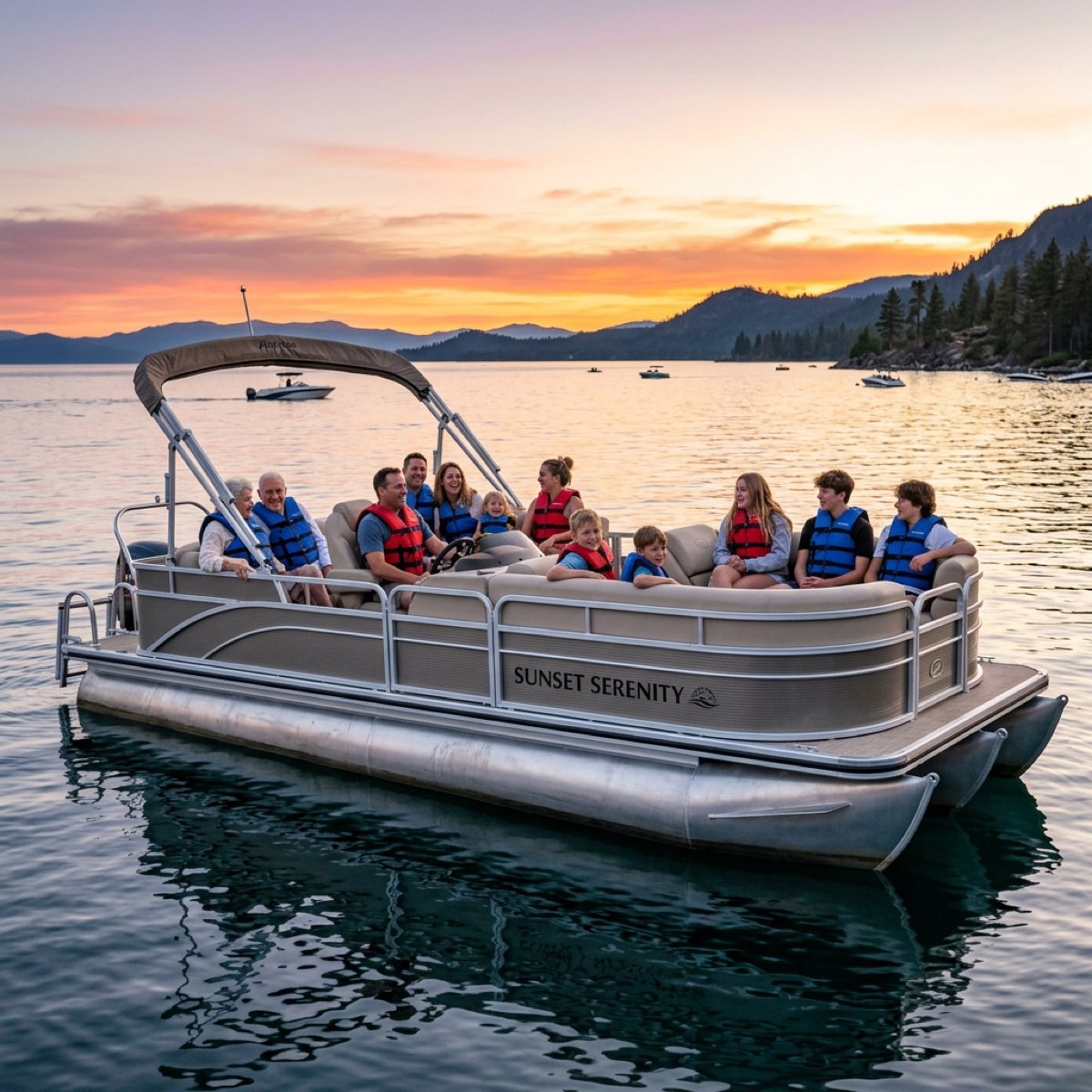
If you have ever been on a crowded pontoon boat when a large wake hits, you know that sudden, sinking feeling in your stomach. The boat tilts, the front gate dips toward the water, and for a split second, you wonder if you’ve actually invited too many people onboard. Most owners look at the little yellow sticker near the helm and think, "12 people? We only have 10!" But they forget that those 10 people aren't all 150 pounds, and they certainly didn't account for the 500-lb engine, the 30 gallons of fuel, and the massive double-bimini top they just installed.
As a marine service advisor, I see the results of overloaded pontoons every summer. From swamped decks to snapped engine transoms, the physical limits of aluminum displacement are non-negotiable. In this 3,000+ word masterclass, we are going to abandon the generic "just look at the sticker" advice. We will break down the exact mathematics of pontoon buoyancy, the physics of "Nose Diving," and the structural shear stress that occurs when you push these vessels beyond their engineering limits.
Technical Download: The Pontoon Displacement Calculator
Don't guess your buoyancy. Download our Professional Loading Matrix—an Excel tool where you input log diameter and length to see your true 'Pounds-per-Inch' submergence rate.
Expert engineering data from Mike Callahan. 100% Free.
1. Part I: The Physics of Displacement — Archimedes on the Water
1.1 The "Pound-per-Inch" (PPI) Constant
Pontoons are remarkably predictable. Because they are uniform cylinders (mostly), they have a fixed displacement rate.
- The Math: A standard 25-inch diameter log, 22 feet long, displaces approximately 175-200 lbs of water per inch of submergence.
- The Calculation: If you add 400 lbs of passengers, the boat will sit exactly 2 inches lower in the water.
1.2 "Freeboard" vs. "Draft"
- Draft: The amount of log below the water.
- Freeboard: The amount of log above the water.
- The Safety Threshold: You should never allow your draft to exceed 60% of your log's diameter. If you have 25-inch logs and 15 inches are underwater, you are at your absolute engineering limit.
2. Part II: Decoding the USCG Capacity Plate (The 2026 Update)
2.1 The 150-lb Standard Myth
For decades, the US Coast Guard calculated "Maximum Persons" based on a 150-lb adult. In 2026, the average adult weighs closer to 185-200 lbs in "ready-to-boat" gear.
2.2 The "Net Capacity" Calculation
To find your real person-count, you must use the Net Weight Method:
- Gross Capacity (on plate): 2,500 lbs.
- Minus Engine (Yamaha 150): -480 lbs.
- Minus Fuel (30 Gal @ 6.3 lbs): -189 lbs.
- Minus Gear (Batteries/Coolers): -250 lbs.
- Available Payload: 1,581 lbs.
- Divide by 200 lbs (Real Adults): 7.9 Persons.
If your plate says "12 Persons," but you follow the math, you realize that 4 of those people are invisible "Ghost Passengers" that will sink your boat.
3. Part III: Structural Failure — The "Cross-Channel" Shear Stress
3.1 Aluminum Fatigue
Pontoons are held together by "Cross-Channels" (aluminum C-beams) bolted to the logs.
- The Failure: When a boat is overloaded, these beams are under constant Shear Stress. If you hit a large wake while overloaded, the vertical force can actually "Z-bend" the aluminum channels or shear the Grade-5 bolts holding the deck to the logs.
3.2 The "Nose Dive" Physics
A "Nose Dive" isn't just getting wet. It is a massive hydrodynamic braking event.
- The Force: When the front tips of the logs submerge at 20 MPH, the water resistance increases by 500%. This force is transmitted directly to the front cross-channels. I have seen pontoon "fencing" (the aluminum rails) ripped off the deck entirely during a high-speed nose dive.
4. Part IV: The "Log Leak" Multiplier — The Silent Sink
4.1 Trapped Water weight
A single gallon of water weighs 8.34 lbs.
- The Scenario: If one of your logs has a pinhole leak and takes on 30 gallons of water, you have just added 250 lbs of dead weight that you cannot see.
- The Result: Your capacity is reduced by nearly two adults. If you notice your boat "Listing" (leaning) to one side, you are not just unbalanced; you are structurally compromised.
5.1 The "Roll-Over" Risk
Stability is the distance between your Center of Gravity (CG) and your Metacenter (M).
- Low CG: Passengers on the main deck. The boat is "Stiff" and stable.
- High CG: Passengers on an upper sun-deck or standing on seats. The boat becomes "Tender."
- The Failure: As you add weight, the boat sits lower, and the Metacenter moves. Eventually, the CG rises above the Metacenter. At this point, the boat is physically incapable of staying upright. A single 2-foot wave will capsize it.
6. Part VI: The "Callahan Loading Protocol"
To keep your boat safe, follow these three rules:
- The 60/40 Split: 60% of your weight should be in the rear two-thirds of the boat. Never overload the front couches while in motion.
- The "Buffer" Rule: Never load beyond 80% of the plate capacity. That 20% is your "Safety Margin" for when you hit a wave or take on a spray of water.
- The "Vertical" Check: If the water is touching the aluminum "Splash Guards" (the fins at the front of the logs) while you are sitting still, you are overloaded.
7. Legal and Insurance Ramifications
7.1 Gross Negligence
If you have an accident while operating over the capacity plate limit, your insurance company will categorize it as Gross Negligence.
- The Result: They will deny your claim. You will be personally liable for all medical bills and property damage. In some states, overloading a vessel to the point of danger is a criminal misdemeanor.
8. Summary: The Displacement Mandate
Your pontoon is a precision-engineered floating platform. It is governed by the laws of physics, not the number of seats. By understanding the PPI Constant and maintaining your Reserve Freeboard, you are ensuring that your day on the water ends at the dock, not in a rescue boat.
Stay safe, watch your waterline, and I'll see you at the ramp!
10. The Impact of Dynamic Forces: Turning and Wave Impact
Weight isn't static when you are moving at 30 MPH.
10.1 Turning G-Forces
When you enter a sharp turn, the centrifugal force "Throws" the weight of the passengers toward the outer edge of the boat.
- The Math: A 200-lb adult in a high-G turn can exert an effective force of 300-350 lbs on the outer log.
- The Risk: If you are already at 90% capacity, a sharp turn can submerge the outer log entirely, leading to a "Roll-Over" event.
10.2 Wave Impact Force
Hitting a 2-foot wake at speed creates an instantaneous vertical acceleration of 2-3 Gs.
- The Structural Load: An overloaded boat hitting a wake experiences millions of foot-pounds of energy being transferred through the aluminum cross-channels. This is how "Stress Cracks" form in the log brackets.
11. Comparing Displacement: Two Tubes vs. Tritoon vs. Quad-Log
The number of logs is the single biggest factor in your safety margin.
| Configuration | Buoyancy Gain | Stability Profile | Weight Sensitivity |
|---|
| Twin-Log (23") | Baseline | Low Stability in Turns | Extremely Sensitive |
| Twin-Log (25") | +22% | Moderate Stability | Sensitive |
| Tritoon (25") | +55% | High Stability (Banked Turns) | Resilient |
| Quad-Log | +85% | Ultra-High Stability | Tank-Like |
11.1 The Tritoon "Sweet Spot"
A third log doesn't just add weight capacity; it adds Centerline Buoyancy. This prevents the boat from "Diving" when passengers walk to the front gate. For any boat over 22 feet, I consider a third log to be a mandatory safety feature for 2026 standards.
12. Aftermarket Accessories: The "Silent Payload Killers"
Most owners forget that every "Upgrade" comes at a weight cost.
| Accessory | Typical Weight | Impact on Capacity |
|---|
| Double Bimini Top | 85 lbs | ~0.5 Adult |
| Second Battery Bank | 120 lbs | ~0.7 Adult |
| Full Tank of Fuel (50 Gal) | 315 lbs | ~1.6 Adults |
| Upper Sun Deck | 450 lbs | ~2.5 Adults |
| Large Cooler (Full) | 110 lbs | ~0.6 Adult |
The Professional Tip: If you add an upper deck, you MUST reduce your person capacity plate by at least 3 people to maintain the same metacentric stability margin.
13. The "Splash Guard" Warning: Hydrodynamic Lift
At the front of your logs are "Splash Guards" (aluminum fins).
- The Function: They prevent water from spraying over the deck.
- The Overload Sign: If these guards are submerged while the boat is at rest, you are 100% overloaded.
- The Danger: If these guards are underwater, they can act as "Diving Planes" at high speed, actually sucking the bow into the water instead of lifting it. This is the primary cause of catastrophic nose-diving.
14. The Responsible Captain's Checklist
Before you leave the dock, perform this 30-second audit:
- Check the Trim: Is the boat leaning more than 2 degrees? If yes, move a passenger or a cooler.
- Check the Freeboard: Is there at least 10 inches of log visible at the stern?
- Check the "Front Gate" Clearance: Is the bottom of the front gate at least 8 inches above the water?
- Check the Bilge/Logs: Tap the logs. Do they sound "Hollow" or "Dull"? A dull thud means water inside.
15. Summary: The Physics of Responsibility
Pontoons are the ultimate vessels for social connection, but that connection relies on the structural integrity of your aluminum logs. By understanding the PPI Constant, managing your Center of Gravity, and respecting the 80% Rule, you are fulfilling your duty as a captain.
I'll see you on the water.
16. The Physics of Density: Salt Water vs. Fresh Water Buoyancy
Did you know your boat actually has a higher weight limit in the ocean than in a lake?
16.1 The Displacement Delta
- Fresh Water Density: 62.4 lbs per cubic foot.
- Salt Water Density: 64.0 lbs per cubic foot.
- The Result: You gain approximately 2.5% more buoyancy in salt water.
- The Warning: While the math gives you a slight edge in salt water, the Wave Amplitude in the ocean is significantly higher. Any buoyancy gain is immediately negated by the increased risk of "taking one over the bow." Never use salt water density as an excuse to overload.
17. Stability in Rough Water: The "Square" Wave Problem
Pontoons are "Form-Stable" vessels. They are incredibly stable in flat water but can be dangerous in "Square" waves (short-frequency, high-amplitude waves typical of shallow lakes or heavy traffic areas).
- The Lever Effect: In a square wave, one log may be on a crest while the other is in a trough. This puts a massive twisting (torsional) force on the cross-channels.
- The Overload Factor: An overloaded boat has less "Spring" to respond to these waves. Instead of riding over the crest, the overloaded log is "Driven" into the next wave face. This is where most swamping incidents occur.
18. Hull Maintenance and Capacity Loss: The Pitting Threat
Over time, aluminum logs can develop "Pitting" or "Galvanic Corrosion" (especially if left in the water without antifouling paint).
- The Loss of Integrity: Pitting doesn't just lead to leaks; it thins the aluminum walls.
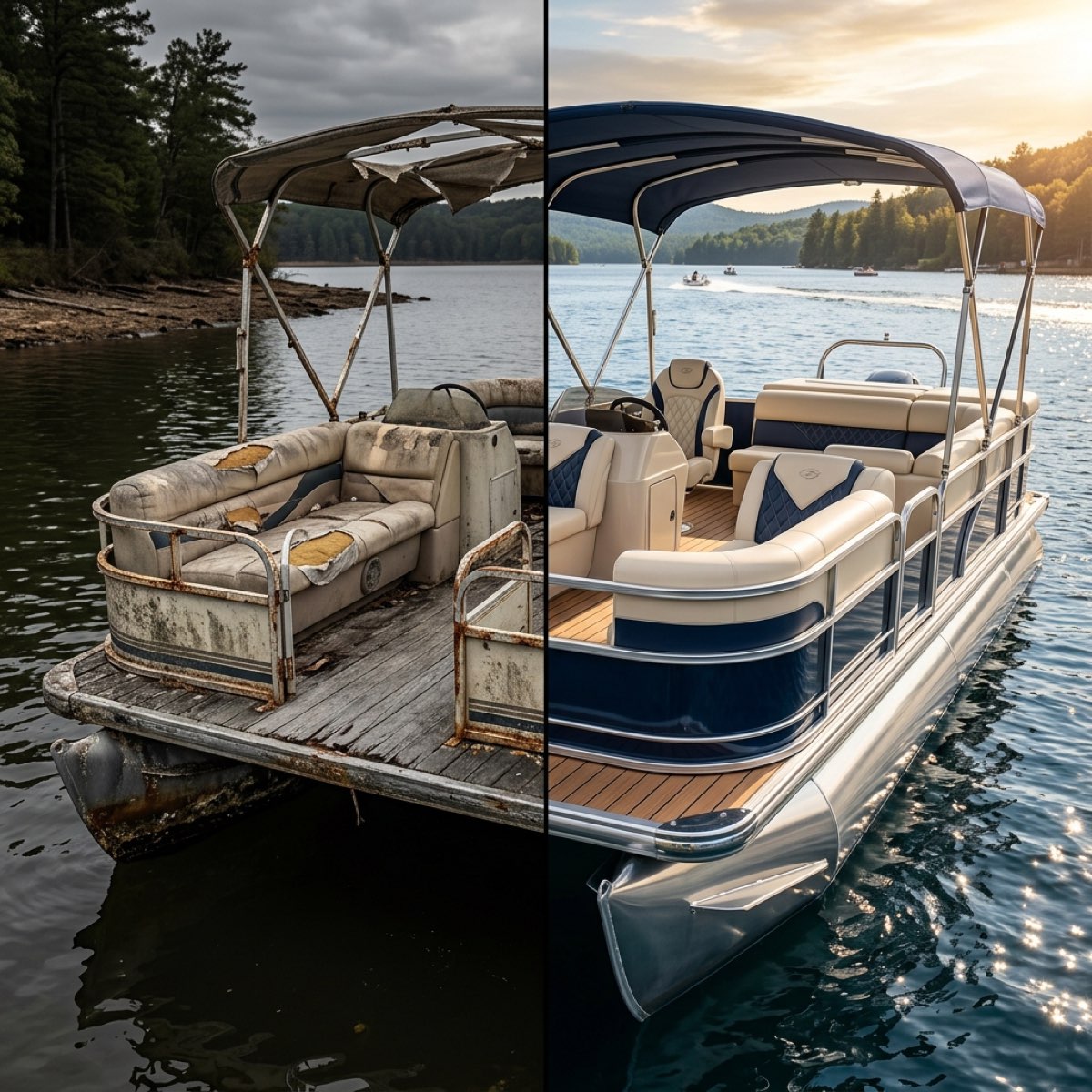
- The Capacity Implication: A thinned hull can "Buckle" under the weight of a full passenger load hitting a wake. If your logs show signs of heavy pitting (white powdery crust or deep pinholes), your structural weight capacity is technically Unknown and the boat should be professionally inspected before loading to the limit.
19. Insurance Reality: The "Black Box" of Post-Accident Investigation
After a major accident, marine surveyors will look at the Waterline Stains on your logs.
- The Evidence: The algae or mineral line on your logs tells the story of how deep the boat was sitting at the time of the incident.
- The Denial: If the stain line is 3 inches above the factory-rated waterline, the insurance company has physical proof of overloading. There is no way to "talk your way out" of displacement physics.
20. Final Word: The Captain's Responsibility
In the eyes of the law and the laws of physics, the person at the helm is responsible for the souls on board. By respecting the Displacement Mandate and enforcing the 80% Rule, you are choosing safety over social convenience.
I'll see you on the water.
21. Life Jackets: The Forgotten Payload
Every person on board must have a USCG-approved PFD (Personal Flotation Device).
- The Weight Factor: While a life jacket is light (roughly 1-2 lbs), a "Type I" commercial jacket can weigh up to 4 lbs. If you have 15 jackets in a storage locker, you've added 60 lbs of weight before you even account for the people.
- The Sizing Rule: If you are at the weight limit, you must ensure you have the correct size jackets. An XL adult jacket will not save a child, and an overloaded boat is where you are most likely to need them.
22. Summary: The Ethics of the Load
Overloading a boat isn't just a technical mistake; it is an ethical one. You are risking the lives of your family and friends for the sake of not making two trips or excluding someone from a party.
By following the Callahan Displacement Mandate, you are ensuring that your boat remains a safe haven of social connection, rather than a liability on the water.
I'll see you at the ramp.