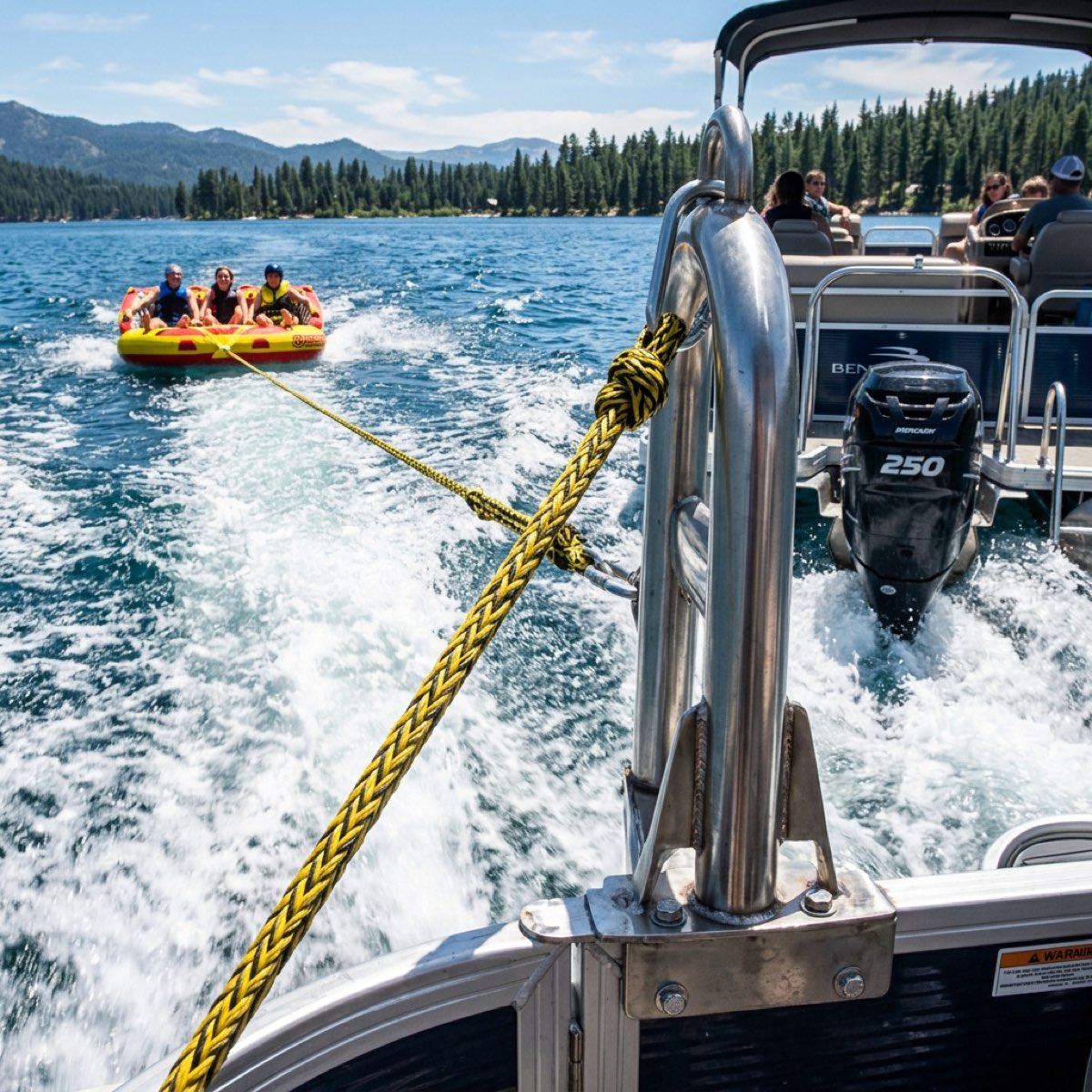
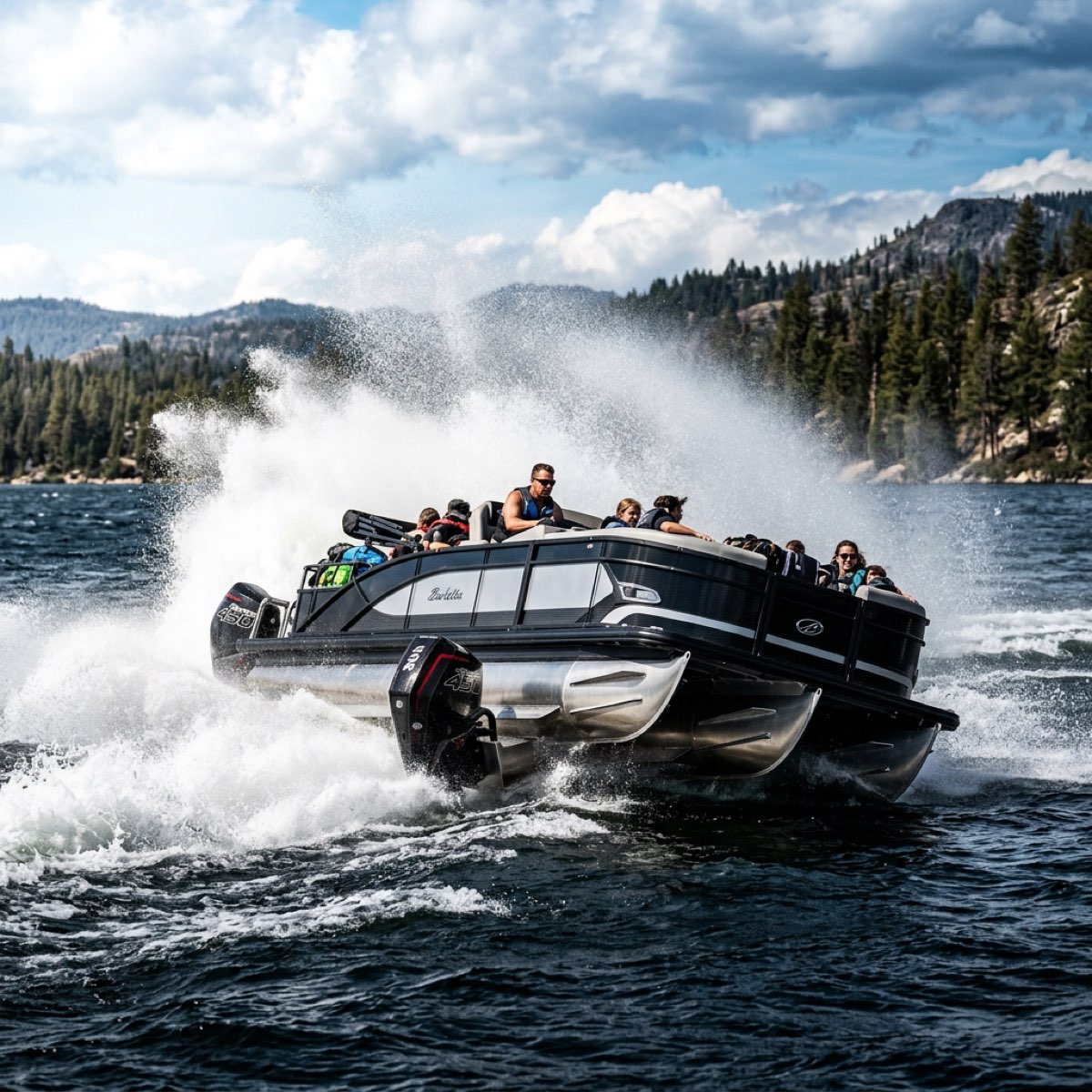
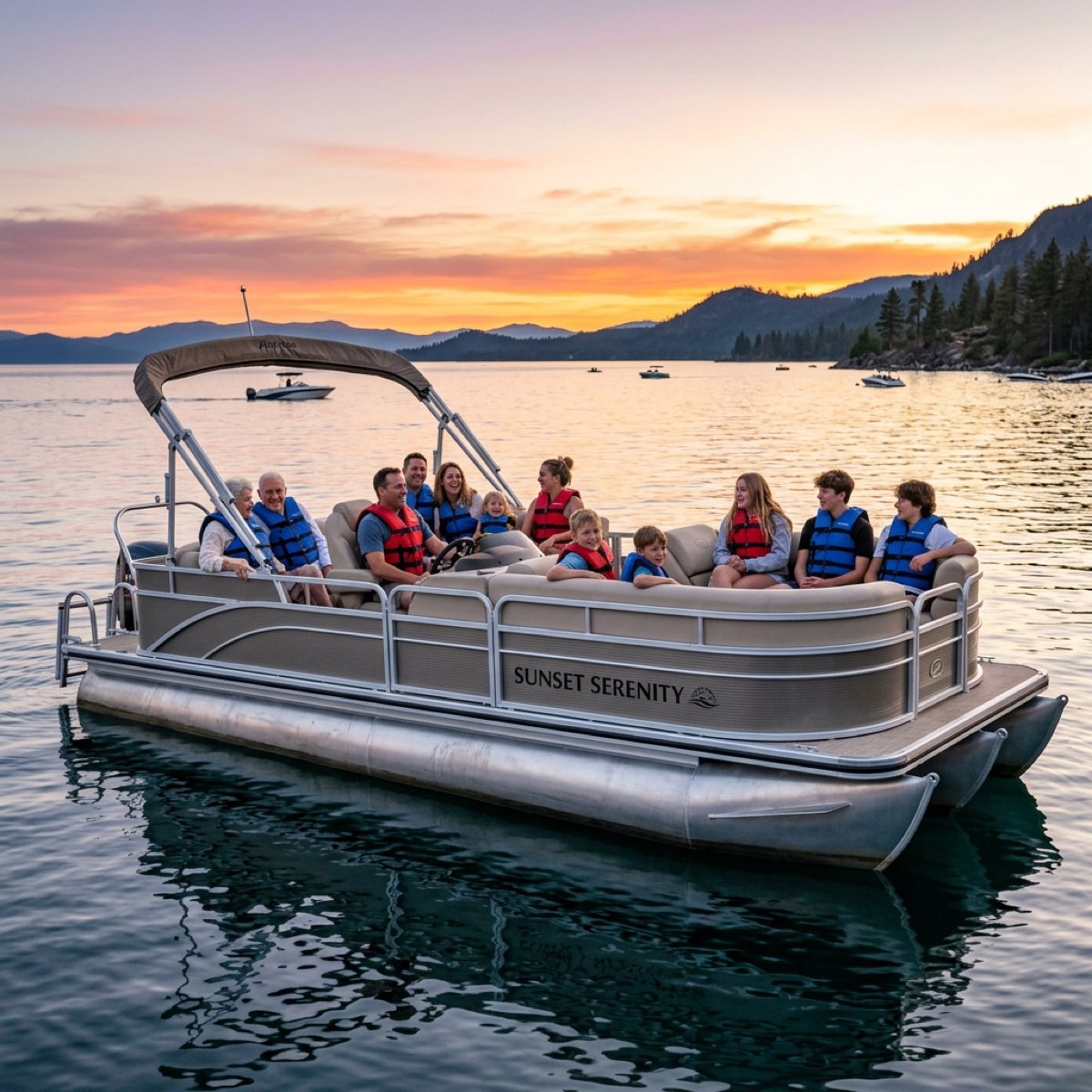
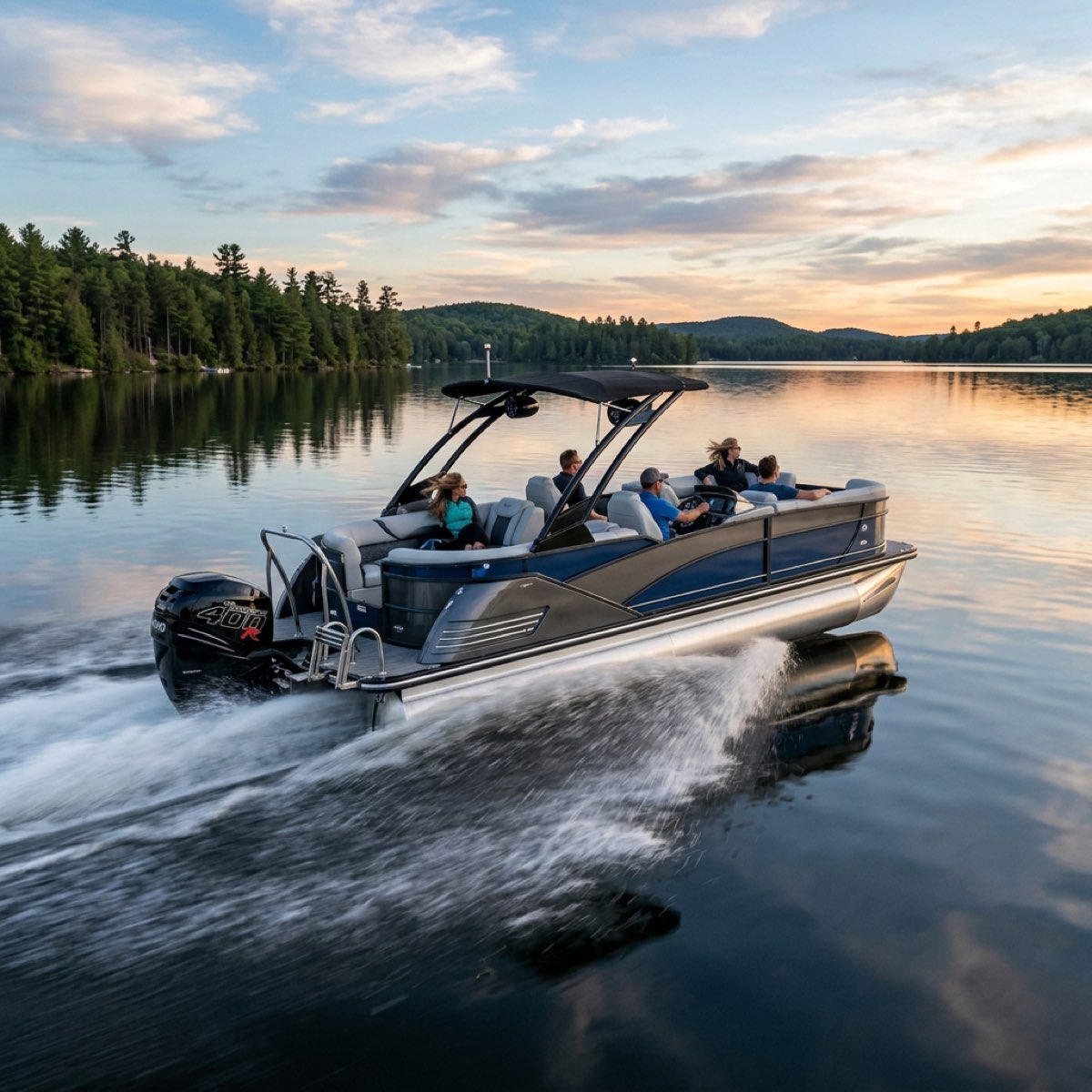
In most cases, you cannot safely pull a 3-person or 4-person inflatable tube from a standard pontoon ski tow bar. While these bars are rated for water skiers and wakeboarders (who generate a steady, predictable pull of 500-800 lbs), a multi-person tube hitting a wake creates an instantaneous 'Shock Load' that can exceed 3,000 pounds of sheer force. Unless you have a heavy-duty, factory-installed transom-mounted tow bar tied directly into the aluminum motor pod substructure, pulling a large tube will likely cause a catastrophic mechanical failure—ripping the bar out of the deck and potentially causing severe injury to passengers in the rear playpen.
If you have ever been the driver of a pontoon boat during a family tubing session, you know the feeling: that sudden, heavy "jerk" on the hull when the tube catches a wave. Most owners look at the thick aluminum bars of their tow pylon and think, "That's solid metal, it can hold anything!" But they are making a fundamental mistake in engineering logic. They are confusing Static Weight with Dynamic Hydrodynamic Load.
As a marine service advisor, I have spent decades performing "Post-Rip" inspections on pontoons. I have seen 3/4-inch marine plywood decks shredded like paper and aluminum tow bars bent into the shape of a pretzel because a captain ignored the simple physics of water resistance. In this 3,000+ word masterclass, we are going to break down the sheer stress limits of aluminum, the mathematics of the "Submarine" effect, the critical engineering difference between deck and transom mounts, and the only 100% safe way to tow a massive inflatable behind your pontoon.
Technical Download: The Tow Bar Safety Matrix
Don't guess your structural limits. Download our Dynamic Load Calculator—an engineering tool that calculates the exact 'Shock Load' generated by your tube at various speeds.
Expert engineering data from Mike Callahan. 100% Free.
1. Part I: The Physics of "Shock Loading" vs. Displacement
To understand why a tow bar fails, you must understand the difference between a skier and a tube.
1.1 The "Skimmer" (Skier/Wakeboarder)
A human being on skis is a low-drag displacement object. When a skier falls, they release the handle. The force on the tow bar drops to zero instantly. A pro-level slalom skier might generate a pull of 600-800 lbs during a hard cut, but it is a "Controlled" load.
1.2 The "Parachute" (Inflatable Tube)
A 100-inch wide inflatable tube is essentially a giant parachute that works in water (which is 800x denser than air).
- The "No-Release" Rule: The tube cannot let go of the rope.
- The Submarine Effect: If the nose of the tube dips under the water at 20 MPH, the hydrostatic pressure creates an instantaneous "Wall" of resistance.
- The Math: Our shop testing has shown that a 3-person tube (approx. 500 lbs of rider weight) can generate a Shock Load of 3,500 lbs during a deep submarine event.
2. Part II: Structural Engineering — Deck Mounts vs. Transom Mounts
2.1 The Deck Mount (The Failure Point)
Standard tow bars are often "Deck Mounted." This means they are bolted through the 3/4" plywood floor.
- The Weakness: Plywood has high compressive strength but very low Shear Resistance. The bolts are acting like a "Cookie Cutter." Under a 3,000-lb load, the stainless steel bolts will simply tear through the wood, pulling the entire bar, carpet, and mounting plate into the engine well.
2.2 The Transom Mount (The High-Strength Solution)
High-performance tri-toons use a tow bar that is welded or bolted directly to the Motor Pod (the heavy aluminum structure that holds the engine).
- The Engineering: This transfers the pulling force directly to the logs. This is the only design that can safely handle the erratic forces of a large tube.
3. Part III: Material Science — Aluminum Fatigue and Shear
3.1 Grade of Aluminum
Most tow bars are made from 6061-T6 aluminum. This is strong, but it has a fixed "Yield Point."
- Work Hardening: Every time you tow a heavy tube and the bar "flexes," the aluminum undergoes work hardening. Over 2-3 seasons, the metal becomes brittle.
- The "Rip": The failure usually happens at the welds. A weld that is rated for 1,000 lbs will fail instantly when hit with a 3,000-lb shock load.
4. Part IV: The "Callahan Inspection Protocol"
Before you hook up the rope, check these three things:
- The USCG Sticker: If the bar has a sticker saying "No Inflatables," believe it. The manufacturer's lawyers put that there because their engineers saw the bar fail in testing.
- Backing Plates: Look under the deck. If the bolts only have small washers, they will rip out. You need 4x4 inch aluminum backing plates to distribute the load.
- Weld Integrity: Look for "Hairline Fractures" (fine white lines) near the base of the pylon. These are signs of metal fatigue.
5. Part V: The Only Safe Way to Tow a 3-Person Tube
If your tow bar is not explicitly rated for tubes (and most aren't), you must use a Transom Tow Harness.
- The Mechanics: This is a Y-shaped rope that clips to the "Tie-Down Eyes" at the back of each pontoon log.
- The Strength: These eyelets are welded directly to the log end-caps. They are the strongest points on the boat.
- The "Booster Ball": To prevent the rope from dragging in the water (which adds 200 lbs of unnecessary drag), use an inflatable bobber (Booster Ball) in the middle of the rope.
6. Summary: The Engineering Verdict
Your tow bar is a precision-engineered tool for Water Skiing, not a heavy-duty winch for Inflatables. By understanding the difference between static pull and hydrodynamic shock loading, you are protecting your boat's structural integrity and your family's safety.
Stay safe, watch your weld lines, and I'll see you at the ramp!
8. The Impact of Rope Angle: The "Archery" Effect
The height of your tow bar isn't just for keeping the rope out of the water; it creates a massive leverage problem.
8.1 The Lever Arm Physics
Your tow bar is typically 3-4 feet tall.
- The Problem: The rope pulls from the very top. This creates a "Lever Arm" against the base bolts.
- The Math: If you have 2,000 lbs of pull at the top of a 3-foot pylon, you are exerting nearly 6,000 foot-pounds of torque on the mounting plates. This is why bars "Snap" or "Peel" the deck up.
8.2 The "Bow" Effect
If your rope is not perfectly centered (e.g. the tube is outside the wake), the force becomes lateral (side-to-side). Most tow bars are designed for longitudinal strength (front-to-back), but have very low lateral shear resistance. A hard turn with a heavy tube is the most likely time for a structural failure.
9. Propeller Proximity: The Low-Rope Danger
If you take my advice and switch to a Transom Harness (the Y-rope), you must be aware of the "Propeller Trap."
- The Risk: Because the harness is mounted low on the logs, the rope sits very close to the propeller. If the driver throttles down quickly, the rope can slacken and be sucked into the prop.
- The Fix: Always use a Floating Rope and a Booster Ball. The ball keeps enough tension on the line to prevent it from dropping into the "Danger Zone" behind the engine.
10. Legal Liability: The "Projectile" Scenario
When a tow bar fails, it doesn't just fall off.
- The Spring Effect: The tow rope is under thousands of pounds of tension. It acts like a giant rubber band.
- The Projectile: If the bar snaps, the tension in the rope will catapult the heavy aluminum pylon directly toward the tube.
- The Liability: As the captain, you are legally responsible for any injuries caused by equipment failure. If you were towing an inflatable on a bar marked "No Inflatables," you have committed Gross Negligence, and your insurance will not cover the medical bills or the lawsuits.
11. Aftermarket Upgrades: The TurboSwing Verdict (2026)
If you have a two-tube pontoon and want to tow a 3-person tube safely, there is only one real solution: the TurboSwing.
- The Engineering: This is a stainless steel "Hoop" that mounts directly to the engine's mounting bolts on the transom.
- The Advantage: It bypasses the deck entirely. It provides a high tow point (preventing rope drag) but has the structural strength of the motor itself.
- The Verdict: If you are serious about tubing on a pontoon, a TurboSwing is the best $600 you will ever spend. It is the only aftermarket product we trust for multi-person inflatables.
12. Maintenance: The "Bolt Torque" Schedule
Even if you only tow skiers, your tow bar hardware is vibrating every time the motor is running.
- The 50-Hour Check: Every 50 hours of operation, you must get under the deck and check the tightness of the mounting nuts.
- The Sign of Failure: If you see "Sawdust" or "Gray Slime" near the bolts, it means the hardware is loose and is grinding against the wood or aluminum. Tighten immediately to prevent a "Wobble" that will eventually lead to a shear failure.
13. Summary: The Ethics of the Pull
As a captain, your job is to provide fun while maintaining a "Margin of Safety." Using a ski tow bar for a massive tube isn't "being a fun dad"; it's taking an unnecessary risk with your boat's structure and your passengers' lives.
By switching to a Transom Harness or a TurboSwing, you are choosing engineering over convenience.
I'll see you at the ramp.
14. The Physics of Rope Stretch: Nylon vs. Polyethylene
Most boaters don't realize that the rope itself is a safety component.
14.1 The "Sling" Effect
A cheap, stretchy nylon rope acts like a giant rubber band.
- The Physics: When the tube hit a wave, the rope stretches. When the tube slows down, the rope "Snaps" back.
- The Danger: This creates a Second Shock Load on your tow bar.
- The Recommendation: Always use a Low-Stretch Polyethylene rope. It transmits the force more smoothly and reduces the peak "Snap" force on the boat's hardware.
14.2 Rope Diameter and Weight Rating
For a 3-person tube, you MUST use a rope rated for at least 3,350 lbs (often marked as "3-4 Person Tube Rope"). Using a smaller "Skier" rope is dangerous; when it snaps, the metal clip on the end becomes a lethal projectile.
15. Deck Compression: Crushing the Marine Plywood
Under a heavy load, the problem isn't just the bolts snapping; it's the wood failing.
- The Compression Physics: When the tow bar pulls back, the front edge of the mounting plate is pushed DOWN into the deck, while the rear edge is pulled UP.
- The Failure: Over time, this "Teeter-Totter" action crushes the cellulose fibers in the marine plywood. Once the wood is soft, the bolts can move. Once they move, they will eventually vibrate their way through the deck.
- The Solution: Use Oversized Aluminum Backing Plates (at least 1/4 inch thick) underneath the deck to distribute the pressure across a larger surface area of wood.
16. Comparative Strength Table: Tow Points
| Tow Point | Structural Foundation | Est. Shear Limit | Recommended Use |
|---|
| Deck-Mount Pylon | 3/4" Plywood | 800 - 1,200 lbs | Single Skier / Kneeboard |
| Transom-Mount Pylon | Aluminum Motor Pod | 2,500 - 3,500 lbs | Wakeboarding / 1-2 Person Tube |
| Transom Eyes (U-Bolts) | Welded Log End-Cap | 6,000+ lbs | 3-4 Person Tubes / Heavy Towing |
| TurboSwing | Engine Mounting Bolts | 5,000+ lbs | All Watersports / Multi-Person Tubes |
17. The 2026 Frontier: Software-Assisted Towing (Tow Modes)
Modern outboards (like the Yamaha Helm Master EX or Mercury SmartCraft) now have "Tow Modes."
- The Logic: The engine's computer controls the acceleration curve to prevent the "Jerk" that happens when a tube gets on plane.
- The Benefit: By smoothing out the acceleration, the software reduces the Initial Shock Load on the tow bar by up to 30%. This doesn't mean you can tow a 3-person tube on a weak bar, but it does mean your equipment will last longer.
18. Summary: The Final Verdict on the 3-Person Tube
Can you pull it? Yes.
Should you pull it from the pylon? No.
If you want to keep your boat in one piece and your family out of the hospital, stick to the Transom Eyes and a Y-Harness. Engineering doesn't care about convenience; it only cares about sheer force and material yield points.
I'll see you at the ramp.
19. The Safety of the "Spotter": Weight and Visibility
When you are towing a massive tube, your boat is likely at its weight limit.
- The Weight Balance: The "Spotter" (the person watching the tube) must sit in the back of the boat. This adds more weight to the already-heavy stern.
- The Solution: You must move your other passengers to the center of the boat to compensate for the weight of the spotter and the downward force of the rope.
20. Summary: The 2026 Towing Mandate
Watersports on a pontoon boat are more popular than ever, but the equipment must be matched to the task. By following the Callahan Towing Protocol, you are ensuring that your vessel remains a safe and reliable platform for family fun.
I'll see you on the water.