You've had the boat for two seasons. It's always felt a little sluggish off the hole — takes forever to get on plane, and the engine sounds like it's working harder than it should. The dealer said everything looked fine when you bought it. So you upgraded the stereo, replaced the bimini, and started wondering if maybe you just need a bigger engine.
You don't. In most cases, you have the wrong propeller.
The propeller is the single most important performance variable on a pontoon boat. If your engine can't reach the manufacturer's WOT (Wide-Open Throttle) RPM range at full throttle — or if it blows past it — you are running the wrong pitch. A 3-inch pitch change costs $150–$400 and can recover 5–8 MPH of lost speed or completely transform your hole shot.
The good news: propeller selection is math, not magic. Once you understand two numbers — your current WOT RPM and your target WOT RPM — the calculation takes about 60 seconds. This guide walks you through it step by step.
Mike Callahan's Masterclass Note: "I've seen boaters spend $8,000 on a bigger engine when they needed a $200 prop change. The propeller is your boat's transmission. Running the wrong pitch is exactly like trying to merge onto the highway stuck in second gear — you'll eventually get there, but you're destroying something along the way."
| Quick Prop Diagnostic | What It Means | Fix |
|---|
| WOT RPM too low (engine lugging) | Pitch too high — over-propped | Drop 1–2 inches of pitch |
| WOT RPM too high (hitting rev limiter) | Pitch too low — under-propped | Add 1–2 inches of pitch |
| Boat planes slowly, poor hole shot | Over-propped OR 3-blade on heavy pontoon | Drop pitch or switch to 4-blade |
| Prop spins, boat barely moves | Spun hub — rubber sleeve failed | Replace hub kit, not the prop |
| High RPM but poor GPS speed | Excessive slip — wrong shape, not pitch | Upgrade diameter or cupping |
When Your Engine Won't Hit Its RPM Numbers
Let's say you're at WOT with a light load and your tach is reading 4,800 RPM. Your engine's spec calls for 5,000–6,000 RPM. You're 200–1,200 RPM short of where you should be.
Your propeller pitch is too high. The engine is working against a prop it can't turn fast enough — like trying to start a car in third gear. It gets there, but it's laboring the whole way: stressing pistons, overloading bearings, burning fuel it shouldn't need. Do this for long enough and you'll have real damage to show for it.
Decoding the Numbers Stamped on Your Hub
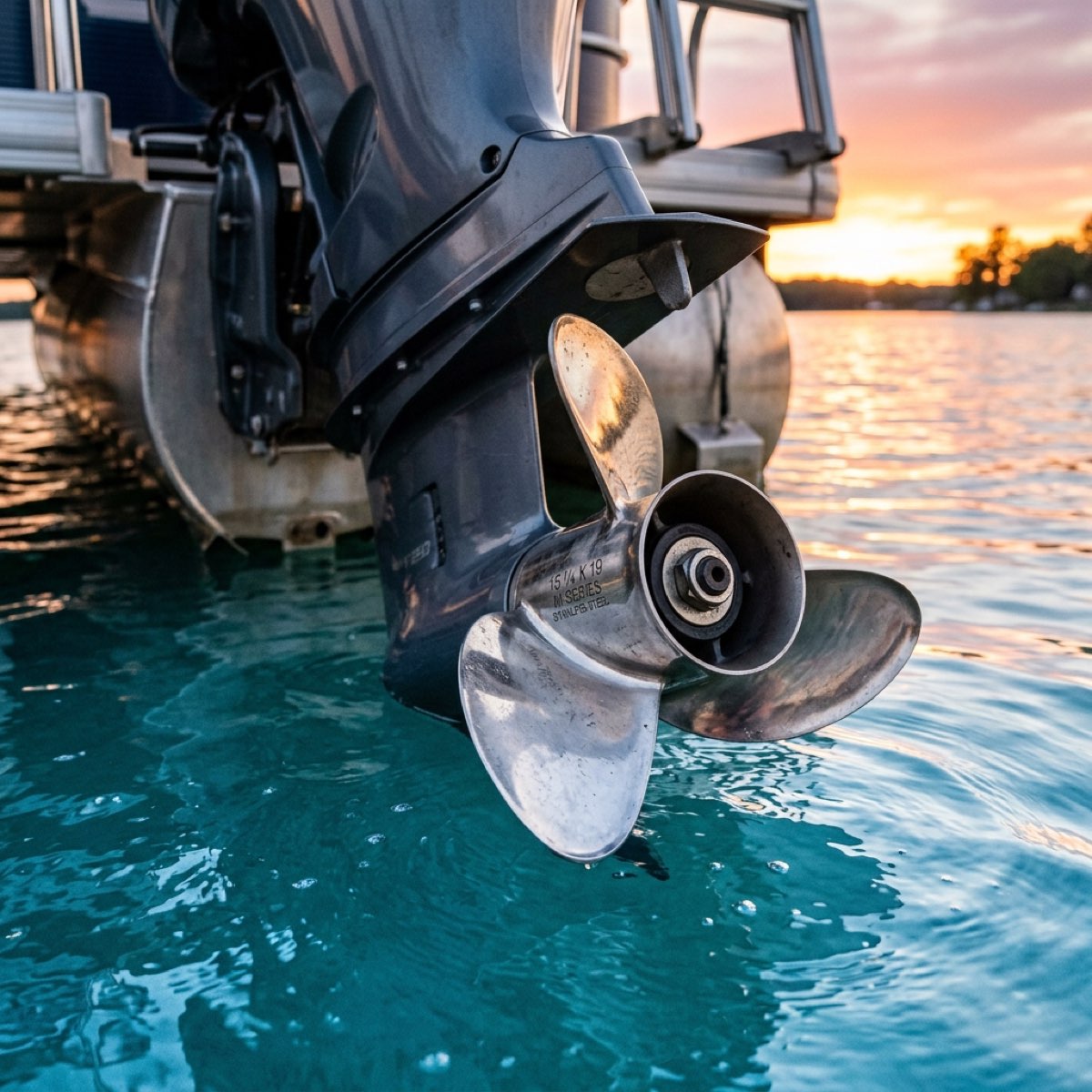
Every propeller has two numbers stamped on the hub (e.g., 14.5 × 19). They tell you everything.
Diameter (first number): The width of the full circle made by the blade tips. Larger diameter moves more water per revolution — critical for heavy, slow-displacement pontoons. Most pontoon props run 13.5"–15.5" diameter.
Pitch (second number): The theoretical distance the prop would travel forward in one revolution if water were solid. A 19-pitch prop would advance 19 inches per revolution in a perfect world. In reality, it slips (we'll calculate that below).
The WOT RPM Targets by Brand
Before you calculate anything, you need your engine's target RPM range. Check your owner's manual first — then use this table as a starting reference:
| Engine Brand / Series | Typical WOT RPM Range | Notes |
|---|
| Mercury FourStroke | 5,000 – 6,000 RPM | Check by displacement; verify serial # |
| Mercury OptiMax 2-stroke | 4,500 – 5,500 RPM | Older models run the lower end |
| Yamaha FourStroke (F115–F350) | 5,000 – 6,000 RPM | F200+ typically targets 5,500–6,000 |
| Honda BF Series | 5,300 – 6,300 RPM | Higher-revving than equivalent HP rivals |
| Evinrude E-TEC | 5,500 – 6,000 RPM | H.O. models same range |
| Suzuki DF Series | 5,000 – 6,000 RPM | DF70–DF300 consistent across range |
Always verify against your specific engine's serial number in the owner's manual. HP class alone doesn't determine the WOT range.
The 200 RPM Rule: Your Pitch Calculation
This is the core mechanic of prop selection. Every 1 inch of pitch change moves your WOT RPM by approximately 150–200 RPM in the opposite direction.
- Decrease pitch → RPM goes up
- Increase pitch → RPM goes down
Worked Example
Your engine: Mercury 150 FourStroke. Target WOT range: 5,000–6,000 RPM. You test at WOT with a normal load (half tank, 2 passengers) and get 4,600 RPM. Current prop: 15 × 19.
You're 400 RPM short of even the bottom of your target range.
At 200 RPM per pitch inch, that's a 2-inch pitch reduction.
New prop to test: 15 × 17
Want to target the middle of your range (5,500 RPM)? You need 900 RPM → 4–5 inches of reduction → try a 15 × 14 or 15 × 15.
Always test with your normal load. A prop dialed in for an empty hull will lug when you add four passengers and a full cooler — the only time you'll actually be on the water.
Calculating Prop Slip: The Efficiency Number Nobody Checks
No prop is 100% efficient. In real water, the blades slip backward relative to what they'd achieve in a solid medium. That slip percentage tells you whether your prop shape is right for your boat — not just whether the pitch is right.
The Formula:
- Theoretical Speed (MPH) =
(RPM × Pitch) ÷ (Gear Ratio × 1,056)
- Record your actual GPS speed at WOT
- Slip % =
(Theoretical − Actual) ÷ Theoretical × 100
Worked Example:
- RPM: 5,500 | Pitch: 19 | Gear ratio: 1.92:1
- Theoretical: (5,500 × 19) ÷ (1.92 × 1,056) = 104,500 ÷ 2,027 = 51.6 MPH
- Actual GPS speed: 42 MPH
- Slip: (51.6 − 42) ÷ 51.6 × 100 = 18.6% — healthy range
| Slip Range | What It Means |
|---|
| 5–10% | Excellent efficiency — stainless prop, clean hull, well-matched setup |
| 10–20% | Normal for most aluminum pontoon props |
| 20–30% | Acceptable but investigate — more cupping or 4-blade may help |
| Over 30% | Prop is "churning butter" — wrong shape, damaged blades, or excessive hull drag |
If your slip is over 25% and you've already confirmed correct pitch by WOT RPM, the solution is diameter (more blade area) or cupping (more blade grip) — not pitch.
📋 Free Download: The BoatGuider Pre-Season Pontoon Checklist
Before you chase prop numbers, make sure your boat's baseline is right. Our 50-Point Pre-Season Pontoon Checklist covers hull inspection, fuel system, electrical, trailer, and engine prep — everything that affects your performance numbers.
[Download free →] (Enter your email below)
3-Blade vs. 4-Blade: The Pontoon-Specific Answer
This is the question I get at every boat ramp. For pontoons specifically, the choice depends on what you do on the water — and it has a clear answer once you know.
When to Stay with a 3-Blade
The 3-blade achieves higher top-end speed for a given pitch and diameter, because three blades create less rotational drag than four. If your pontoon is a lighter single-log or entry-level tritoon and you spend most of your time cruising, three blades are fine.
The one weakness: 3-blade props cavitate (lose grip) in hard turns, especially when trimmed high. On a light pontoon, a momentary slip in a U-turn isn't a problem. On a loaded tri-toon doing tight passes near the dock, it becomes a habit you'll notice.
When a 4-Blade Changes Everything
If any of these apply, a 4-blade is worth the cost of a trial:
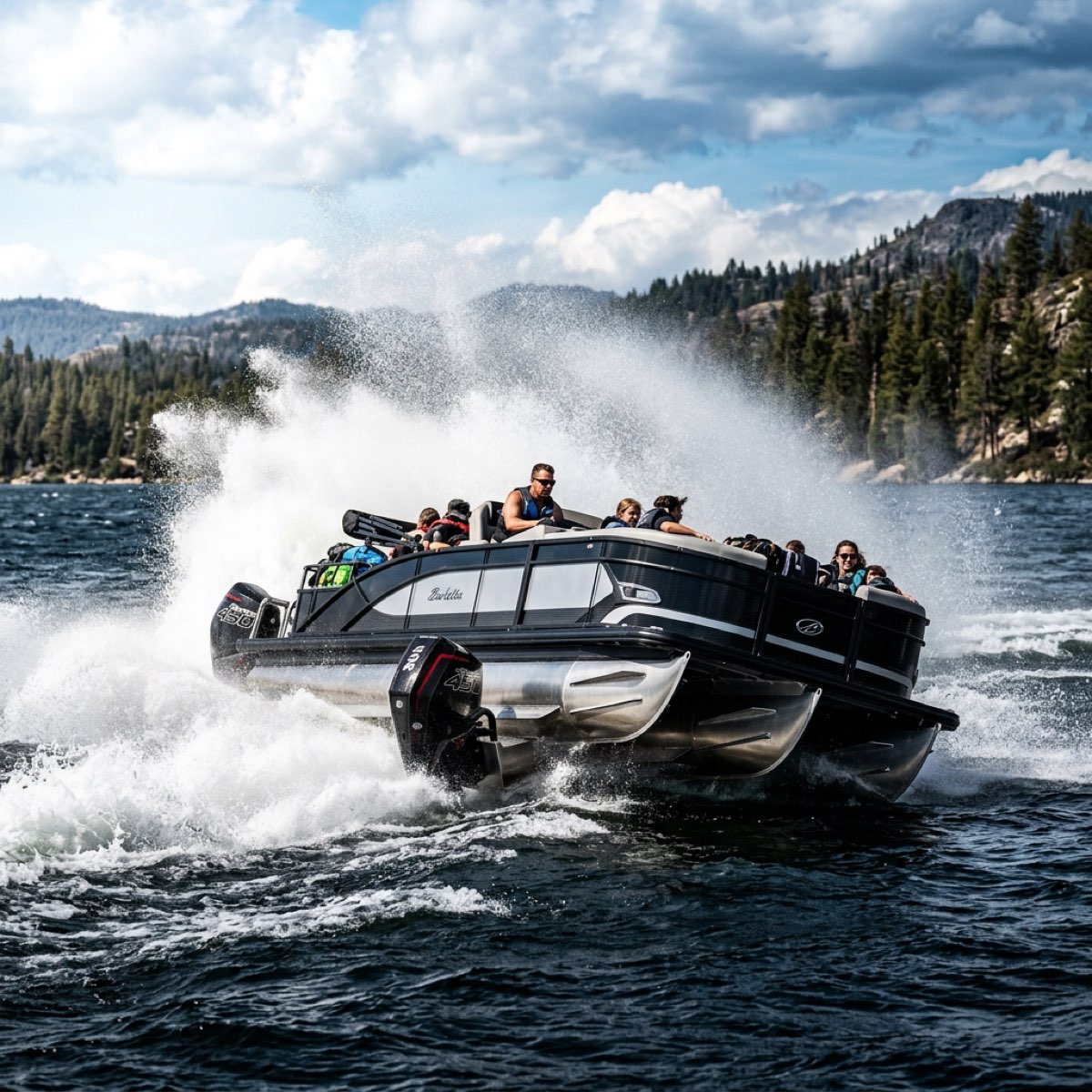
- You regularly tow tubes, skiers, or wakeboards
- You run with heavy loads (4+ passengers plus gear regularly)
- You're consistently over-propped and can't find the right 3-blade pitch
- Your boat blows out (loses grip) in turns under load
What a 4-blade actually does: The extra blade keeps more surface area in contact with the water at any given moment. Result: better hole shot, prop stays hooked in turns, smoother engine vibration at cruise.
The honest trade-off: You'll lose 2–4 MPH at the top end. Most towing families don't care. If your pontoon tops out at 28 MPH and you drop to 25, the improved towing performance is worth far more than those 3 MPH.
Cupping and Rake: The Hidden Specs That Matter
Most online prop calculators ignore these two variables. They're the reason two props with the same pitch number can behave completely differently on the water.
Cupping: The Grip Modifier
Cupping is a small, curved lip rolled into the trailing edge of the blade. More cupping = more grip on the water.
A cupped prop:
- Holds traction better in turns (less blow-out)
- Has an effective pitch slightly higher than its stamped number (usually 1–2 inches equivalent)
- Performs better when trimmed up high
If your current prop is the right pitch but blows out in every hard turn, try the same pitch with more aggressive cupping before jumping to a 4-blade.
Rake: The Bow Lift Variable
Rake is how far the blades tilt back from the hub. High rake pushes the bow up — useful for performance tritoons that want to fly on their lifting strakes at speed. Low rake keeps the bow level — better for traditional twin-log pontoons where bow lift creates instability.
If your boat runs nose-high even with the engine trimmed to neutral, a lower-rake prop can bring the bow down without sacrificing speed.
Stainless vs. Aluminum: The Honest ROI
Should you spend $600 on stainless or $150 on aluminum? Here's the actual calculation.
Aluminum: At 5,000 RPM, the blades flex slightly under water pressure (called blade flex). You're losing 1–2 MPH to this flex alone. Aluminum props also nick, dent, and distort easily from minor impacts.
Stainless: Approximately 5x stronger than aluminum. Thinner blades (less drag) that don't flex at speed. Real-world result: 2–4 MPH faster on most pontoons, plus measurably better fuel economy over a season.
The one stainless risk: Hit a hard submerged object with aluminum and the prop deforms, absorbing the impact before it reaches your gearcase. With stainless, the force may travel up the shaft and damage your lower unit. Always run stainless with a properly rated hub kit (Mercury Flo-Torq, Yamaha hub system) designed to slip under severe impact.
The verdict: If you boat in clear, deep water — stainless pays for itself in performance and longevity. If you navigate shallow rivers or gravel ramps regularly, stick with aluminum and treat it as a wear item.
The Callahan Prop Audit: 4 Steps Before You Buy
Step 1 — Test WOT RPM with your real load. Not an empty boat — your actual typical passenger count and fuel level. Record the tach at WOT.
Step 2 — Calculate your slip. Over 25% slip means your prop shape (diameter, cupping) is the problem, not the pitch.
Step 3 — Check the hub. If the engine revs freely but the boat barely accelerates, the internal rubber hub sleeve has spun. This is a $40–$80 fix misdiagnosed as a pitch problem more often than you'd think.
Step 4 — Inspect the blades. A single 1/8" nick on a blade tip causes measurable RPM loss and vibration. Take the prop to a prop shop for repair — it's always cheaper than buying new.
Frequently Asked Questions
What pitch prop should I run on a 115 HP pontoon?
There's no single answer — it depends on your boat weight, typical load, and tube configuration. The correct starting point is testing WOT RPM and applying the 200 RPM Rule. Most 115 HP pontoons in the 20–22 ft range run best in the 17–19 pitch range with a light load, but verify on the water with your specific setup.
Will a 4-blade prop make my pontoon faster?
No — a 4-blade typically reduces top-end speed by 2–4 MPH compared to an equivalent 3-blade. It trades top speed for better hole shot, better traction in turns, and smoother cruise. Right choice for towing and heavy loads; wrong choice if top speed is the goal.
What is a spun hub, and how do I know if I have one?
A spun hub means the internal rubber sleeve inside the prop hub has failed, separating the blades from the shaft. Symptom: engine revs normally, sounds healthy, but the boat barely moves. If the engine runs perfectly in neutral and the prop spins freely by hand after shutdown, you have a spun hub. Replace the hub kit — not the whole prop.
Can I use an online prop calculator to find my prop?
Online calculators are useful for a first approximation, but they can't account for your hull's drag, engine mounting height, or lifting strakes. Use a calculator to narrow down 2–3 pitch options, then verify each one on the water with the WOT RPM test. The tach always beats the calculator.
WOT RPM ranges cited are general references for modern recreational outboards. Always verify the exact range for your engine's model and serial number in your owner's manual. RPM-per-inch pitch change results are approximate and vary with hull weight, engine mounting height, and load.