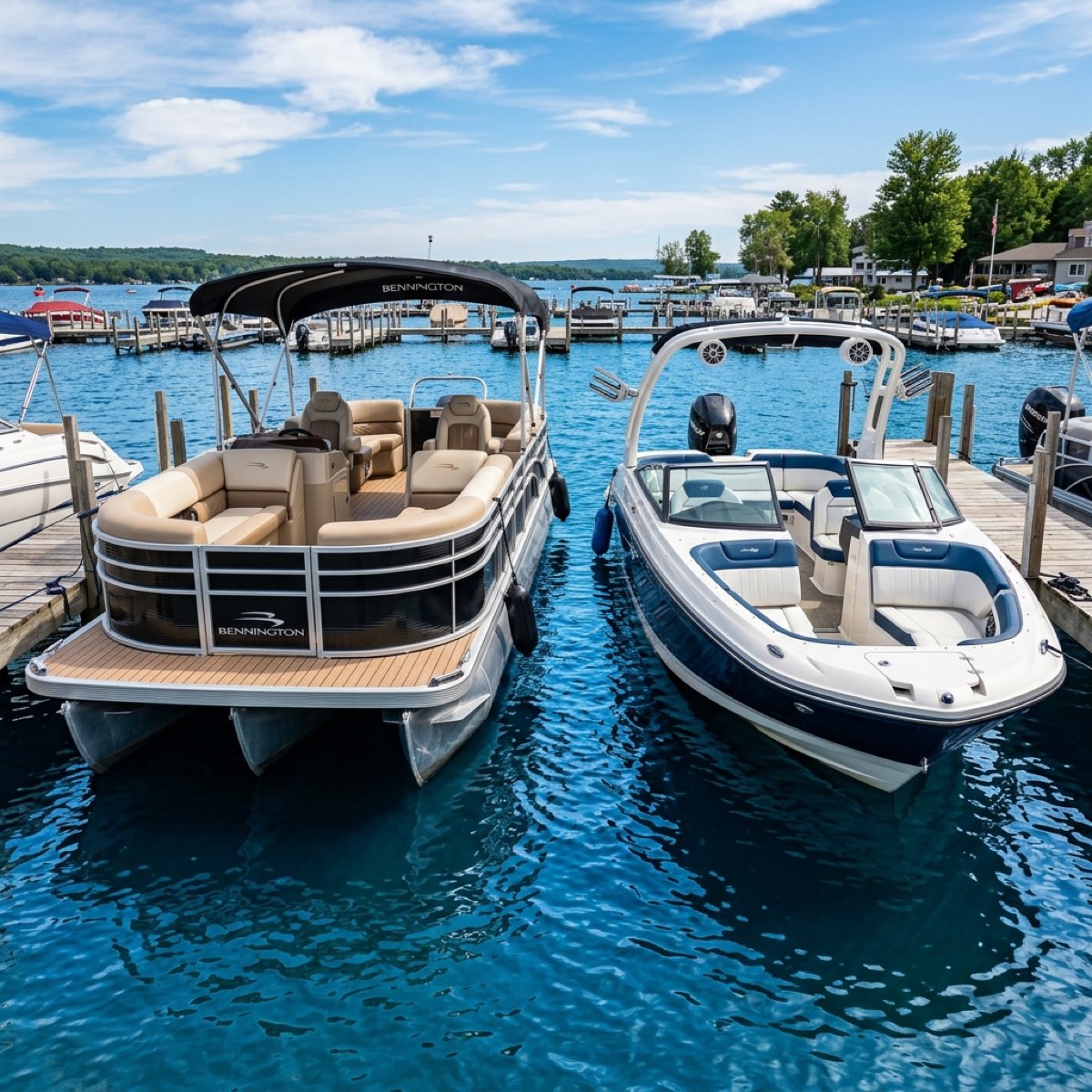
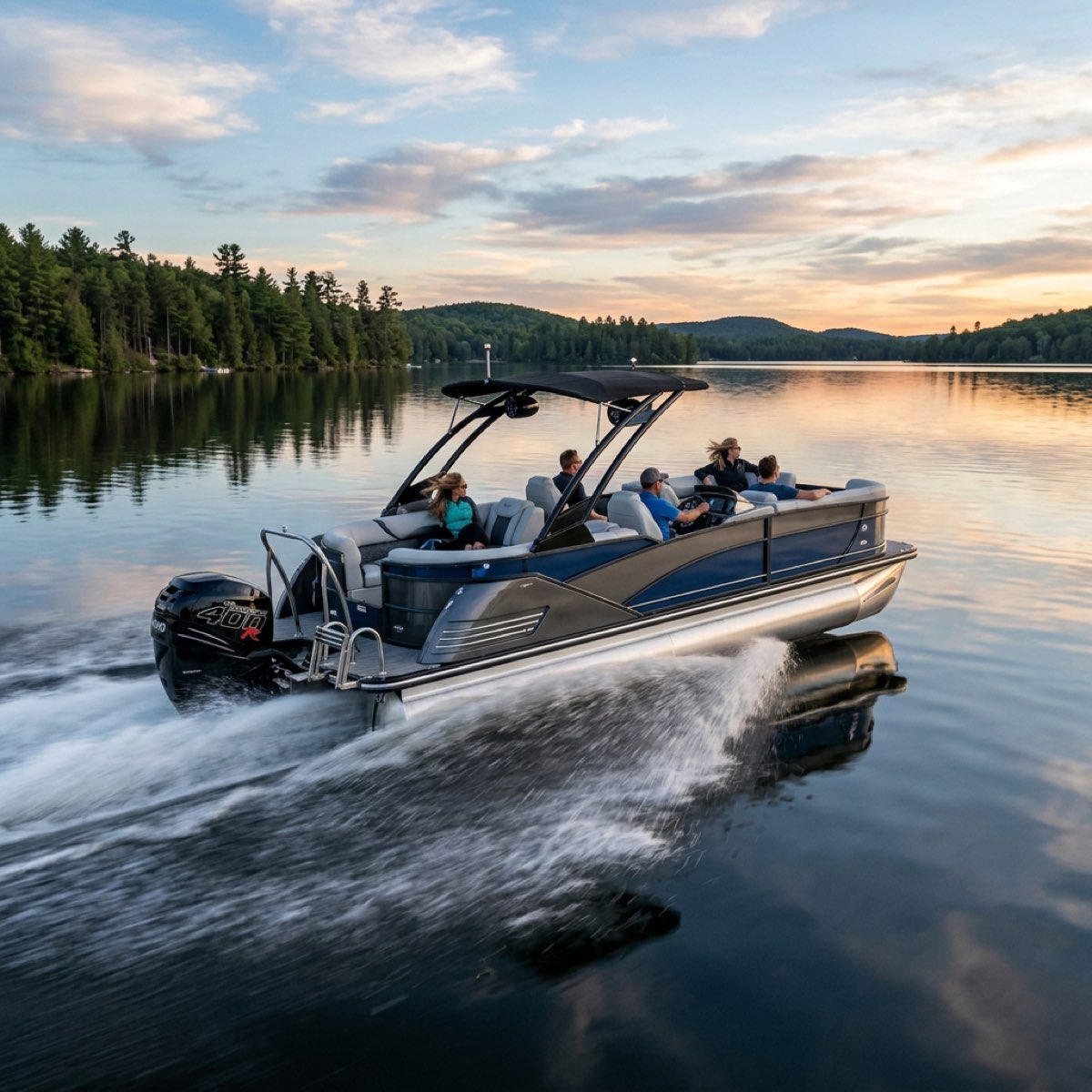
The choice between a pontoon and a deck boat comes down to a trade-off between passenger capacity and hydrodynamic performance. Pontoons offer superior square footage, flat-water stability, and a shallow draft for sandbar beaching. Deck boats provide a traditional fiberglass V-hull handling experience with faster hole-shot acceleration, tighter turning radiuses, and significantly better fuel efficiency at high speeds.
If you walk into a marine dealership today with a spouse and three kids in tow, you are going to experience an immediate family divide. Your kids will migrate toward the sleek, fast-looking fiberglass deck boat with the aggressive wakeboard tower. Your spouse will gravitate toward the 24-foot pontoon with the changing room, the table for lunch, and the dual captain's chairs that look like they belong in a luxury living room.
You are standing in the middle, staring at the $60,000 price tags and wondering: "Is a deck boat just a pontoon with a fiberglass hull? Or is a pontoon just a slow deck boat?"
As a marine service advisor, I have watched hundreds of families make this choice. I have also seen the devastating buyer's remorse that happens when a family buys a deck boat to host 12-person dinner cruises, or buys a twin-log pontoon for a family of aggressive wakeboarders.
In this comprehensive engineering and lifestyle guide, we are abandoning the sales brochures. We will break down the exact physics of how these hulls interact with the water, the hidden costs of fiberglass maintenance, the realities of towing weights, and the docking dynamics that no salesman will tell you about.
1. The Hull Physics: Aluminum Logs vs. Fiberglass V-Hull
The most fundamental difference between these two vessels is displacement mechanics—how the boat pushes water out of the way.
The Pontoon (Surface Displacement)
A standard pontoon boat sits on two (or three) air-filled aluminum cylinders. It is essentially a floating rectangular platform. At low speeds, it provides absolute lateral stability. You can have five heavy adults stand on the port side rail to look at a fish, and the boat will barely tilt.
However, because it has a flat, blunt-nosed profile, it does not "cut" through the water. It pushes it. This means that as you increase speed, the hydrodynamic drag increases exponentially. You need massive horsepower to make a pontoon go fast, and in tight turns, the boat remains completely flat (or even leans outward slightly), which can feel unnerving at high speeds.
The Deck Boat (Hydrodynamic Lift)
A deck boat uses a fiberglass V-hull that is "flared" out extremely wide at the top to create a massive deck. Below the waterline, it behaves exactly like a traditional runabout or bowrider.
As a deck boat accelerates, the V-hull generates "lift," pushing the bow of the boat out of the water. This reduces the "wetted surface area" (the amount of hull touching the water), drastically reducing drag. When you turn a deck boat, the V-shape creates a "pocket" of water that the hull leans into. This lowers the center of gravity and allows for aggressive, sports-car-like handling that a pontoon physically cannot replicate.
However, at the dock, a deck boat is much more "tippy." If three adults stand on the side rail of a deck boat, the V-hull will list (tilt) significantly.
Find Your Perfect Family Boat
Ready to see the difference between aluminum displacement and fiberglass lift in person? Use our Certified Dealer Locator to find top-rated marine showrooms in your area and schedule a test drive today.
Connecting you with authorized Bennington, Harris, and Sea Ray dealers.
2. Seating Capacity: The "Square Footage" Battle
When you are buying a family boat, you are paying for usable square footage.
The Pontoon "Playpen"
Pontoons are the undisputed champions of space. Because the deck is a perfect 8.5-foot-wide rectangle from bow to stern, every single square inch is usable.
A standard 22-foot pontoon has roughly 180 square feet of deck space. You can comfortably fit a full L-shaped rear couch, two massive front loungers, a pop-up changing room, and a removable dining table. If you want to host a birthday party with 6 kids and 4 adults, the pontoon allows everyone to walk around without constantly tripping over each other.
The Deck Boat "Cockpit"
A 22-foot deck boat has about 30% less usable floor space than a 22-foot pontoon. Because the fiberglass hull must taper to a point at the bow for hydrodynamic efficiency, you lose the massive, wide front-end seating.
Furthermore, deck boat seating is "molded in." You cannot walk flush to the edge of the boat. If you put 10 adults on a 22-foot deck boat, you will experience a severe lack of legroom. Knees will be touching in the bow. A deck boat is realistically built for a family of 4 to 6 who wants to go fast, not a large group of 10 who wants to lounge.
3. Water Sports: Wakeboarding, Skiing, and Tubing
If your family’s main goal is pulling a tube, a wakeboarder, or a slalom skier, the hull design drastically impacts the "fun factor."
The Deck Boat Advantage (The Hole Shot)
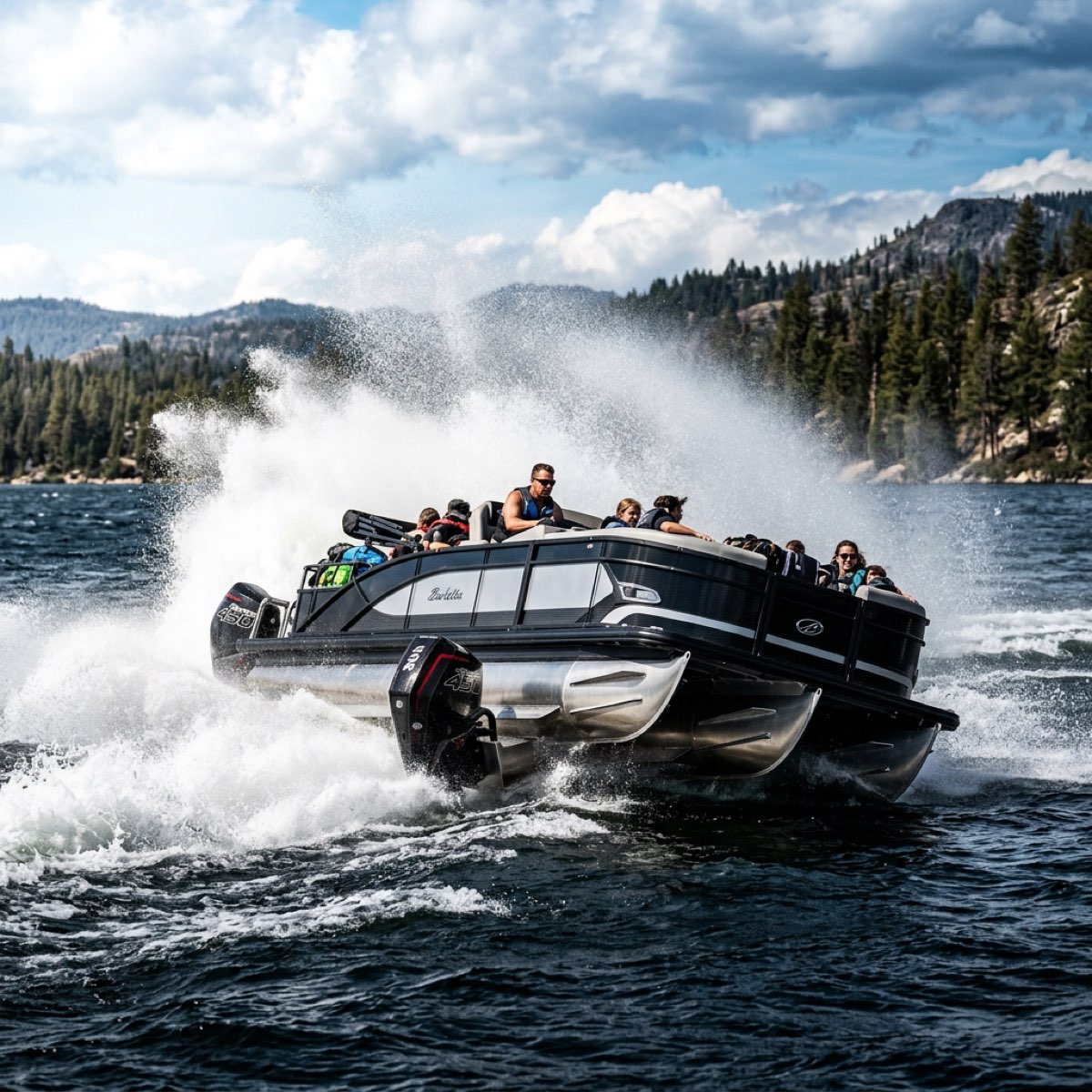
Deck boats are built for water sports. Because the V-hull generates hydrodynamic lift, a deck boat has a vastly superior "hole shot" (the time it takes to accelerate from zero to a planing speed).
If you are pulling a 200-lb adult on a single slalom ski, a deck boat with a 150HP engine will pop them out of the water in seconds. The deck boat also creates a defined, shapeable wake that wakeboarders can use to jump.
The Pontoon Reality (The Drag Factor)
A traditional twin-log pontoon is terrible for serious water sports. It creates a massive, turbulent wash (white water) rather than a clean wake. Furthermore, because aluminum logs do not generate lift, the boat "plows" through the water, making it very difficult to pull heavy skiers out of the water quickly.
The Exception: Modern Tri-Toons with 200+ HP engines and lifting strakes have changed the game. A high-performance Tri-Toon can now pull a wakeboarder almost as well as a deck boat, though the wake remains wider and flatter.
4. Pontoon vs. Deck Boat: Spec Comparison
To understand the mechanical differences, look at the baseline averages for a 22-foot model of each:
Feature
22' Pontoon (Tri-Toon)
22' Deck Boat
Max Capacity (Avg.)
12 - 14 Persons
8 - 10 Persons
Top Speed (150HP)
32 - 38 MPH
45 - 50 MPH
Handling Dynamics
Flat / Highly Stable
Leans / Aggressive
Rough Water Ride
"Shovels" into large waves
Cuts through waves
Maintenance Need
Low (Bare Aluminum)
High (Fiberglass/Gelcoat)
Fuel Efficiency (Cruise)
Poor (High Drag)
Excellent (High Lift)
5. Maintenance Costs: Aluminum vs. Fiberglass
This is where the long-term budget and your personal free time come into play.
The Fiberglass Burden (Deck Boat)
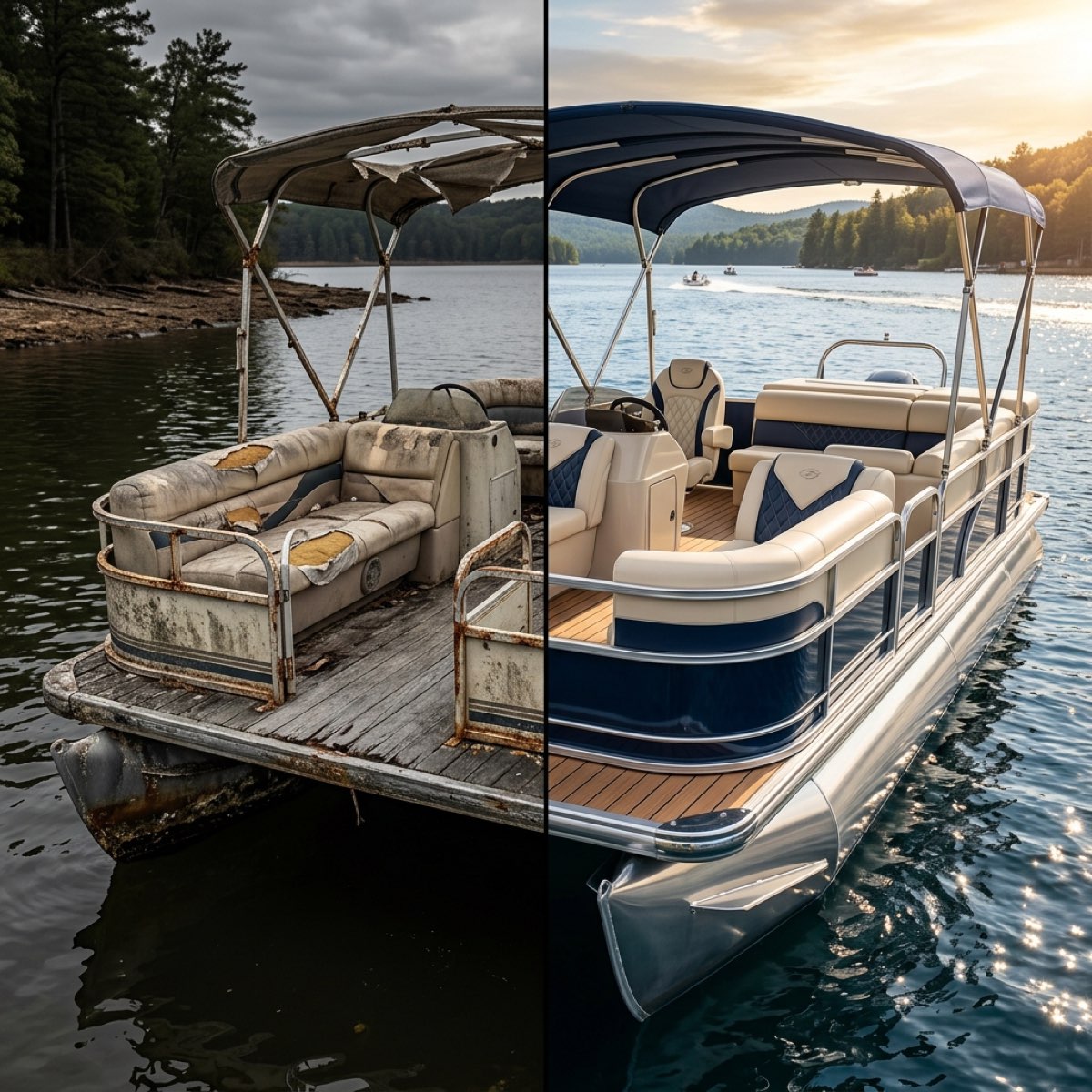
Fiberglass is beautiful, sleek, and highly customizable. It is also a massive maintenance burden. If you leave a deck boat exposed to the sun and water, the gelcoat will oxidize and turn "chalky" within two years. You must physically buff and wax a deck boat at least once a year to maintain its structural integrity and resale value.
Furthermore, fiberglass is fragile. If you accidentally hit a submerged rock or a wooden dock piling too hard, the gelcoat will shatter. A fiberglass hull repair requires grinding, epoxy resin, color-matching gelcoat, and sanding. It can easily cost $1,500 for a minor impact.
The Aluminum Advantage (Pontoon)
Aluminum logs are incredibly durable and require almost zero cosmetic maintenance. You do not have to wax them. If you leave them in the water all summer, they will turn brown (oxidation), but a simple $30 acid wash in the fall will turn them silver again.
If you hit a dock piling with a pontoon log, you might get a dent. Unless the log is physically punctured, you simply ignore the dent and keep driving. From a pure "cost-per-hour-of-fun" perspective, the pontoon is the cheapest boat on the water to maintain.
6. Shallow Water and Sandbar Beaching (The Draft)
If you spend your weekends pulling up to sandbars, islands, or shallow coves, you need to understand your boat's "draft" (how deep the hull sits in the water).
Pontoon Shallow Water Capability
Pontoons are incredible for shallow water. Because the weight of the boat is spread over massive aluminum cylinders, the hull only drafts about 10 to 14 inches of water (with the engine trimmed up). You can drive a pontoon right onto a sandy beach, drop the front ladder, and let the kids run straight into ankle-deep water.
Deck Boat Deep Draft
A deck boat’s V-hull acts like a blade. To maintain stability, the heaviest part of the hull (the "V") sits much deeper in the water—often drafting 18 to 24 inches or more.
If you try to beach a deck boat on a shallow sandbar, the sharp fiberglass keel will grind into the sand and rocks, severely damaging the gelcoat. You usually have to anchor a deck boat in deeper water and swim to the sandbar.
7. Towing Requirements: Vehicle Matching
Do not buy a boat without verifying that your current SUV or truck can safely pull it down the highway.
Towing a Deck Boat:
Fiberglass is heavy. A 22-foot deck boat on a tandem-axle steel trailer will often weigh between 4,500 and 5,500 lbs fully loaded with fuel and gear. You cannot tow this with a mid-size crossover (like a Ford Explorer or Honda Pilot). You must have a half-ton pickup truck (F-150, Silverado) or a full-size SUV (Tahoe, Expedition) with a dedicated V8 tow package.
Towing a Pontoon:
Aluminum is exceptionally light. A standard 22-foot twin-log pontoon on a trailer usually weighs between 2,800 and 3,500 lbs. Many mid-size SUVs with a 3,500 to 5,000 lb tow rating can safely pull a pontoon to the local ramp.
(Note: If you upgrade to a Tri-Toon with a 250HP engine, the weight will jump back up to 4,500+ lbs, requiring a larger truck).
8. Docking Dynamics: The Windage Factor
This is the secret that dealerships never mention during the test drive.
Docking a Deck Boat
A deck boat sits low in the water. It has very little "windage" (surface area exposed to the wind). When you are trying to navigate into a tight slip at the marina, a deck boat goes exactly where you point it. It is highly maneuverable and predictable at idle speeds.
Docking a Pontoon
A pontoon boat is essentially a giant aluminum sail. With the high side-paneling (fencing) and the massive bimini top, the wind catches the boat aggressively. Furthermore, because the logs are essentially "skating" on top of the water rather than cutting into it, pontoons have very little lateral grip.
If you are trying to dock a pontoon in a 15 MPH crosswind, the wind will push the boat sideways faster than the engine can push it forward. Docking a pontoon in heavy wind requires significant skill, brief bursts of high throttle, and a lot of patience.
9. Resale Value: The 2026 Market Analysis
When you buy a boat, you should always be thinking about the day you sell it.
In the current 2026 market, pontoons are holding their value significantly better than deck boats. Because the aluminum hull is indestructible and the outboard engines are easily accessible for repowering, a 10-year-old pontoon is still a highly desirable asset. A well-maintained premium pontoon retains up to 70% of its original MSRP after five years.
Deck boats depreciate faster because of the fiberglass degradation. Any spider-cracks in the gelcoat or fading in the colored hull sides will drop the value by 15-20% instantly. Buyers are also inherently wary of older fiberglass boats because of the risk of hidden structural rot in the stringers.
10. The Cockpit Layout: Helm and Ergonomics
If you spend eight hours a day driving a boat, the design of the helm console is just as important as the hull.
The Pontoon Helm (The "Command Center")
Modern pontoon helms are designed for absolute comfort. They feature high-backed, deeply cushioned captain’s chairs that often recline and swivel 360 degrees. Because the console is mounted on a massive flat deck, the driver has incredible 360-degree visibility. You are sitting high above the water, making it very easy to spot channel markers, other boats, and swimmers.
Furthermore, many pontoons now offer "Dual Helm" layouts. Instead of an L-shaped couch in the rear, there is a second captain's chair directly next to the driver. This "co-captain" setup is incredibly popular for couples who want to sit together and navigate without having one person relegated to a bench seat.
The Deck Boat Helm (The "Sports Car")
Deck boat helms are designed for active driving. You sit much lower to the water, deeply integrated into the fiberglass console. The seats are typically "bucket style" with high lateral bolsters to hold you in place during aggressive turns.
While this low seating position feels incredibly sporty, it significantly reduces your forward visibility, especially when the boat is accelerating. As the bow lifts out of the water (the "hole shot"), the driver's vision is often completely obscured by the nose of the boat for several seconds. To combat this, most deck boats feature a "flip-up bolster" on the driver’s seat, allowing you to temporarily sit higher, but it is never as commanding or comfortable as a pontoon helm over a long day.
11. Insurance and Ownership Logistics
When budgeting for your family boat, the purchase price is only the beginning. The hull material dictates your recurring costs.
Pontoon Insurance Advantages
Because pontoon boats are statistically involved in fewer high-speed accidents, and because their aluminum logs are incredibly cheap to repair compared to fiberglass, marine insurance premiums for pontoons are generally lower. Insurance companies view pontoons as slow, safe, family-oriented vessels.
Deck Boat Insurance Reality
Deck boats, with their high-horsepower engines and aggressive handling profiles, are often classified similarly to runabouts and ski boats. They are statistically more likely to be involved in high-speed incidents or suffer catastrophic hull damage from hitting submerged objects. Consequently, your annual insurance premium for a high-end deck boat will likely be 15% to 25% higher than a comparable pontoon.
Final Thoughts: Making the Choice
So, which is better for your family?
If you have a large family (4+ kids), love to host other couples, value flat-water stability, want to pull up to shallow sandbars, and desire the lowest possible long-term maintenance, buy the pontoon. It is the ultimate "floating patio" and will provide more comfortable memories per dollar spent.
If you are a smaller family of four who aggressively pursues water sports, wants a boat that handles like a sports car, needs to cross large stretches of rough water quickly, and doesn't mind spending a Saturday morning waxing fiberglass, buy the deck boat. It’s the choice for the "active" family that is always on the move.
Both options are incredible ways to spend time on the water. Just make sure you take a test drive of both before you sign the paperwork. Use our Dealer Locator to find a showroom that carries both styles—most major marine retailers will have both pontoons and deck boats on the floor so you can compare the interior legroom side-by-side.
Don't let the sales pitch sway you—sit in the seats, imagine your kids dropping chips on the deck, and think about how you actually spend your time on the lake. Happy boating!
12. Handling Physics: The "Chine Walking" Crisis
When you push a deck boat to its limits, you encounter a physical phenomenon called Chine Walking.
12.1 The Deck Boat "Wobble"
As a V-hull deck boat reaches high speeds (45+ MPH), it begins to lift so far out of the water that it is essentially balancing on a very narrow strip of the hull (the "Pad").
The Result: The boat will begin to rock from side to side. If the driver doesn't know how to "Catch" the walk with small steering inputs, the boat can become dangerously unstable.
12.2 The Pontoon "Rail" Effect
Pontoons do not chine walk. Because they have two or three points of contact with the water that are spread wide apart, they are incredibly stable at high speed. You can drive a 50 MPH tri-toon with one finger on the wheel, whereas a 50 MPH deck boat requires active, two-handed concentration.
13. Safety Logistics: Deck Height and the "Child Factor"
If you have toddlers or small children, the "Vertical Safety" of the boat is a major engineering consideration.
Pontoon Safety: The aluminum fencing (the rails) on a pontoon is typically 24 to 30 inches high. It is a solid perimeter that keeps children "Inboard." The floor is perfectly flat, with no "Step-Downs" that could cause a trip or fall.
Deck Boat Safety: Deck boats have much lower "Gunwales" (the sides of the boat). While they are safe, the interior depth of the cockpit is shallower. Furthermore, deck boats often have "Step-Ups" to the bow or "Walk-Through" transoms that create tripping hazards for small children in a moving vessel.
14. Storage Engineering: In-Floor vs. Under-Seat
Where do you put the stuff?
Deck Boats: Usually feature a massive In-Floor Ski Locker. Because the V-hull has a deep cavity, you can store 6-foot skis, wakeboards, and even a spare anchor out of sight. However, the under-seat storage is often cramped because the fiberglass hull curves inward.
Pontoons: Offer the most "Cubic Feet" of storage. Every single seat cushion lifts up to reveal a massive rot-molded plastic bin. You can fit enough life jackets, coolers, and toys for 12 people.
The Catch: Unless you have a performance tri-toon with a center-log locker, pontoons lack a long, horizontal space for skis. They often end up leaning against the rails, which is a major tripping hazard.
15. Aerodynamics: The Bimini "Parachute" Problem
At 30 MPH, the wind resistance of a pontoon boat is a serious engineering drag.
The Pontoon Sail: A pontoon's fencing and square front act like a wall. The Bimini top is often high and boxy, creating a "Parachute Effect" that can drop your fuel economy by 20%.
The Deck Boat Streamline: Deck boats are designed to be aerodynamic. The low-profile windshield and swept-back wakeboard towers cut through the air. This is why a deck boat with a 150HP engine will always be 10-15 MPH faster than a pontoon with the same engine.
16. Regional Suitability: Salt Water vs. Fresh Water
Where you boat dictates what the hull should be made of.
Fresh Water: Both are excellent.
Salt Water (The Fiberglass Osmosis): If you leave a fiberglass deck boat in salt water for weeks at a time, the hull can develop "Osmotic Blistering" (tiny bubbles in the gelcoat). You must apply a "Bottom Paint" (antifouling) which is expensive and ugly.
Salt Water (The Aluminum Risk): Pontoons are great in salt water, but the aluminum logs must have "Sacrificial Anodes" (Zinc or Magnesium) attached to the hull to prevent the salt from eating the aluminum via electrolysis.
17. The Mike Callahan Decision Matrix (The 60-Second Test)
Still undecided? Answer these three questions:
Do you have more than 6 people on the boat more than 50% of the time? (Yes = Pontoon).
Is your primary goal to teach your kids to wakeboard or slalom ski? (Yes = Deck Boat).
Do you boat on a lake with constant 2-foot whitecaps? (Yes = Deck Boat or High-End Tri-Toon).
18. Summary: The Verdict for 2026
The gap between pontoons and deck boats is closing. High-end tri-toons handle like deck boats, and modern deck boats are becoming wider and more spacious. But from a pure Engineering and Value perspective, the Pontoon remains the king of family versatility, while the Deck Boat remains the king of performance.
Choose the hull that fits your lifestyle, not the one that looks the coolest in the showroom.