The pattern is always the same. You pull into the marina Friday evening, everything fine. Saturday morning you step aboard and the key gives you nothing. Dead battery. You jump it, it starts, you go out, it charges back up on the water, and everything works again. Sunday night you leave it on the dock. Monday morning, dead again.
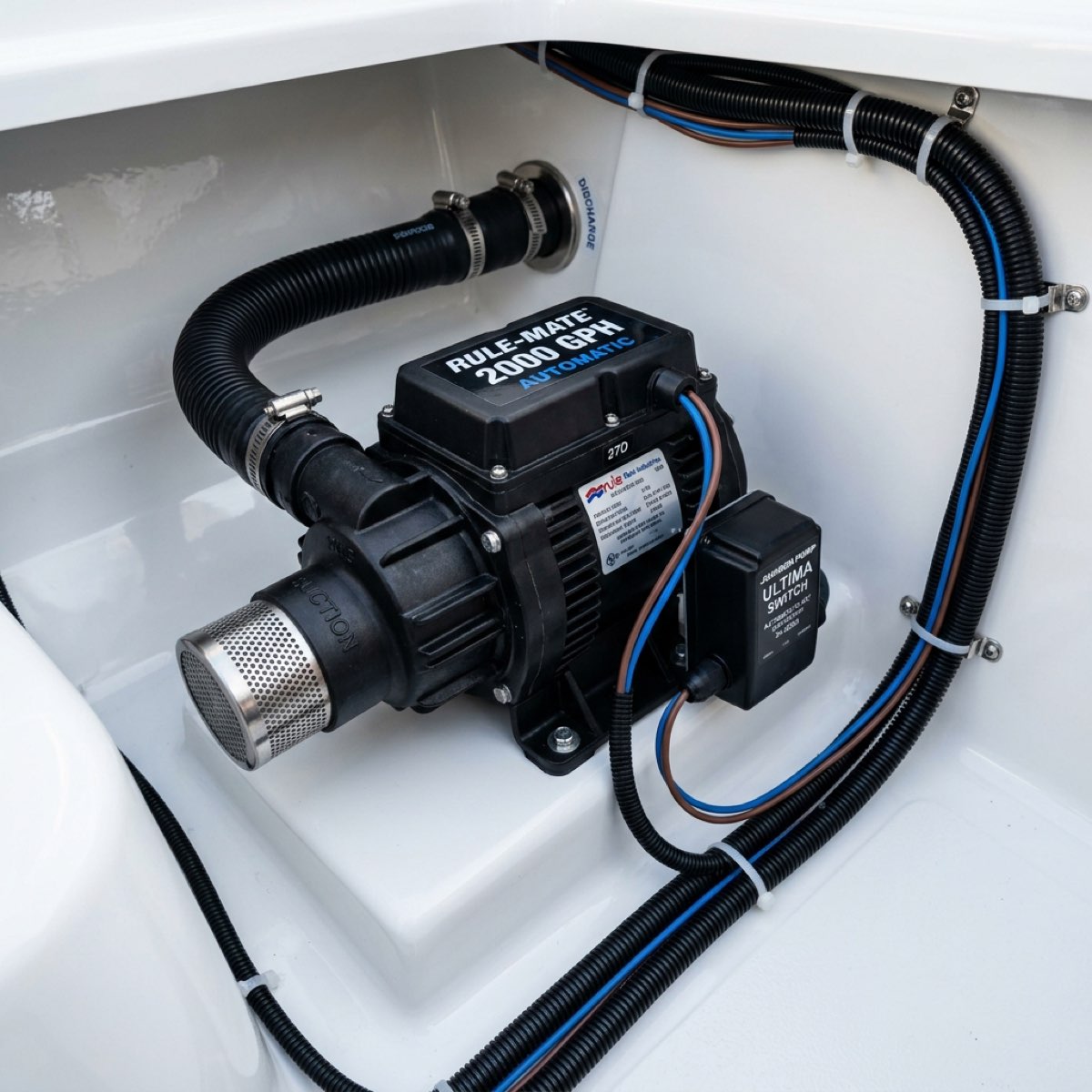
That happened to me for three weekends on the Sun Tracker before I found the cause. It was a $14 bilge pump float switch that was wicking a small but continuous current even when the bilge was completely dry. The pump itself was not running — the float switch was just drawing enough current through its circuit to pull the battery down to 10.8 volts over twelve hours.
The maddening thing about a parasitic draw is that the boat works fine when you are using it. The charging system puts the current back in while you are running. The draw only shows up when the boat sits — and by then you are not aboard to catch it in the act.
This guide gives you the exact method to find it.
About this guide: Mike Callahan has twenty-two years of recreational boating experience and four years as a service advisor at a Yamaha-certified marine dealership in central Florida. Parasitic draw diagnosis was one of the most common service calls he handled — particularly on boats with aftermarket electronics, aging wiring, and bilge pump systems that had never been serviced. The method in this guide is the same procedure used in certified marine service departments. A digital multimeter is required. The test takes approximately 30–45 minutes and requires no disassembly.
First: Rule Out the Battery Itself
Before hunting for a parasitic draw, confirm the battery is capable of holding a charge at all. A battery with a dead or sulfated cell will drain to zero overnight regardless of whether there is a draw — it simply cannot hold charge anymore.
The quick test:
- Charge the battery fully with a quality charger (4–8 hours on a 10-amp charger, or until the charger indicates complete).
- Disconnect the charger and let the battery rest for two hours with nothing connected.
- Measure the resting voltage with a multimeter.
| Resting Voltage (Nothing Connected) | Battery Condition |
|---|
| 12.7V or higher | Fully charged, healthy |
| 12.4–12.6V | Partially discharged — charge again and re-test |
| 12.0–12.3V | Significantly discharged, likely aging |
| Below 12.0V | Dead or sulfated cell — battery needs replacement |
A healthy battery charged to 12.7V should still read 12.5V or above after sitting 24 hours with zero draw. If yours drops to 11.8V overnight with nothing connected, the battery is the problem — no amount of parasitic draw hunting will fix a battery with a failed cell.
Marine battery lifespan: In Florida's heat, a cranking battery lasts 3–4 years. In cooler northern climates, 4–6 years. If your battery is over 4 years old and draining overnight, replace it first before running the draw test — you may solve the problem immediately and save yourself an hour of diagnostics.
Replacement batteries worth considering:
The Parasitic Draw Test: Step by Step
A parasitic draw is current flowing out of the battery when everything on the boat is supposed to be off. Any draw over 50 milliamps (0.050 amps) will drain a typical marine battery overnight.
What you need:
- Digital multimeter with a 10A DC current setting (AstroAI AM33D at ~$14 works fine)
- Pen and paper to track which fuse you pulled
- 30–45 minutes
Important before you start: Some boat electronics — GPS units, VHF radios with memory, depth finders — reset their settings when power is interrupted. Know which devices on your boat will need reprogramming before you begin pulling fuses. On most boats this is minor, but it is worth knowing.
The Test Procedure
Step 1: Turn everything off. Engine off. Every switch in the off position. Close all hatches. Give the boat two minutes to let any timed circuits complete their shutdown cycle.
Step 2: Set your multimeter to DC amps — the 10A setting. Plug the red probe into the 10A port on the multimeter (not the standard voltage port). This is important — if you accidentally put 10 amps through the standard voltage port, you will blow the multimeter's internal fuse.
Step 3: Disconnect the negative battery cable from the battery terminal.
Step 4: Connect the multimeter in series between the negative cable end and the battery's negative post. Red multimeter lead to the cable end, black multimeter lead to the battery post. Current now flows through your meter.
Step 5: Read the display. This is your total parasitic draw.
| Reading | What It Means |
|---|
| 0–20 mA | Normal — no significant draw |
| 20–50 mA | Borderline — acceptable but worth investigating |
| 50–200 mA | Confirmed parasitic draw — will drain battery in 1–3 days |
| 200+ mA | Serious draw — will drain battery in hours |
If your reading is above 50 mA, continue to Step 6.
Step 6: Pull fuses one at a time. Your fuse panel is usually in the console or under a hatch near the battery. Pull each fuse individually while watching the multimeter. When the reading drops significantly — you found the circuit.
Note which fuse dropped the reading. Reinstall it and move to the next fuse to confirm no other circuits are also drawing. When you have identified the fuse(s) causing the draw, trace the circuit those fuses control to the specific device.
The 7 Real Causes (In Order of Frequency)
Cause 1: Bilge Pump Float Switch Stuck in the "On" Position
This is the most common cause I saw at the dealership, and the one that bit me personally on the Sun Tracker.
The float switch is a small sensor in the bilge that tells the pump to run when water rises above a set level. The switch contains a mechanical component — a ball or reed mechanism — that can corrode, stick, or accumulate debris and remain in the triggered position even when the bilge is completely dry.
The pump itself may not be running. The float switch circuit can draw current through the pump motor's stator windings even without full motor operation — just enough to pull the battery down slowly over 8–12 hours.
How to identify it: The bilge pump fuse will be the one that drops your draw reading. With that fuse pulled, physically inspect the float switch in the bilge. If the bilge is dry and the float is in the up (triggered) position, it's stuck.
Fix: Disconnect the float switch wire connector and reconnect it firmly. If it's stuck again within a week, replace it. A quality float switch runs $15–$30:
Cause 2: Stereo, GPS, or Electronics Left in Standby Mode
Modern boat electronics — chartplotters, stereo head units, VHF radios — often draw power in standby even when you believe they are "off." A chartplotter in standby mode can draw 150–400 mA continuously. Left for 12 hours, that is enough to kill a battery.
This is compounded on boats where the electronics are wired directly to the battery without going through a master switch — a common shortcut in factory wiring on fishing boats.
How to identify it: These devices will each be on their own fuse or breaker. Pull them individually and watch the meter.
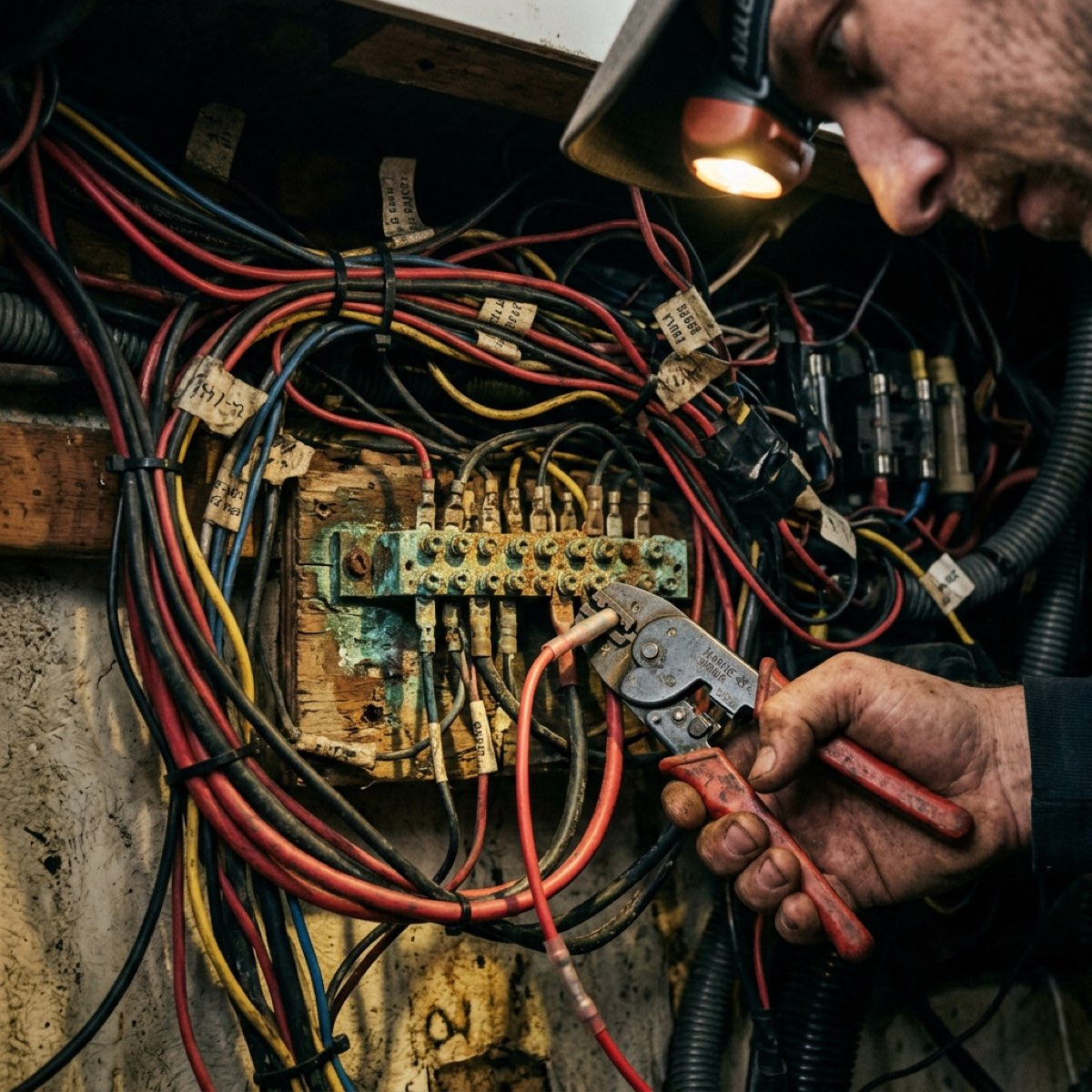
Fix — the right way: Wire all electronics through a master battery switch so one switch disconnects everything when you leave the boat. A Blue Sea Systems m-Series dual-circuit plus battery switch (~$85) lets you disconnect all electronics while leaving the bilge pump circuit active — this is the correct marine electrical architecture for any boat with multiple electronics.
Fix — the quick way: If rewiring is not immediate, make a habit of using each device's physical off switch and confirming the display is dark before leaving the boat.
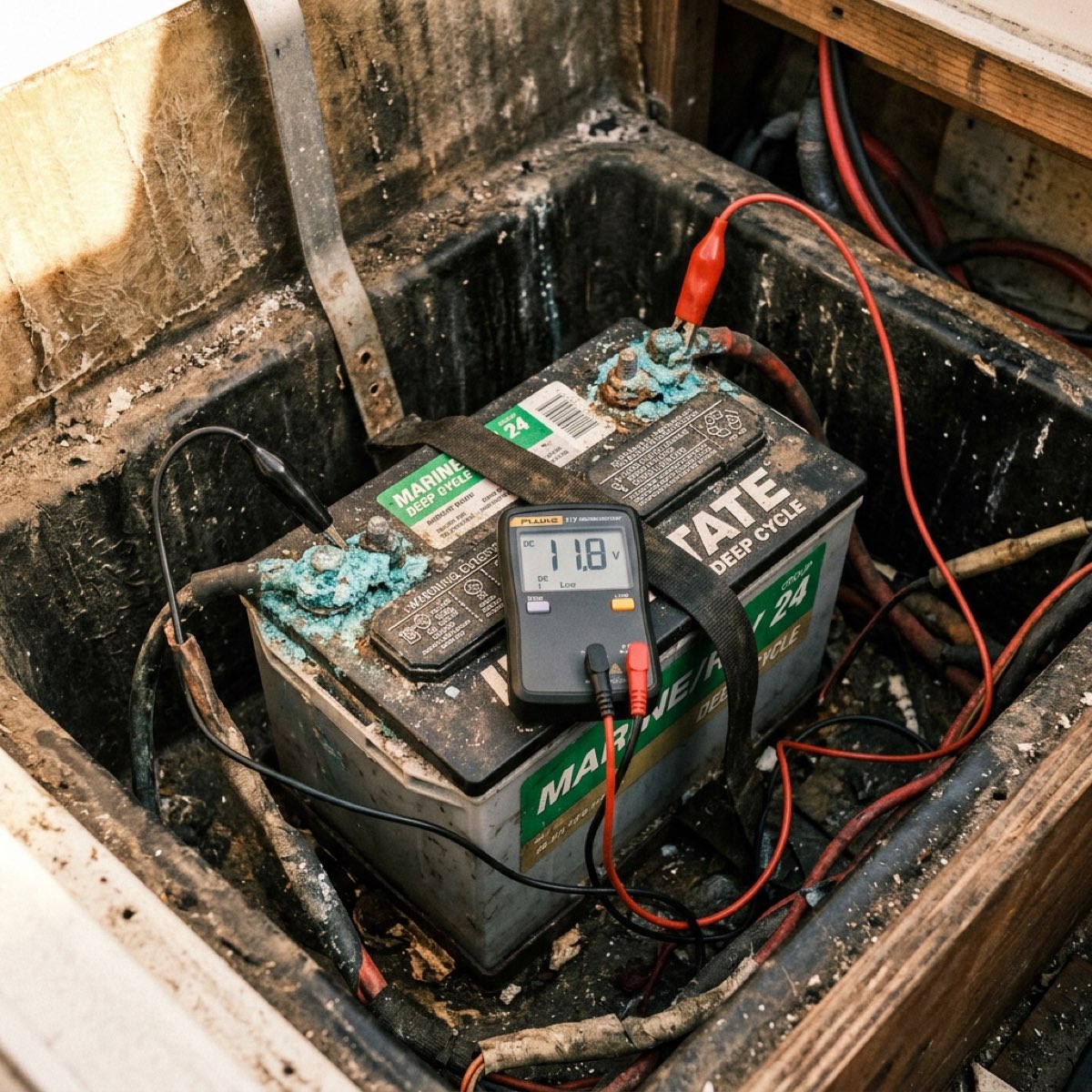
Cause 3: Corroded Battery Terminals Causing Inefficient Charging
This one is counterintuitive. Corroded terminals are usually thought of as a no-start problem, but they also cause drain — indirectly.
Heavy terminal corrosion increases resistance in the charging circuit. When the engine runs, the alternator/stator charges the battery, but the resistance means not all of the charging current gets through. The battery charges to 12.3V instead of 12.7V. Then overnight, a small normal draw (the chartplotter standby, the bilge pump circuit) pulls it down from 12.3V to 10.8V — a dead battery in the morning.
The same boat with clean terminals and a full 12.7V charge would have been fine.
How to identify it: Measure battery voltage immediately after a 30-minute run. If it reads below 13.5V with the engine running or below 12.6V within an hour after shutdown, the charging system is not completing a full charge. Check for terminal corrosion.
Fix: Clean terminals with a battery terminal wire brush ($8), apply CRC Battery Terminal Protector spray or dielectric grease, and re-measure. The charging voltage should improve immediately.
Cause 4: Aging Battery That Can No Longer Hold a Full Charge
A battery with one weak or dead cell will measure approximately 10.5V at rest instead of 12.6V — the missing 2.1V represents the dead cell's nominal contribution. You can charge it all day and it will never reach a healthy resting voltage.
A subtler version: a battery that charges to 12.4V but discharges to 10.5V in four hours even with minimal draw. The internal resistance has increased to the point where the battery cannot deliver or hold useful charge.
The load test: Any auto parts store (AutoZone, O'Reilly, NAPA) will load test a battery for free. They apply a controlled electrical load and measure how far the voltage drops. A healthy battery holds above 9.6V under load. A failing battery drops below 9V within seconds.
Do this before replacing any other component. A battery that fails the load test must be replaced — no charger, conditioner, or additive will meaningfully restore a battery with a dead cell.
Cause 5: Faulty Shore Power Converter / Battery Charger
This one surprised me when I first encountered it at the dealership. A shore power battery charger that is failing or that has a faulty diode can actually backdraw current from the battery when shore power is disconnected.
The scenario: you run the boat, dock it, plug in the shore power charger. Charger works normally. You disconnect shore power the next morning to head out. The charger's internal circuitry — specifically a failed isolation diode — now allows current to flow backwards out of the battery through the charger's circuitry.
How to identify it: Run the parasitic draw test with the shore power disconnected but the charger still wired to the battery (as it would normally be). If the draw disappears when you pull the charger's fuse or disconnect the charger's battery leads, the charger is the source.
Fix: Replace the charger. A quality onboard marine battery charger with proper isolation circuitry:
Cause 6: Live Well Pump or Aerator Timer Fault
On fishing boats with live wells, the aeration pump is typically controlled by a timer — it cycles on for a set period to oxygenate the water, then shuts off. A faulty timer can lock the pump in continuous operation even with an empty live well.
A typical 12V live well aerator pump draws 3–8 amps. Running continuously overnight, that is enough to flatten a battery in 6–10 hours.
How to identify it: Open the live well. Listen for pump operation with everything in the "off" position. The live well pump circuit will have its own fuse — pull it and watch the draw meter.
Fix: Most live well timers are simple mechanical or electronic units that can be replaced for $20–$45 at a marine supply store. The timer is usually accessible behind the console or beneath the gunwale near the live well compartment.
Cause 7: Navigation Lights Left On
This one is embarrassing but common, and I include it because it took me longer than it should have to figure it out the first time it happened.
LED navigation lights draw 0.5–1.5 amps each. Leave all three running lights on overnight and you are looking at 3–5 amps of continuous draw. A 100Ah marine battery is down to 50% capacity in 10–15 hours at that rate — and you should not discharge a starting battery below 50% regularly without shortening its life.
How to identify it: Walk around the boat in the dark before leaving. Bow light, stern light, and masthead or all-round anchor light should all be visually confirmed off.
Fix — long term: Wire navigation lights through the master battery switch. Wire the anchor light to a separate switch that is physically labeled and located away from the nav light switch to prevent confusion.
If You Have Multiple Batteries: Add an Isolator
Many boats with larger electronics loads — trolling motors, depth finders, stereos, live well systems — run two or more batteries. The typical setup is one starting battery for the engine and one deep-cycle battery for the electronics. Without an isolator between them, a draw on the electronics battery can bleed the starting battery down overnight.
A battery isolator prevents this by allowing current to flow into each battery from the charging system while preventing current from flowing between batteries. It is a diode-based device that costs $25–$85 and is one of the highest-value wiring upgrades on a multi-battery fishing or pontoon boat.
Battery isolators worth considering:
The Blue Sea ACR (Automatic Charging Relay) is worth the extra cost on boats where you regularly run electronics off the second battery. Unlike a diode isolator, it does not create a voltage drop in the charging circuit — a diode isolator loses approximately 0.5–0.7 volts across the diode, which means batteries charge slightly less fully.
The Battery Maintenance System That Prevents All of This
The real solution to chronic battery drain on a boat that sits at the dock between weekends is an automatic battery maintainer — not a charger, but a maintenance device that monitors voltage and applies a small "float" charge to compensate for self-discharge and minor draws.
The difference between a charger and a maintainer: a charger applies a constant current until the battery is full, then stops. A maintainer continuously monitors the battery and tops it up as voltage drops. Left on indefinitely, a quality maintainer extends battery life by preventing the repeated deep discharge cycles that kill marine batteries.
Maintainers worth using:
If your boat lives at a slip with shore power available, plug the maintainer in whenever you leave. A battery that never drops below 12.5V between uses will last significantly longer than one that cycles to 10.8V every weekend.
Quick Reference: The 7 Causes and Their Fixes
| Cause | Identifying Fuse | Fix | Cost |
|---|
| Bilge pump float switch | Bilge pump fuse | Replace float switch | $15–$30 |
| Electronics in standby | GPS/radio/stereo fuse | Add master battery switch | $85 |
| Corroded terminals | N/A — charging issue | Clean terminals, apply protector | $8 |
| Failing battery | N/A — battery itself | Load test, replace if failed | $130–$280 |
| Shore power charger fault | Charger fuse | Replace charger | $65–$120 |
| Live well timer fault | Live well pump fuse | Replace timer | $20–$45 |
| Navigation lights left on | Nav light fuse | Confirm lights off before leaving | $0 |
9. The Physics of Galvanic Leakage: When Your Hull Becomes a Ground
On aluminum-hulled boats (pontoons and fishing skiffs), a parasitic draw isn't always inside a wire. It can be a Hull Leak.
9.1 The "Stray Current" Phenomenon
If a positive wire has a tiny nick in the insulation and is touching the aluminum hull, it creates a circuit using the boat itself as the conductor.
- The Hazard: This doesn't just drain your battery; it causes Electrolysis. The current flowing through the aluminum into the water will literally dissolve your pontoon logs or hull over time, creating "pitting" that eventually leads to leaks.
- The Test: Set your multimeter to DC Volts. Place the black lead on the battery negative terminal and touch the red lead to any bare aluminum on the hull. If you see anything above 0.1V, you have a "Hot Hull." You must find the shorted wire immediately before it eats your boat.
10. NMEA 2000 Bus Drains: The "Backbone" Trap
Modern boats are networked. Your GPS, Engine, and Fish Finder all talk to each other over an NMEA 2000 (N2K) backbone.
10.1 The Power "T"
The N2K network requires its own 12V power supply.
- The Mistake: Many installers wire the N2K power lead directly to the battery or a "hot" fuse block.
- The Drain: Even if your GPS is turned off, the N2K network backbone—including all the sensors (fuel flow, speed, depth)—remains powered and "awake." This draws roughly 50-100 mA.
- The Fix: Your N2K power lead MUST be wired to a switched power source (the ignition key or a master dash switch). If your battery dies in 3 days, check if your N2K network is staying "Live" at the dock.
11. Lithium (LiFePO4) Drains: The BMS Intelligence Factor
If you have upgraded to Lithium Marine Batteries, you are dealing with a battery that has a built-in computer called a BMS (Battery Management System).
11.1 The Internal Consumption
The BMS itself draws a very small amount of power (micro-amps) to monitor the cells. However, some Bluetooth-enabled BMS units draw more.
- The "Sleep Mode" Crash: If you have a small parasitic draw on a Lithium battery, the BMS will eventually detect the low voltage and "Shut Down" to protect the cells. To the boater, the battery appears "Dead" (0 Volts).
- The Wake-Up: You cannot jump-start a "Shut Down" Lithium battery with a standard charger. You need a charger with a "Lithium Wake-Up" or "Force" mode to tell the BMS it is safe to accept current again.
12. The "Callahan Isolation Protocol": Final Troubleshooting
If you have pulled every fuse and the multimeter still shows a draw, the leak is located in a Non-Fused Circuit.
There are only three things on a boat usually wired without a fuse in the main panel:
- The Starter Motor: A faulty solenoid can leak current internally to the engine block.
- The Alternator/Stator: A blown diode in the alternator can allow current to "back-flow" into the engine block.
- The Master Switch: A corroded master switch can have "tracking" across the internal plastic, leaking current between the terminals.
The Protocol: One by one, disconnect the large positive leads from the Starter, then the Alternator. If the draw on your multimeter disappears when you disconnect the Alternator, you have a failed diode. Replace the alternator—it’s not just a drain; it’s a fire hazard.
13. Summary: The Quiet Thief
A parasitic draw is a silent thief that steals your weekend before it even begins. By using the Series Multimeter Test and understanding the hidden draws of NMEA 2000 and Alternator Diodes, you move from a "Guesser" to a "Technician."
Keep your terminals clean, your N2K switched, and your bilge float clear of debris.
I'll see you on the water.