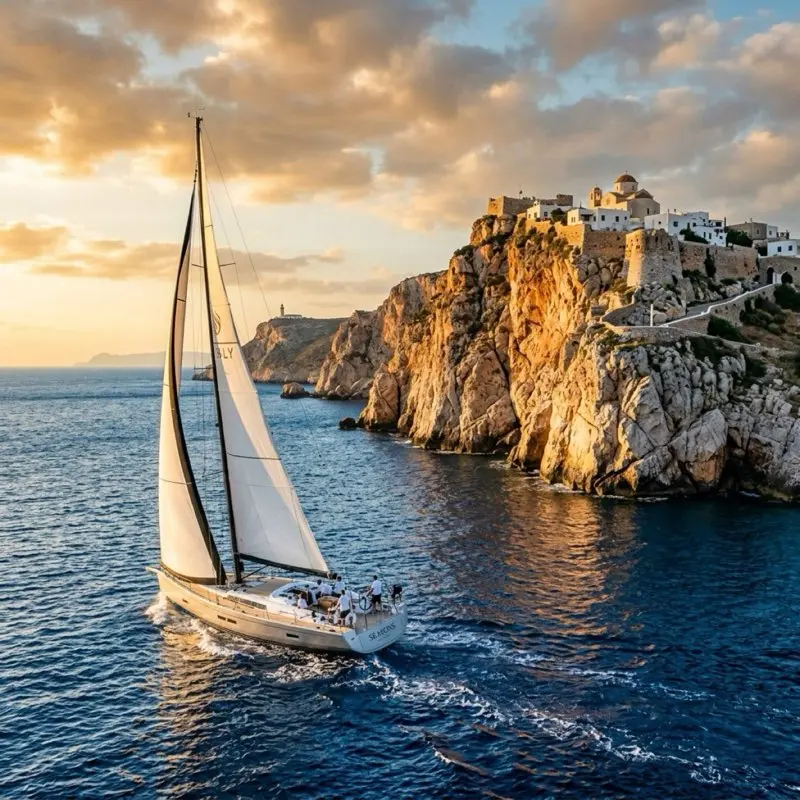
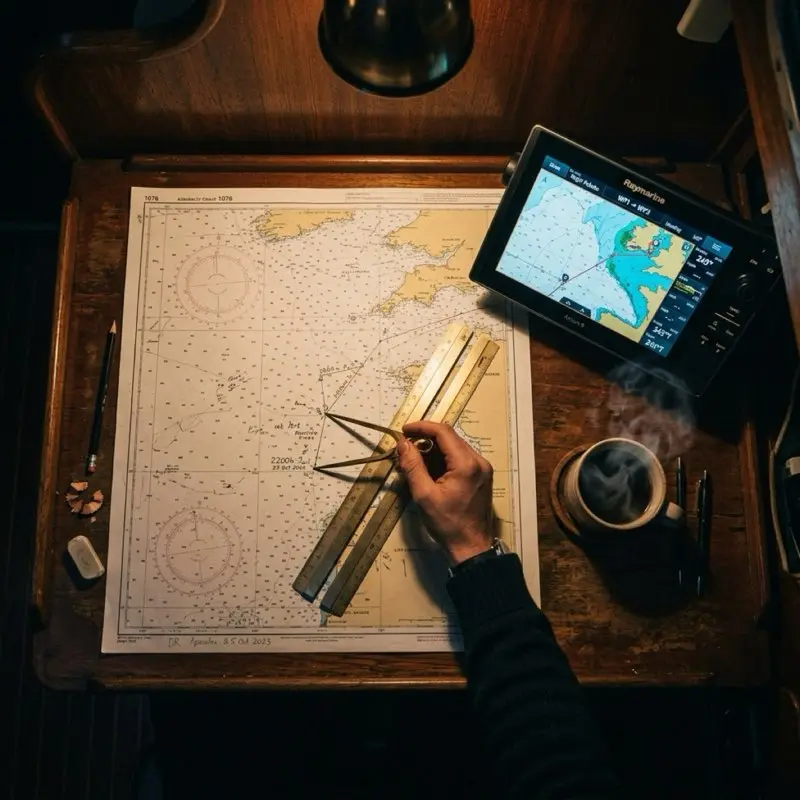
The approach to Stromboli at dusk is one of those sailing passages that lodges permanently in the memory and competes unfairly with everything that comes after it. We had left Siracusa forty hours earlier, motorsailed through a windless Ionian dawn, and then watched Sicily shrink behind us while the volcanic cone of Stromboli resolved itself from a haze smudge into a 924-metre island that was visibly, rhythmically, erupting every twenty minutes, a low orange belch of lava and smoke that lit the summit the way a camp fire lights a tent from inside.
The crew had been quiet for most of the passage. They were louder after that.
The Sicily-to-Greece sailing corridor is one of the most historically rich, geologically dramatic, and navigationally underrated routes in the Mediterranean. While the Cyclades attract the majority of charter tourism, the passage from Eastern Sicily through the Aeolian Islands and across the Ionian to the Greek mainland offers something rarer: genuinely mixed sailing conditions, active volcanism a hundred metres from your anchorage, Italian fishing villages that have not adjusted their menus for English-speaking visitors, and a Greek arrival, Corfu or Lefkada, that feels properly earned in a way a direct Corfu charter flight never could.
This guide covers the complete 7-island circuit: Siracusa → Vulcano → Lipari → Stromboli → Corfu → Lefkada → Ithaca. Approximately 750 nautical miles. Realistically 14 to 21 days.
About this guide: All route intelligence, anchorage notes, and navigation hazards are drawn from Alex Rivera's complete passage of the Sicily-to-Greece corridor in June 2023 (full crew, 46-foot sloop) and a second bareboat passage from Lefkada northward in September 2024. Wind and sea state data cross-referenced with HNMS (Hellenic National Meteorological Service) seasonal averages and Instituto Nazionale di Geofisica e Vulcanologia (INGV) volcanic activity reports. Disclosure: No charter company, marina authority, or tourism board compensated BoatGuider for any recommendation in this guide.
Why This Route Instead of the Cyclades
Before the route breakdown, a word on why this corridor is worth choosing over the more famous Cyclades circuit.
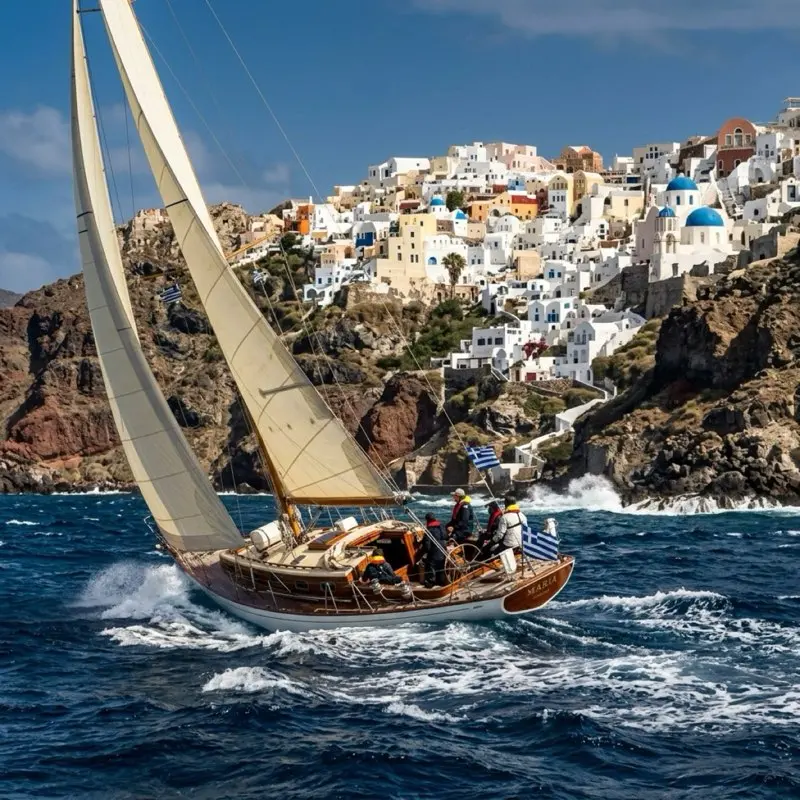
The Aegean offers dramatic island scenery and reliable meltemi summer sailing. It also offers 35-knot winds arriving without negotiation, crowded marinas at Mykonos and Santorini where a berth in July costs more than most weekly charter fees, and a homogenised tourist infrastructure that has largely erased the distinction between islands. The Cyclades are extraordinary. They are also, in peak season, exhausting in a way that has little to do with sailing.
The Ionian and the Aeolians offer a different rhythm. The Ionian wind, the maestrale in its Italian form and the northwesterly in the Greek section, is lighter and more consistent than the meltemi. Anchorages on Lefkada and Ithaca remain genuinely tranquil into July. The Aeolians are a UNESCO World Heritage archipelago that most Mediterranean charter sailors have never visited. And the passage itself, crossing the Ionian Sea in proper offshore conditions, is the kind of sailing that reminds you why you learned to sail.
Seasonal Timing: When to Sail This Route
| Month | Sicily / Aeolians | Ionian Crossing | Greek Ionian | Overall |
|---|
| May | 10–18kts NW, green and clear | Occasional SW swell | Quiet, uncrowded | Excellent, early season |
| June | 12–20kts, settled | Usually benign | Warming up | Ideal |
| July | 15–22kts, hot | Afternoon NW chop | Busy in Lefkada | Good, plan evening anchorages |
| August | 15–25kts | Can build to 3m swell | Peak tourist season | Good sailing, crowded harbours |
| September | 12–18kts | Most settled of season | Crowds thinning | Excellent, preferred window |
| October | Variable, fronts arriving | Increasing swell risk | Empty and beautiful | Experienced sailors only |
My recommended window: June 10 to September 20. The late June and September sweet spots avoid the August peak in the Greek Ionian while keeping you well inside the Sicilian and Aeolian weather window.
Island 1: Siracusa, Sicily, The Departure Point
Siracusa earns its place as a sailing departure base through a combination of excellent marina infrastructure, a UNESCO-listed old town, and a position that makes the run northwest to the Aeolians largely a beam reach in the prevailing northwesterly.
Marina Siracusa Yachting sits on the Ortigia island causeway, ten minutes walk from one of the finest baroque cityscapes in Italy. Berths are well-organised, fuel is dockside, and the marina office speaks enough English and French to handle customs formalities for non-EU vessels. Budget a full day for provisioning, the Ortigia market is the last truly excellent fresh produce opportunity before Greece. Buy aggressively: Sicilian capers, sun-dried tomatoes in oil, anchovies, four cheeses you don't recognise, and whatever the fishmonger has that morning.
Navigation note for departure: The approach channel to Siracusa from the south has a submerged reef system extending east of Punta del Braccio. Stay in the marked channel. The Grande Porto is deep and straightforward once inside, but the approach from the southeast in strong southwesterly conditions creates confused swell at the outer breakwater.
What not to miss ashore: The Archaeological Park of Neapolis, the Greek theatre of Syracuse, 2,500 years old and still used for summer productions, is two kilometres from the marina. The Ear of Dionysius is nearby: an artificial cave with acoustics so precise that even a whisper carries 22 metres. The Greeks knew what they were doing with stone.
Island 2: Vulcano, The Sulphurous Doorstep of the Aeolians
The Aeolian Islands officially number seven: Lipari, Vulcano, Stromboli, Salina, Panarea, Filicudi, and Alicudi. Vulcano is the southernmost and the logical first stop from Siracusa, typically a 9 to 12-hour passage of around 130 nautical miles in a working westerly-to-northwesterly.
Vulcano announces itself from a distance through smell before sight: a compound sulphur reek, not entirely unpleasant, that arrives roughly ten miles out as you close the southern coast. The Porto di Levante is a straightforward anchorage in the bay between the main Vulcano island and the smaller Vulcanello promontory, well-sheltered from the northwesterly in the summer pattern.
The mud pool: The famous fanghi, volcanic thermal mud, sit in an open-air thermal pool at the northern end of Porto di Levante bay, a five-minute walk from the anchorage. Entry costs €3. You cover yourself in grey volcanic mud, cook gently, rinse in the adjacent thermal sea water, and emerge apparently years younger. The scientific evidence for this is unclear. The experience is genuinely unlike anything else.
Navigation warning: Porto di Levante is uncomfortable and can become dangerous in southerly or southwesterly swell. If the forecast shows anything from the south for more than 12 hours, anchor on the east side of Vulcano in the sheltered bay, or proceed to Lipari. The anchorage has no shelter whatsoever from south through east.
Island 3: Lipari, The Capital of the Aeolians
Lipari is where the Aeolians organise themselves. Population 10,000, the largest town in the archipelago, a proper Castello on the hilltop with a cathedral and a volcanic museum that is genuinely worth two hours, and a harbour, Porto di Sottomonastero, that accommodates visiting yachts on a long concrete quay with stern-to berthing in the Italian fashion.
Navigation note: The channel between Vulcano and Lipari (roughly 4 nautical miles) runs fast in the northwesterly. Time your transit for a beam reach and enjoy one of the finest short passages in the Mediterranean. The hillsides above the channel carry obsidian, black volcanic glass that was the principal export of the Aeolians to the ancient Mediterranean world. This detail lands differently when you're actually sailing through it.
Provisioning: Lipari has a proper supermarket, a fresh fish market on Tuesday and Friday mornings, and a marine chandlery near the ferry terminal that stocks the sort of things you need after 130 miles of sailing: impeller kits, fuel filters, hose clamps, stainless wire. The chandler speaks Italian only, but the inventory is well-organised.
Island 4: Stromboli, The Lighthouse of the Mediterranean
The ancient Romans called Stromboli the "Lighthouse of the Mediterranean" because its eruptions marked the position for sailors crossing the Tyrrhenian for two thousand years. Modern sailors have better AIS systems and GPS, but Stromboli still marks something real: this is where the Aeolian circuit reaches its peak.
The anchorage is on the northwest coast at Scari, the small black-sand beach settlement below the village of San Vincenzo. Anchor in 5–8m on black volcanic sand, holds well, with the bow pointing toward the summit. Bring a dinghy; there is no real quay for visiting yachts.
Do not miss the night eruption watch. From the anchorage between 2300 and 0100, the volcano erupts every 15 to 25 minutes, each eruption illuminating the rim and sending a visible lava trail down the Sciara del Fuoco (the "Street of Fire" on the northwest slope). Sit in the cockpit with a glass of Salina Malvasia (brought from island 3) and watch geology in real time at something approaching geological speed.
Navigation consideration: Stromboli sits exposed in the northern Tyrrhenian. In northwesterly conditions over 25 knots, the anchorage at Scari becomes unpleasant and potentially unsafe. There is no shelter. If a blow is coming from the northwest, either anchor and depart before it arrives or anchor on the lee side, this provides temporary shelter in southwesterlies only. Read the weather carefully before committing this leg. I use PredictWind GRIB files for the 72-hour window and check the INGV volcanic activity bulletin, which occasionally affects the recommended approach sector.
The Ionian Crossing: Sicily/Aeolians to Greece
From Stromboli, the route turns east, or more precisely, northeast, toward the Greek Ionian. The most direct route to Corfu from Stromboli is approximately 350 nautical miles, typically a 2.5 to 3.5-day passage depending on conditions.
Option A: The Direct Offshore Crossing
Committed offshore sailors run directly from Stromboli to Corfu in a single passage, typically taking the southern route through the Strait of Otranto to stay in deeper water and maintain sea room. This is proper offshore sailing, 350nm with no intermediate stop. Required equipment: Category 1 EPIRB, jacklines rigged, proper night watch rotation, and a weather window of at least 72 hours of settled forecast.
Typical conditions: The Ionian Sea in summer is characterised by light northwesterly winds (8–15kts) and a residual 1–2m swell from the northwest quadrant. Afternoon sea breeze development can add 8–10kts along the Italian coast. The crossing is generally benign in June and September; July and August can produce more developed afternoon chop in the centre of the sea when the sea breeze and northwesterly stack on the same vector.
Option B: The Coastal Route via Calabria
More cautious sailors or those with more time hug the Italian Calabrian coast south of Scilla (where the Strait of Messina meets the Ionian), stopping at the Porto di Crotone or Porto di Taranto before crossing to Corfu. This adds 2–3 days and approximately 150nm but keeps you within easy reach of Italian marinas for the majority of the passage.
The Strait of Messina: If departing from Siracusa rather than Stromboli, many sailors choose to pass through the Strait of Messina, the channel between Sicily and mainland Italy, famous in Homer's Odyssey as the lair of Scylla and Charybdis. The strait is real, narrow, and subject to tidal currents up to 4 knots at springs. Time the transit for the south-going stream if heading to the Aeolians from the Tyrrhenian side. A chartplotter with current overlay and AIS is essential in the Strait of Messina, commercial shipping traffic is constant and fast.
Island 5: Corfu, The Greek Arrival
Arriving in Corfu from the Ionian crossing after two days offshore is one of the best moments in Mediterranean sailing. The Diapontia Islands materialise off the port bow, then the mountains of Albania to the northeast, then the green bulk of Corfu itself, one of the only genuinely tree-covered Greek islands, which is why it looks so dramatically different from the white-and-brown limestone of the Aegean.
Gouvia Marina is the main yacht base on Corfu's east coast, modern, well-run, with full fuel, water, and shore power. It is also, in July and August, packed. The Port Authority at Corfu Old Town (south of Gouvia, near the Old Fortress) is worth anchoring outside for the approach alone.
The Old Town: Corfu Old Town is probably the most architecturally distinctive place in Greece. Two Venetian fortresses frame a UNESCO-listed old quarter of French-influenced colonnades, British-era cricket ground, and Venetian alleyways. None of this exists elsewhere in the Greek islands. Budget one full day ashore minimum.
Island 6: Lefkada, The Island Connected to the Mainland
Lefkada is technically connected to the Greek mainland by a causeway and a swing bridge (opens on the hour for mast-bearing vessels from 0600 to 2200). This minor logistical detail makes it the main provisioning hub for the southern Ionian sailing ground.
Nidri on the east coast is the sailing centre of Lefkada, a town built entirely around the charter market, with a chandlery, laundry, water taxi fleet serving the offshore islands, and a taverna count that exceeds its permanent population. It is where you re-provision before heading to Meganisi, Ithaca, and Kefalonia.
Porto Katsiki on the west coast is why you are here. A beach at the base of 200-metre white limestone cliffs accessible only by boat or a punishing staircase from the clifftop. In June or early September, before the tripper boats arrive at 1000, it is one of the finest anchorages in the Mediterranean. Arrive before 0830. Deploy your own anchor in 4–5m on sandy gravel. Swim in water that is genuinely, embarrassingly clear.
Island 7: Ithaca, The End That Feels Like a Beginning
Ithaca is where this circuit earns its emotional weight. Small (117 sq km), mountainous, and largely resistant to the charter-scaled commercialism of its neighbours, Ithaca gives you a Vathy harbour ringed by hills, a single main street along the waterfront, tavernas that refuse to be anything but local, and the knowledge that this was, by Homer's accounting, the whole point of the entire Odyssey.
The symbolic weight sits gently, not obtrusively. Nobody is selling Odysseus-themed merchandise on Ithaca with any particular enthusiasm. The island doesn't lean into it. That restraint is, itself, the reason to come.
Anchor in Vathy Bay in 5–8m on sand. Walk the waterfront to one of the three or four family-run tavernas. Order whatever is written on today's hand-chalked board, not the printed menu. Drink the local wine from unlabelled decanters. Watch the sun drop behind the hills and understand exactly why Odysseus was in such a hurry to get back.
Practical Guide: The Full Circuit
At a Glance
| Leg | Route | Distance | Estimated Time |
|---|
| 1 | Siracusa → Vulcano | 130nm | 12–16 hrs |
| 2 | Vulcano → Lipari | 8nm | 1 hr |
| 3 | Lipari → Stromboli | 25nm | 3–4 hrs |
| 4 | Stromboli → Corfu (offshore) | 350nm | 2.5–3.5 days |
| 5 | Corfu → Lefkada | 90nm | 8–12 hrs |
| 6 | Lefkada → Ithaca | 30nm | 3–4 hrs |
| Total | | ~635nm | 14–21 days |
Charter Considerations
- Italian Aeolian legs: Charter from Palermo, Catania, or Milazzo (the ferry port for the Aeolians) for an Aeolian-only circuit before flying to pick up a Greek Ionian charter separately.
- Full circuit: A bareboat or skippered charter from Siracusa to Lefkada is available through operators including Dream Yacht Charter, Sunsail, and several independent Sicilian operators. Require that the charter agreement explicitly covers both Italian and Greek territorial waters, not all standard agreements do.
- Crew qualification: The Ionian offshore crossing requires RYA Coastal Skipper or ICC equivalent plus evidence of offshore passage-making for bareboat charter. Skippered charter removes this requirement.
Documents Required
- EU flagged vessels: Ship's papers, skipper's licence (ICC), insurance in Italian and Greek waters
- Non-EU vessels: Customs clearance at the first Italian port of entry, transit log stamped at each official port
- Firearms on board: Strictly regulated in Italian waters. Declaration mandatory and enforcement real.