You just spent $1,200 on a high-definition fish finder with Side-Scan and Down-Imaging. You mount it to the back of the log, drop the boat in the water, and everything looks great, until you hit 5 MPH. Suddenly, your screen turns into a "Digital Blizzard" of white static. You’ve lost the bottom, you’ve lost the fish, and your expensive electronics look like they’re broken.
The problem isn't the fish finder; it's Hydrodynamics.
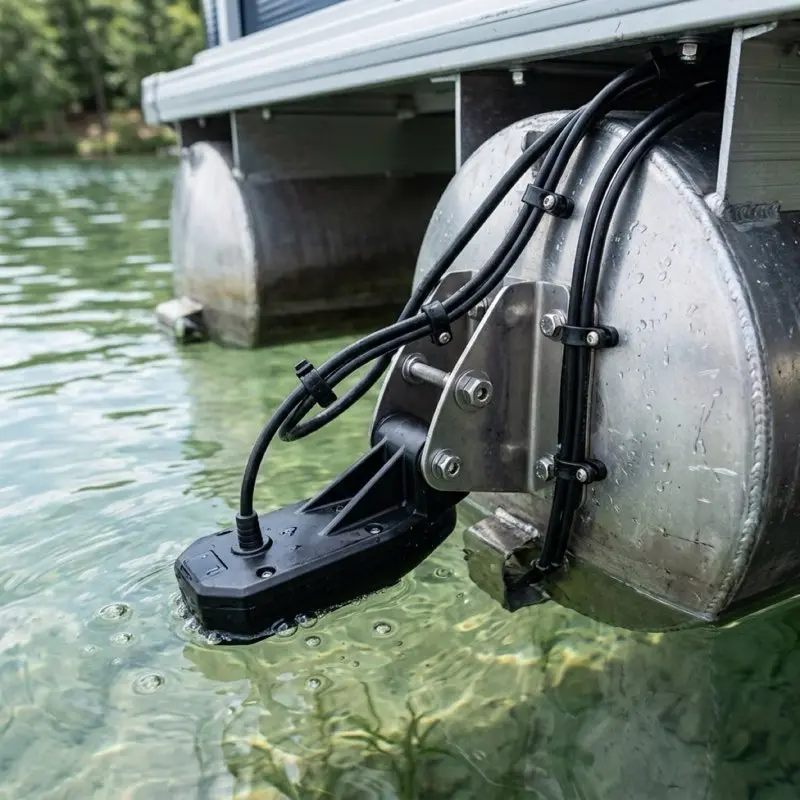
To get a clear sonar signal on a pontoon, you must mount the transducer on the Starboard (Right) log, positioned exactly 1/8 inch below the bottom edge of the hull. This location ensures the transducer sees 'Clean Water' that hasn't been aerated by the propeller's clockwise rotation. For Side-Scan units, you must also ensure the engine's lower unit isn't 'Shadowing' the sonar beam by trimming the motor up or using a bracket extension.
The good news: Your electronics are fine. You just need to move them out of the "Dirty Water" path. Here is the exact rigging protocol used by professional marine technicians to get clear readings at 25+ MPH.
Mike Callahan's Masterclass Note: "Pontoons are essentially 'Bubble Factories.' Because the logs are round, they push a massive volume of air underwater as they move. Sonar cannot see through air bubbles. If your transducer is even half an inch too high, it’s like trying to look through a frosted glass window. We have to find the 'laminar flow', the smooth, bubble-free water sliding off the bottom of the log."
| The Pontoon Mounting Matrix | Best Log Location | Ideal Depth | Side-Scan Clear? |
|---|
| Twin-Log (Standard) | Rear Starboard Bracket | 1/8" below log edge | Yes (Requires Trim-Up) |
| Tritoon (Center Pod) | Center Pod (Either Side) | Flush with bottom | No (Engine Blockage) |
| High-Speed Performance | Outer Starboard Edge | 1/4" below log edge | Yes |
| Trolling Motor Mount | Lower Unit of TM | Submerged | No |
Scenario A: The "Dirty Water" Blizzard (Aeration & High-Speed Failure)
If your screen works at idle but fails at speed, you are suffering from Aeration.
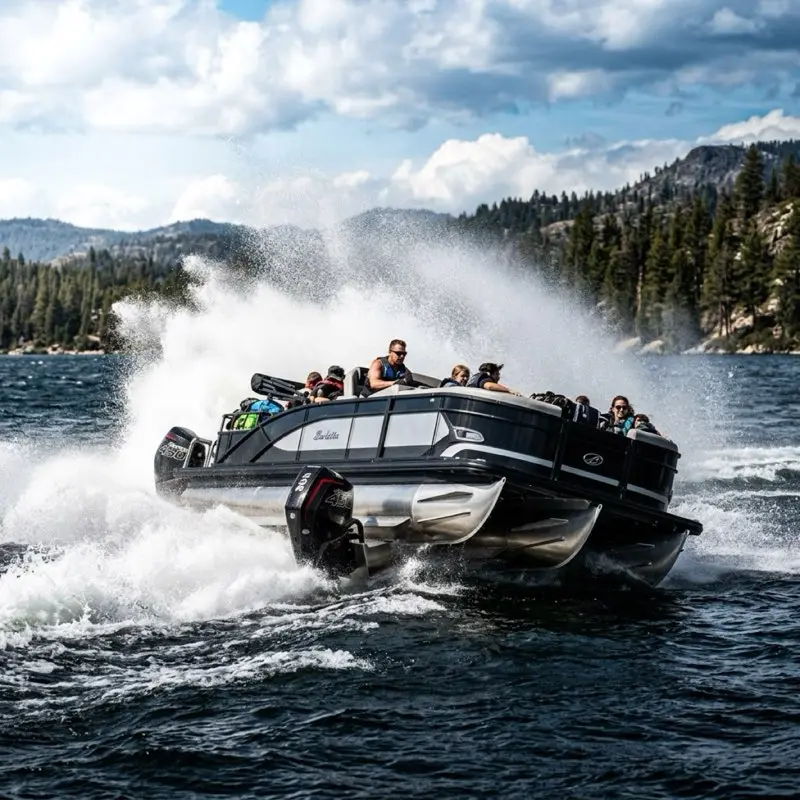
As a pontoon log moves through the water, it creates a "rooster tail" of bubbles and spray behind it. If your transducer is mounted too high on the factory bracket, it is sucking in those bubbles.
- The Fix: Lower the transducer in 1/8-inch increments until the signal stays locked at high speed.
- The Warning: Do not go more than 1/2 inch below the log. At high speeds, the "drag" on the transducer will be so high it can snap the plastic bracket or create a massive "spray" that soaks your engine.
Scenario B: The "Side-Scan" Shadow (Engine Blockage)
Side-Scan sonar (Garmin SideVü, Humminbird MEGA) sends beams out horizontally to the left and right.
If your transducer is mounted on the inner side of the starboard log, the engine's lower unit is sitting directly in the path of the "Left" beam.
- The Result: The left half of your screen will be dark or show a ghosting image of your own propeller.
- The Pro Fix: You have two options. Either mount the transducer on the outer edge of the log (clearing the motor entirely) or use the "Trim-Up" Trick. By trimming your motor up 20% while searching for fish, you lift the lower unit out of the sonar's line of sight.
Technical Deep Dive: The "No-Drill" Rule (Why you never drill a log)
I see it every year: A boater wants a "custom" location, so they drill two holes directly into the aluminum pontoon log to mount a bracket.
Never drill directly into a pontoon log.
- Pressure Loss: Logs are slightly pressurized. Once you breach that seal, the log can take on water from condensation or small leaks, causing the boat to lean.
- Corrosion: Stainless steel screws in an aluminum log create Galvanic Corrosion. The aluminum will literally dissolve around the screw over 2–3 seasons, leaving you with a permanent leak.
- The Fix: Always use the pre-welded factory bracket or an Aluminum Mounting Block. These blocks are glued or welded to the log, providing a safe "sacrificial" surface for your screws.
Scenario C: The "Electronic Ghost" (RFI and Trolling Motor Noise)
If you see vertical lines or "snow" on your screen only when the engine is running or the trolling motor is on, you have Radio Frequency Interference (RFI).
Your transducer cable is an antenna. If it is bundled tightly with your engine's main battery cables, the high-voltage "noise" from the alternator will leak into the sonar signal.
- The Fix: Run your transducer cable through a separate channel. If you must cross a power wire, cross it at a 90-degree angle. Never run them parallel for long distances.
- The Pro Tip: Install a Ferrite Bead (a small snap-on magnet) on the transducer cable near the back of the fish finder unit. This acts as a "filter" for electronic noise.
Frequently Asked Questions
Why does my transducer create a 'Rooster Tail' of water?
This is caused by the water hitting the square back of the transducer bracket. Most manufacturers sell a small "Spray Shield" to deflect this water back down. If you don't have one, you can slightly "toe-in" the front of the transducer to reduce the pressure.
How do I level the transducer if the boat is on a trailer?
You can't. Pontoons sit differently on a trailer than they do in the water.
- The Trick: Put the boat in the water, sit at the helm, and have a friend use a spirit level to see the "Running Angle" of the deck. Then, go back to the trailer and replicate that angle by adjusting the trailer jack. Now, you can level your transducer relative to the water, not the ground.
Can I mount the transducer on the port (left) log?
You can, but it’s not ideal. Standard propellers rotate clockwise. This means the water on the port side is being pulled up toward the surface, bringing air with it. The water on the starboard side is being pushed down, creating a "cleaner" signal path.
What is 'High-Speed' Sonar?
If you want to read depth at 40+ MPH, you often need a dedicated "2D P66" style transducer mounted slightly deeper. Side-Scan and Down-Imaging are optimized for speeds under 10 MPH; they will almost always fail at wide-open throttle due to the physics of water turbulence.