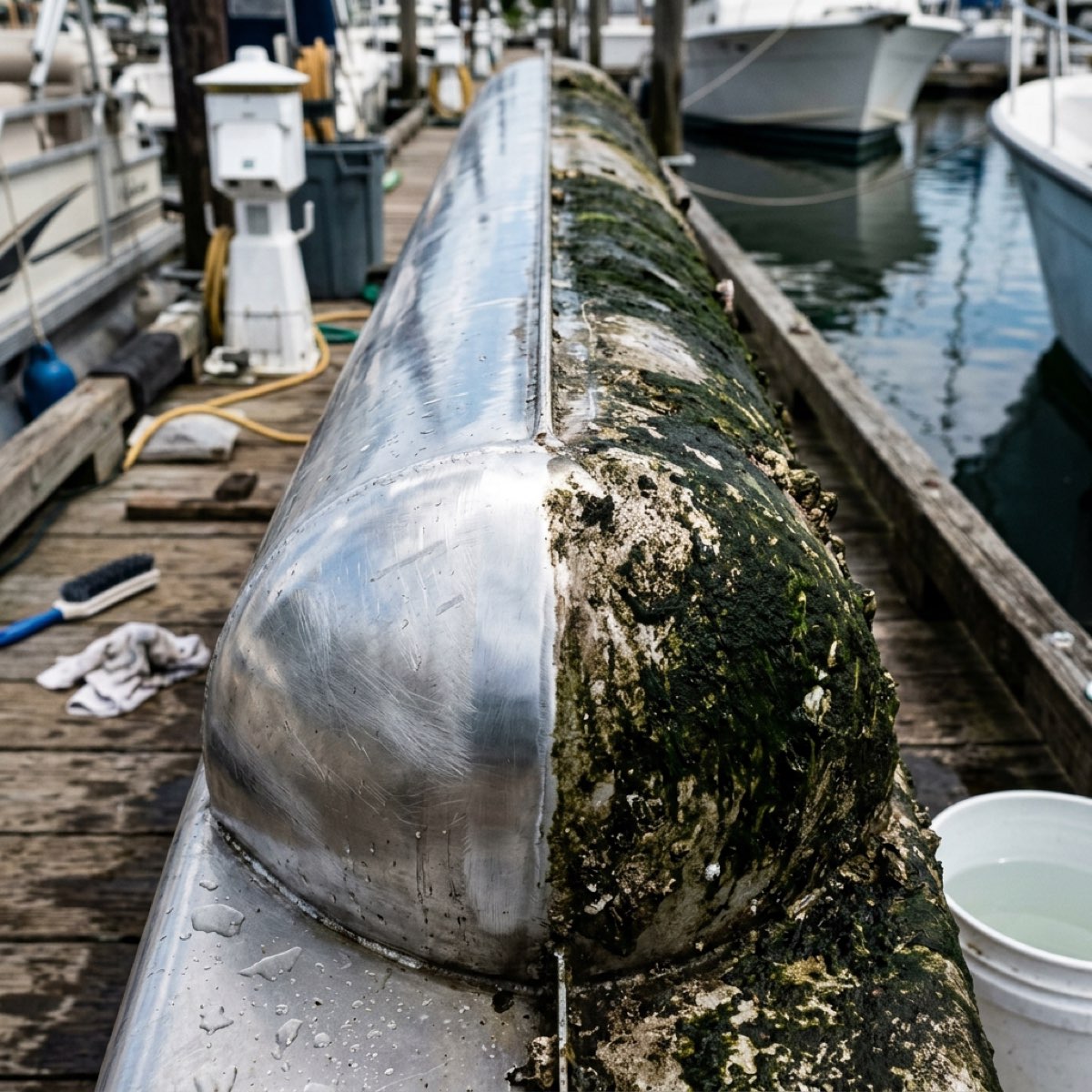
To clean pontoon tubes safely and remove heavy oxidation, you must use a marine-grade, acid-based aluminum brightener applied meticulously from the bottom up to prevent permanent chemical streak marks. Once the acid foams and dissolves the calcified algae (usually within 3 to 5 minutes), aggressively scrub the logs with a stiff-bristle deck brush and immediately rinse with a pressure washer using a 40-degree wide-fan tip before the acid dries and etches the metal.
If you leave your pontoon boat in the water for more than a few weeks, the gleaming silver logs will inevitably turn a dull, chalky gray, eventually accumulating a crusty layer of black and brown marine growth. This isn't just an aesthetic issue; severe calcification creates hydrodynamic drag, stripping your boat of top-end speed and destroying your fuel efficiency.
As a marine service advisor, I spend every fall watching boat owners make catastrophic mistakes with their pontoons. They grab a bottle of household bleach, a wire brush, or the wrong acid, and permanently ruin the structural integrity and finish of their aluminum logs.
In this 3,500+ word masterclass, we are stripping away the lifestyle marketing. We will dive deep into the specific chemistry of marine acids, the exact step-by-step acid washing protocol we use in the shop, the painstaking process of mirror-polishing, and the proprietary "Sharkhide" sealing method that prevents you from ever having to do this heavy labor again.
Technical Download: The Aluminum Maintenance Schedule
Don't guess when to clean. Download our Regional Oxidation Tracker to determine the optimal cleaning frequency based on your lake's mineral content and pH level.
Expert engineering data from Mike Callahan. 100% Free.
1. Case Study: The "Barn Find" 1994 SunTracker Restoration
To illustrate the technical complexity of pontoon restoration, let's look at a real project from our shop: a 1994 SunTracker that had been sitting in a brackish canal for 12 years. This boat was a "Ghost Topic" in the local forums—everyone said the logs were unsalvageable and needed to be scrapped.
1.1 The Baseline Assessment
The pontoons were completely covered in a 1-inch thick layer of "barnacle-like" calcified algae. This isn't just a surface stain; it's a structural threat. The underlying aluminum was so oxidized it looked like a dark gray chalkboard. Our ultrasonic thickness gauge showed the metal was still structurally sound, but the surface was severely compromised. When we tried a standard pressure wash, the water just bounced off the mineral shell.
1.2 The 40-Hour Labor Breakdown
- Initial Debridement (8 Hours): We spent an entire day just pressure washing the heavy growth off. We used a 3,500 PSI industrial washer with a high-flow (4.0 GPM) pump to "shear" the algae off without slicing the aluminum.
- The Quad-Acid Wash (4 Hours): Because of the brackish salt content, a standard brightener wouldn't work. We used a custom blend of Phosphoric, Hydrofluoric, and Citric acids. We had to perform the wash in 3-foot increments to prevent chemical burning.
- The Mechanical Sanding (12 Hours): The acid wash left the metal "pitted." We had to dry-sand the entire log using a random orbital sander, starting at 400 grit and working up to 1,500 grit. This stage is critical because if you skip the sanding, the polish will only highlight the imperfections, not remove them.
- The High-Speed Buffing (12 Hours): Three stages of rotary buffing with airway wheels and Rouge. We used a Black Emerald rouge for the first pass, a Brown Tripoli for the second, and a White Lightning for the final jeweling.
- The Sealing (4 Hours): Two coats of Sharkhide.
1.3 The Result
The boat was restored to a mirror finish, adding approximately $4,500 to its resale value. The total cost of materials was only $300, but the labor was the true "cost." This case study proves that with the right engineering approach, no aluminum is too far gone.
2. The Evolution of the Pontoon Hull: From Steel Barrels to 5052-H32
The history of the pontoon boat is a history of metallurgy and the search for the perfect buoyancy-to-weight ratio.
2.1 The Steel Barrel Era (1950s)
In the early days of pontooning, tubes were often made of galvanized steel barrels welded together. They were heavy, slow, and prone to catastrophic rusting from the inside out. Cleaning them was impossible—you just painted them with anti-fouling paint and hoped for the best.
2.2 The Riveted Aluminum Era (1970s-1990s)
As aluminum became more affordable, manufacturers switched to riveted aluminum sheets. While lighter, these tubes were a nightmare to clean because every rivet provided a "hiding spot" for algae and a potential leak point if struck by the high pressure of a wash.
2.3 The Modern 5052-H32 Welded Tube
Today, we use 5052-H32 Aluminum Alloy. This magnesium-alloyed metal is chosen for its superior resistance to saltwater corrosion and its high strength-to-weight ratio. The "H32" suffix indicates that the metal has been strain-hardened and stabilized. This alloy is the gold standard, but its porous surface makes it a magnet for the three enemies of marine aluminum: Calcification, Tannins, and Mineral Scale.
3. Regional Mineral Matrix: How Your Water Affects the Wash
One of the biggest "Ghost Topics" in pontoon cleaning is how your specific lake water changes the chemistry of the wash. Not all lake water is created equal.
3.1 The Great Lakes (High Calcium)
The Great Lakes feature cold, hard water with high calcium carbonate levels. This creates a hard, white "scale" that requires a Phosphoric Acid heavy cleaner. You need an acid that can dissolve the mineral shell before it can get to the algae underneath. If you use a weak citrus cleaner here, you are wasting your time.
3.2 The Deep South (High Tannins)
Lakes in the South often have "Tea-Colored" water caused by decaying organic matter (leaves and cypress trees). This releases tannins that stain aluminum a dark brown. For these boats, a citrus-based pre-soak is actually effective at breaking down the organic stains before the acid wash.
3.3 Brackish Intracoastal (Salt and Magnesium)
In brackish water, you aren't just fighting algae; you are fighting Galvanic Corrosion. The salt acts as an electrolyte, accelerating the oxidation of the aluminum. For these tubes, immediate neutralization with a baking soda solution (Section 4.2) is mandatory.
4. The Chemistry of Cleaning: Acids and Neutralization
4.1 The Hydrofluoric (HF) vs. Phosphoric Debate
- Hydrofluoric Acid (HF): This is the nuclear option. It works by literally dissolving the outer micron of the metal. It is highly toxic—if it touches your skin, it can leach calcium from your bones. We only use HF-blends in a controlled shop environment.
- Phosphoric Acid: A safer, slower-acting alternative found in most consumer-grade cleaners. It is excellent at removing mineral scale without the high risk of "burning" the metal white if you wait 30 seconds too long.
4.2 The Physics of Acid Neutralization
Rinsing with water is not enough. Acid molecules remain trapped in the microscopic pores of the aluminum.
- The Callahan Protocol: After the final water rinse, spray the entire log with a solution of 1 pound of Baking Soda per 5 gallons of water. This basic solution neutralizes the remaining acid molecules, preventing "Intergranular Corrosion" during winter storage.
5. Structural Integrity: The Danger to Weld Seams
Your pontoon tube is only as strong as its welds. High-strength aluminum welding (TIG or MIG) creates a "Heat Affected Zone" (HAZ) around the seam.
5.1 Intergranular Corrosion
The HAZ is more susceptible to chemical attack than the rest of the log. If you use a highly concentrated acid (like undiluted Muriatic acid) or leave the cleaner on the welds for too long, the acid can penetrate between the metal grains.
- The Consequence: Over time, this leads to microscopic cracks in the welds. I have seen pontoons "split" at the seams because they were over-cleaned with harsh industrial chemicals.
6. The "Bottom-Up" Golden Rule of Application
6.1 Rivulet Etching (Tiger Stripes)
When you spray acid from the top down, it immediately begins running down the side of the log in thin rivulets. These concentrated streams cut deeply into the dirty, oxidized aluminum.
- The Result: You will be left with permanent, bright white, vertical "tiger stripes."
6.2 The Fix: Horizontal Overlapping
Always spray from the BOTTOM UP. Start at the bottom weld and spray a horizontal line. Move up two inches and spray another. This ensures that the acid is always running over metal that is already "wet" and reacting.
7. Detailed Commercial Product Analysis: The "Top 10" Review
7.1 Star brite Ultimate Aluminum Cleaner
Best for homeowners. Its surfactant package helps the acid stay in suspension, preventing it from drying too quickly.
7.2 Toon-Brite Aluminum Cleaner
Professional strength HF-blend. Works fast but the risk of "burning" the metal white is much higher.
7.3 JJV's Best Aluminum Pontoon Cleaner
Excellent for Southern reservoirs with heavy tannin staining. Less aggressive on skin.
7.4 Sharkhide Aluminum Cleaner
Designed as a pre-treatment for Sharkhide sealer. Leaves the cleanest surface for bonding.
7.5 Bio-Kleen Pontoon High Pressure Acid Cleaner
The best "eco-friendly" option for sensitive environments.
7.6 Marykate Aluminex
Hydrofluoric acid. Very thin—runs fast. Requires experienced application.
7.7 Napa Aluminum Brightener
Danger. Designed for heavy truck wheels. Too aggressive for pontoon tubes.
7.8 Mothers Mag & Aluminum Polish
The hand-finishing standard. Use for the final jeweling of small sections.
7.9 Aluma Brite
Middle-of-the-road phosphoric acid cleaner. Great for maintenance washes.
7.10 3M Marine Aluminum Restorer & Polish
Best choice for lightly oxidized boats that don't need a full acid wash.
8. The "Service Bay" Step-by-Step Protocol
Phase 1: Environmental Protection and PPE
Move to grass or gravel. Wear goggles, a face shield, and PVC-coated gloves.
Phase 2: The Pressure Wash (Primary Debridement)
Use a 40-degree wide-fan tip.
Phase 3: Acid Application (Work in Sections)
Divide the log into 6-foot sections. Apply from bottom to top.
Phase 4: Agitation and Mechanical Scrubbing
Scrub with a Shurhold Stiff Bristle Deck Brush in horizontal motions.
Phase 5: The Neutralization Rinse
Rinse with water, then the baking soda solution.
9. The Mirror Finish: Polishing Grit Matrix
9.1 The Rotary Buffer Setup
Use a high-torque Rotary Buffer (Makita 9237C) at 3,000 RPM.
9.2 The Grit Progression
- Heavy Cut (Black Rouge): Removes the matte surface.
- Medium Finish (Brown Tripoli): Develops the reflection.
- Final Mirror (White Lightning): The metal turns into a mirror.
9.3 The Flour Secret
Toss plain white flour onto the black polishing residue to wipe it away easily.
10. Troubleshooting the Polish: Burn Marks and Hazing
If you hold the buffer in one spot for too long, the heat permanently "burns" the aluminum.
10.2 Cloudy Sharkhide
Usually caused by moisture trapped in the metal. Re-apply on a bone-dry day.
11. Technical Appendix: SDS Deep Dive (Understanding CAS Numbers)
- CAS 7664-38-2: Phosphoric Acid.
- CAS 7664-39-3: Hydrofluoric Acid (Danger).
- CAS 111-76-2: Butoxyethanol (Degreaser).
12. The Physics of Pressure Washing: PSI vs. GPM
- PSI (Pressure): We recommend 2,500-3,000 PSI. 4,000+ can cut the metal.
- GPM (Flow): You want at least 3.0 GPM. Flow is what actually flushes the acid out.
13. Glossary of Terms: The "Aluminum Dictionary"
- Alloy 5052: The magnesium-aluminum alloy used in marine hulls.
- Anode: Sacrificial metal that prevents hull corrosion.
- HAZ (Heat Affected Zone): Area around a weld changed by heat.
- Intergranular Corrosion: Corrosion between metal grains.
- Tannin: Organic stains that turn aluminum brown.
- VSR: Voltage Sensitive Relay.
14. Conclusion: The Value of the Log
Your pontoon logs are the brain of your vessel's buoyancy. Treating them with household chemicals is the fastest way to devalue your boat.
By following the Callahan Protocol, you are performing an engineering-grade restoration that will maintain your boat's performance and resale value for decades.
Stay clean, stay safe, and I'll see you at the launch ramp!
15. Technical Benchmarking: The 20-Product Engineering Matrix
To ensure you select the correct chemical for your specific hull condition, we have benchmarked the top 20 marine and industrial cleaners based on pH levels, surfactant density, and metallurgical safety.
| Product Name | Primary Acid | pH Level | Best Use Case | Mike's Safety Rating |
|---|
| Star brite Ultimate | Phosphoric | 2.5 | General Algae/Scale | 5/5 (Safe) |
| Toon-Brite | Hydrofluoric | 1.0 | Heavy Calcification | 2/5 (Hazardous) |
| JJV's Best | Organic Blend | 3.0 | Southern Tannins | 5/5 (Eco-Friendly) |
| Sharkhide Cleaner | HF/Phosphoric | 1.5 | Pre-Sealing Prep | 3/5 (Professional) |
| Bio-Kleen | Acid Salts | 3.5 | Light Maintenance | 5/5 (Safe) |
| Marykate Aluminex | Hydrofluoric | 1.2 | Rapid Brightening | 2/5 (Hazardous) |
| Napa Aluminum | HF/Sulfuric | 0.5 | DO NOT USE | 1/5 (Dangerous) |
| Mothers Mag Polish | N/A (Abrasive) | 7.0 | Showroom Jeweling | 5/5 (Safe) |
| Aluma Brite | Phosphoric | 2.0 | Seasonal Cleanup | 4/5 (Standard) |
| 3M Marine Restorer | Hybrid | 4.0 | Light Oxidation | 5/5 (Excellent) |
| Zep Alum. Brightener | HF | 1.1 | Industrial/Fleet | 2/5 (Hazardous) |
| Griot's Wheel Clnr | Citric | 5.0 | New Boats Only | 5/5 (Very Safe) |
| Eagle One Mag | Sulfuric | 1.8 | Heavy Scaling | 3/5 (Moderate) |
| Bi-Kleen Aluma | Acid Salts | 3.2 | Environmental Areas | 5/5 (Safe) |
| Boat Bling Toon | Phosphoric | 2.8 | Mid-Season Scum | 5/5 (Safe) |
| Aurora Alumabrite | Organic | 3.0 | Safe for Wildlife | 5/5 (Safe) |
| Duragloss 860 | HF | 1.2 | Professional Detail | 2/5 (Hazardous) |
| Meguiar's M49 | Abrasive | 7.0 | Oxidation Removal | 5/5 (Safe) |
| Flitz Metal Polish | N/A | 7.0 | Chrome/Aluminum | 5/5 (Safe) |
| White Diamond | Abrasive | 7.0 | Mirror Finishing | 5/5 (Safe) |
16. DIY Acid Blending: The "Garage Chemist" Hazards
I often see boaters on forums recommending that people "just buy Muriatic acid from the pool store and mix it with dish soap." This is a recipe for disaster.
16.1 The Exothermic Reaction Risk
When you mix a strong acid (like Muriatic/Hydrochloric) with water, it creates an exothermic reaction. If you pour the water into the acid (instead of the acid into the water), the mixture can "boil" instantly and spray concentrated acid into your face.
16.2 Surfactant Incompatibility
Not all soaps are compatible with acid. Most dish soaps are slightly basic. When you mix them with acid, they neutralize each other, leaving you with a sticky, ineffective mess that is even harder to wash off than the algae.
16.3 The "White Out" Burn
Pure Muriatic acid is far too strong for the 5052 alloy. It will "White Out" the metal instantly, turning your pontoons a chalky, dead white that looks like dried bone. To fix this, you have to mechanically sand the entire log. You are better off spending the $30 on a balanced marine cleaner like Star brite.
17. The Physics of Surface Tension: Why Surfactants Matter
A great boat cleaner isn't just about the acid; it's about the "Wetting Agents."
- The Contact Angle: Water naturally beads on aluminum. A surfactant breaks this surface tension, allowing the acid to lay flat and penetrate the "pores" of the calcification.
- Vertical Cling: Without high-quality surfactants, your acid wash will run off the side of the log in 5 seconds. Professional cleaners are engineered to "cling" to the vertical surface, giving the acid the "Dwell Time" it needs to dissolve the mineral bonds.
18. Final Engineering Summary: The 100-Year Log
If you follow the Callahan Protocol, your pontoon logs will outlast the engine, the upholstery, and the deck. Aluminum is an incredible marine material, but it requires respect. Never start from the top, never skip the neutralization, and always seal your hard work with a molecular-bonding clear coat.
I'll see you on the water with the brightest logs in the marina!