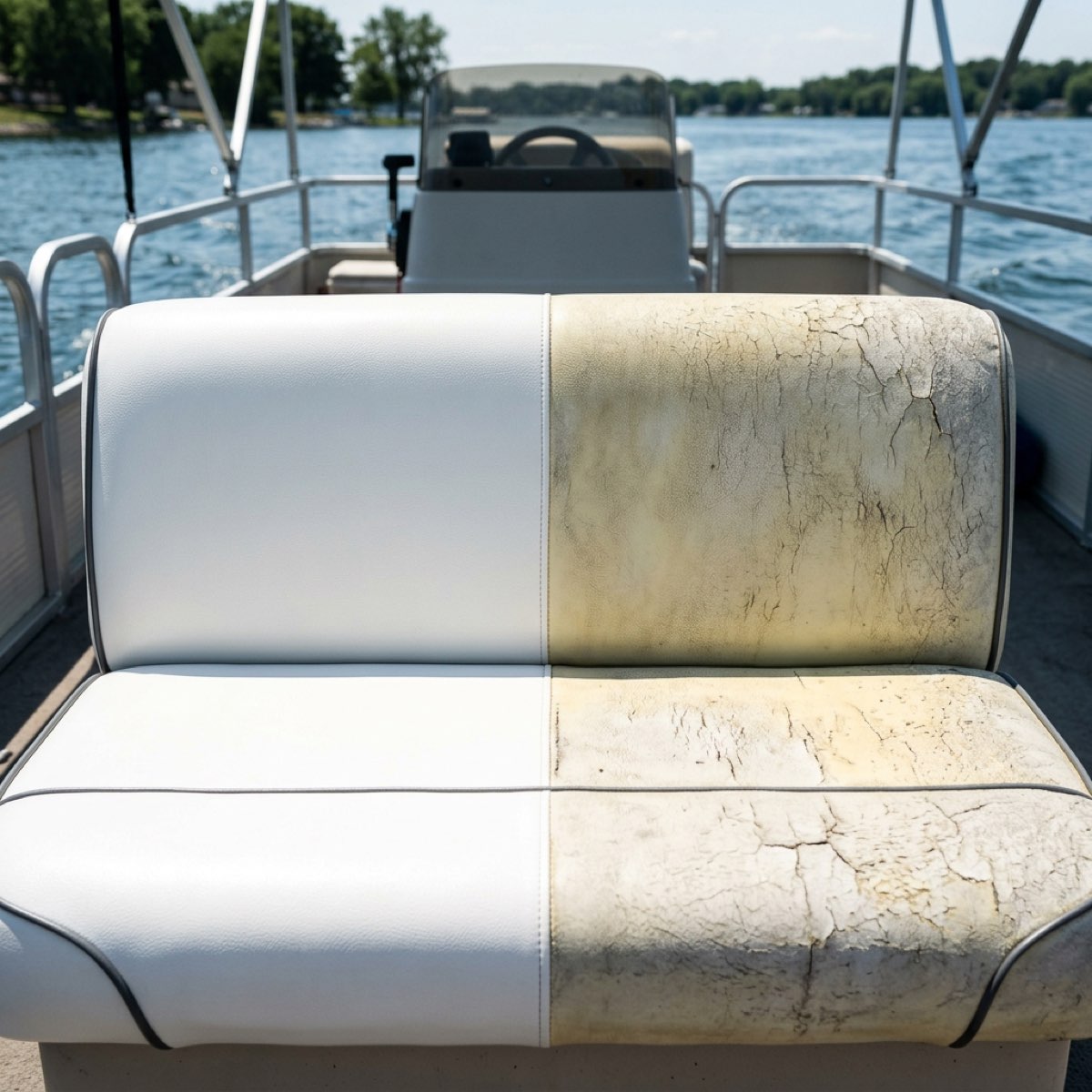
Every spring, without fail, the service department gets a frantic phone call from a pontoon owner who just pulled the winter cover off their boat. They expect to see the bright, supple white vinyl seats they paid $80,000 for just two years ago. Instead, they are staring at cushions that are chalky, brittle, and yellowing at the seams.
They always ask the same question: "Can you guys detail this out?"
As a marine service advisor, the hardest conversation I have to have is explaining the difference between dirt and chemical degradation. When marine vinyl fades, it is not simply losing its color. The material is fundamentally breaking down on a molecular level.
In this comprehensive engineering guide, we are going to look past the generic cleaning advice. We will break down exactly how the sun destroys marine PVC, the chemical burns caused by your favorite sunscreen, the catastrophic mistake of using "Magic Erasers," and the exact multi-step protocol our dealership uses to keep pontoon interiors looking showroom-new for a decade.
1. The Science of Marine Vinyl (Why the Sun Wins)
To understand why your boat seats are fading, you have to understand how they were manufactured. Marine vinyl is not leather. It is essentially a sandwich of three materials: a woven polyester backing for strength, a thick layer of Polyvinyl Chloride (PVC), and a microscopic clear-coat top layer.
The Plasticizer Problem:
Raw PVC is actually a hard, rigid plastic (think of a white PVC plumbing pipe). To make it soft enough to use as boat seating, chemical manufacturers inject it with oils known as "plasticizers."
When your pontoon is parked uncovered on a boat lift, the intense UV radiation and extreme heat (which can reach 160°F on dark grey vinyl) break the molecular bonds of these plasticizer oils. As the bonds break, the oils are drawn to the surface of the vinyl and evaporate into the air. This process is called "outgassing."
Once the plasticizing oils evaporate, the vinyl begins to revert to its natural state: hard plastic. It becomes stiff, chalky to the touch, and visually dull (faded). The moment someone steps on this stiff, dehydrated vinyl, it will shatter or crack. Once the vinyl cracks, it is a structural failure. No amount of "conditioner" can put the evaporated oils back into the PVC matrix.
2. The Danger of Household Cleaners: The Magic Eraser Trap
The fastest way to destroy a pontoon interior is to clean it like a kitchen counter.
When a boat owner sees their vinyl turning slightly dull or yellow, their instinct is to scrub it aggressively. They reach for bleach-based bathroom mold removers, harsh degreasers, or the absolute worst offender: the Melamine Foam sponge (commonly known as the "Magic Eraser").
Why Magic Erasers Destroy Vinyl:
A Magic Eraser feels like a soft sponge, but it is actually a micro-abrasive. It is structurally similar to extremely fine sandpaper. When you scrub a pontoon seat with a Magic Eraser, you are physically sanding the factory UV clear-coat off the vinyl.
Yes, the seat will look incredibly bright and clean for exactly one week. But because you have removed the UV barrier, the sun will immediately begin cooking the plasticizers out of the raw PVC. Within a month, the seat will turn rapidly yellow and feel like dry cardboard.
The Dealership Cleaning Standard:
You must only use dedicated, pH-balanced marine vinyl cleaners (such as Boat Bling Vinyl Sauce or 303 Marine Multi-Surface). These chemical formulas are designed specifically to emulsify dirt, sweat, and body oils out of the textured "pebble grain" of the vinyl without degrading the protective topcoat.
The Dealership Vinyl Protection Kit
If you have been using harsh household cleaners, you need to restore the UV protection immediately. Grab the exact two-step cleaning and protection combo that marine detailers mandate to prevent sun damage.
Affiliate disclosure: We may earn a commission if you purchase through these links.
3. The Irony of Sunscreen Stains (Avobenzone Chemical Burns)
This is one of the most frustrating warranty denials in the marine industry. You carefully apply SPF 50 sunscreen to your children to keep them safe from UV rays, but that very same sunscreen is a death sentence for your boat’s upholstery.
Many common spray and lotion sunscreens (specifically aerosol sport sprays) contain a chemical UV filter called Avobenzone.
The Chemical Reaction:
When Avobenzone comes into contact with marine vinyl and is subsequently baked by the heat of the sun, it triggers a permanent chemical reaction. The vinyl does not "fade"—it is essentially chemically dyed, resulting in a bright, irreversible yellow or orange stain that looks exactly like a spilled mustard or rust stain.
Because this is a chemical reaction that penetrates the clear coat, no amount of scrubbing or bleaching will remove the stain.
The Sunscreen Protocol:
- Never allow aerosol sunscreen to be sprayed while standing inside the pontoon. The overspray travels in the wind and coats the entire interior. Make guests apply spray sunscreen on the dock.
- If guests are heavily lotioned, require them to lay a beach towel down before sitting on the vinyl.
- If you see sunscreen wiped onto the vinyl, immediately neutralize it with a damp cloth or your pH-balanced vinyl cleaner before the sun bakes it into the material.
4. The "Pink Stain" Mystery (Internal Foam Failure)
Occasionally, an owner will bring their boat in complaining that their seats are fading to a bright pinkish-orange color, assuming it is a strange type of sun damage.
In reality, this is not sun fading. This is a biological failure caused by a specific microorganism called Streptoverticillium reticulum.
The Mechanics of Pink Stain:
This specific bacterium thrives in dark, warm, wet environments—specifically, the internal open-cell foam inside your seat cushions. When water penetrates the stitching of the seat (usually because the boat was left uncovered in the rain), the foam acts like a sponge.
As the Streptoverticillium reticulum bacteria grow inside the wet foam, they produce a bright pink dye as a biological byproduct. Because the dye is produced inside the cushion, it migrates upward and stains the back of the vinyl, eventually bleeding all the way through to the surface.
No amount of surface UV protectant or vinyl cleaner will fix this, because the stain is coming from the inside out. If you have the true "Pink Stain," the only remedy is a total replacement of both the foam core and the vinyl skin for that specific cushion.
5. Professional Re-upholstery Costs vs. Prevention
When your seats have faded to the point of turning brittle or cracking, you have passed the point of chemical restoration. You must call a professional marine upholstery shop.
Marine upholstery is not cheap. Unlike residential furniture, marine seats require specialized mold-resistant high-density foam, marine-grade PVC vinyl, stainless steel staples, and rot-proof backing boards.
The 2026 Replacement Market Costs:
- Single Seat Cushion Re-skin: Expect to pay $250 to $450 per cushion just for the fabric and labor (assuming the foam is still good).
- Captain's Chair Rebuild: $600 to $900 due to the complex curves and multiple fabric panels.
- Full Pontoon Interior Replacement: For a standard 22-foot pontoon with bow loungers and an L-shaped rear couch, a total interior overhaul (new foam, new vinyl, custom stitching) can easily range from $5,500 to $9,000.
You can spend $30 a year on a gallon of UV protectant and ten minutes wiping down your seats, or you can spend $7,000 every six years on a new interior. The financial math heavily favors prevention.
6. Upholstery Thread Failure (The Unseen Enemy)
Sometimes, you may look at your seats and think they are in phenomenal shape. The vinyl is bright, soft, and supple. However, when you press on the cushion, the seams literally "unzip" or pull apart. You have a thread failure problem.
The Weak Link: Polyester Thread
The sun's UV radiation is often much more aggressive toward the thread than it is toward the vinyl fabric itself. Most mass-produced pontoon boats use standard marine-grade bonded polyester thread. In high-sun states like Florida, Texas, or Arizona, polyester thread has a maximum UV life of about 3 to 5 years.
Once the UV rays degrade the polyester, the thread loses all tensile strength. If you try to pull a seam tight and the thread snaps effortlessly like a piece of dry pasta, you are looking at a total re-stitch job. Even if the vinyl is perfect, the seats must be removed, disassembled, and run back through an industrial sewing machine.
The Pro Upgrade: PTFE (Teflon) Thread
If you are paying an upholstery shop to re-skin your faded seats, demand that they use PTFE (Polytetrafluoroethylene) thread, commonly known by brand names like Tenara or SolarFix.
PTFE thread is essentially immune to UV damage, mold, and harsh cleaning chemicals. It is guaranteed to outlast the fabric itself, often surviving for 20+ years in direct sunlight without losing strength. It is significantly more expensive than polyester thread, but it ensures your seams will never "sun-rot" and split open.
7. Mooring Covers vs. Individual Seat Covers (Moisture Management)
The single best way to prevent UV fading is to completely block the sun when the boat is not in use. However, the type of cover you use dictates whether your interior survives.
The Danger of Individual Seat Covers
Many owners buy cheap, individual, elastic-banded plastic covers for each seat. This is structurally unsafe for long-term storage. While these small covers do block UV rays, they are not breathable. They trap ambient humidity directly against the vinyl surface. Because the vinyl cannot "breathe," you create a greenhouse effect that accelerates severe mildew growth deep within the grain of the vinyl.
The Full Mooring Cover Standard
The gold standard for prevention is a high-quality, full-length mooring cover made from a breathable marine canvas (like Sunbrella or SharkSkin).
A proper mooring cover provides a 100% UV block for the entire interior while allowing ambient humidity to escape through engineered roof vents. You must use a dedicated "tent pole" support system to keep the cover pitched tightly. If water pools on the cover above a seat, the immense weight of the water can permanently stretch the canvas, allowing moisture to seep through and soak the seat foam beneath it.
8. Vinyl Heat Absorption: The "Blackout" Trend
If you are currently shopping for a new pontoon and you love the look of the modern "Blackout" or "Charcoal" interior packages, you need to understand the thermal physics at play.
The Thermal Penalty of Dark Vinyl:
Dark colors absorb significantly more Infrared (IR) radiation from the sun. On a typical 90-degree summer day, a traditional white or light-tan pontoon seat might reach a surface temperature of 110°F. A charcoal grey or black vinyl seat can easily hit 160°F to 180°F.
This extreme, concentrated heat vastly accelerates the plasticizer "baking" process we discussed earlier. A dark interior will off-gas its essential oils at almost twice the rate of a light interior. Owners of dark vinyl packages must be absolutely religious about applying UV protectants every two weeks, or they will experience rapid, premature fading and cracking.
9. The "Outgassing" Trap (New Boat Owners Beware)
If you just took delivery of a brand-new, $100,000 pontoon boat, you may inadvertently trigger a vinyl failure by trying to be too protective. This is a counter-intuitive problem that happens almost exclusively to highly cautious new owners.
Modern, premium marine vinyl contains a massive concentration of fresh chemical plasticizers that continue to "outgas" (release invisible chemical vapors) for six to twelve months after the boat leaves the factory.
If you take your brand-new boat, park it in the hot sun, and immediately seal it tightly with a heavy, non-breathable plastic shipping tarp or an unvented cover, those chemical vapors get trapped in the cabin. The trapped gasses react with the heat and the vinyl's clear coat, causing a "melting" effect where the seats become permanently gummy, sticky, or discolored.
This is not sun fading—it is a trapped chemical burn from the inside out. Always ensure your mooring cover poles are erected high and your vents are completely unobstructed, especially during the crucial first year of outgassing.
10. The Hidden Threat: Seat Core Rot (Plywood vs. Composite)
While we spend a lot of time talking about the vinyl skin, we must also address what is happening underneath the upholstery. If you see your vinyl starting to sag, wrinkle, or pull away from the seat bases, you might assume the fabric is stretching. In many cases, the vinyl is fine—the actual structural core of the seat is rotting away.
Marine Plywood Seat Bases:
Historically, almost all pontoon boat seats were built using treated marine plywood for the base and backrest supports. While marine plywood is highly water-resistant, it is not waterproof. If you leave your pontoon uncovered and the seats get soaked, the water works its way down past the foam and settles on the wooden base.
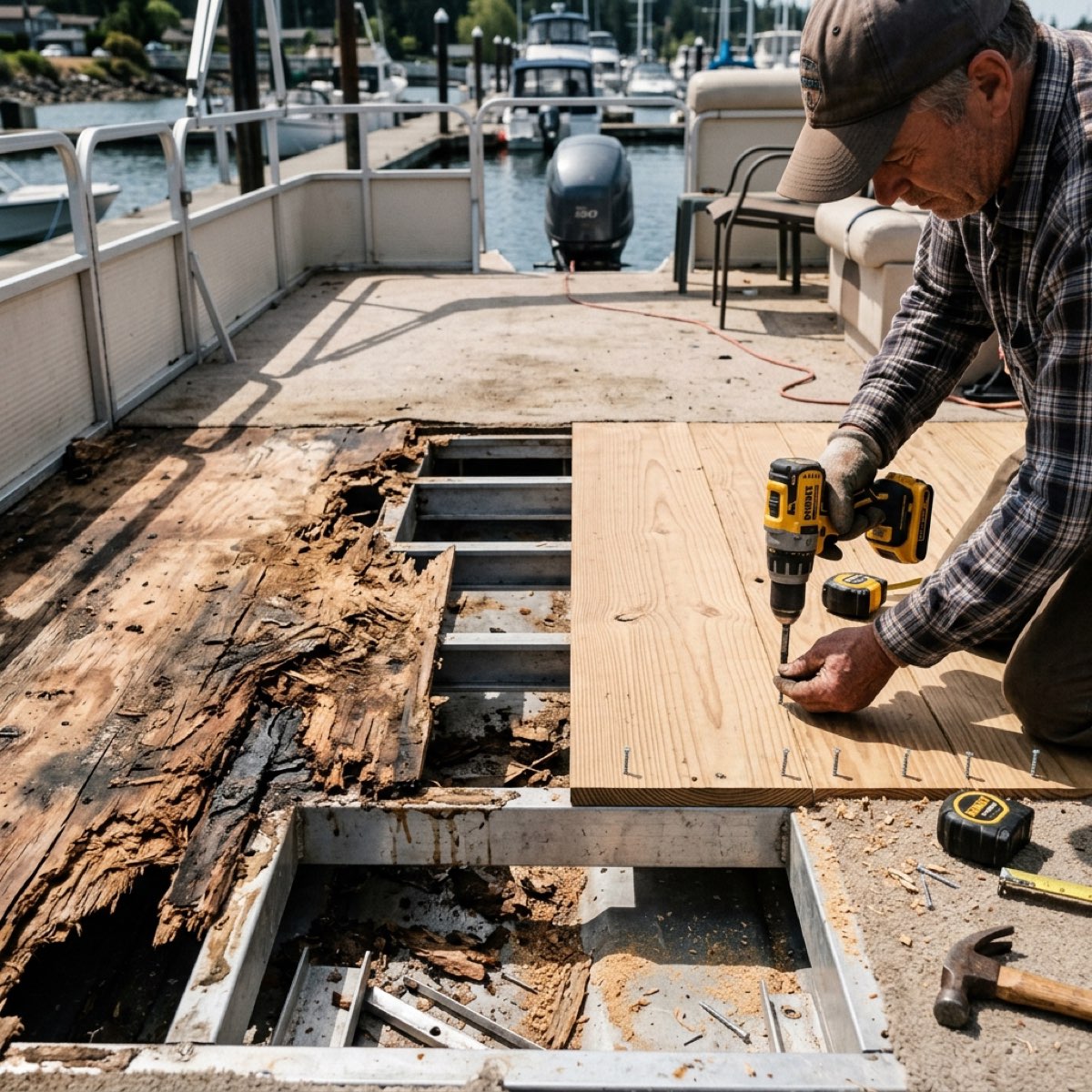
Over a period of five to seven years, this trapped moisture will cause the plywood to delaminate and rot. When the wood rots, the stainless steel staples holding the vinyl in place lose their grip. The vinyl pulls loose, the foam sags, and the entire seat structure collapses. If you are re-upholstering an older pontoon, you will almost certainly have to rebuild the wooden seat bases from scratch before attaching the new fabric.
Rotocast Plastic and Composite Cores:
If you are shopping for a newer pontoon (or replacing your interior with aftermarket furniture), look for seats built on "Rotocast" plastic bases or starboard composite cores.
These modern materials are 100% impervious to water. They will never rot, and the staples will never pull loose due to moisture degradation. Upgrading to composite bases guarantees that even if your vinyl eventually fades in the sun, the physical structure of your seating will outlast the boat itself.
11. Winterization Protocols for Marine Vinyl
We've focused heavily on summer sun damage, but winter storage can be equally destructive if not handled correctly. The "Cold Crack" phenomenon we touched on earlier is entirely preventable with the right off-season preparation.
The Pre-Winter Conditioning:
Before your boat goes into storage (whether shrink-wrapped or covered in a barn), you must perform a final deep-clean and conditioning.
- Clean: Remove all summer sunscreen, sweat, and dirt using a pH-balanced marine cleaner. If you leave body oils on the seats during winter storage, they can permanently stain the vinyl.
- Condition: Apply a heavy, liberal coat of your UV protectant. This final coat isn't for UV blocking (since the boat will be covered); it is to hydrate the material with plasticizers so the vinyl remains as soft and flexible as possible during sub-zero thermal contraction.
Moisture Control During Shrink Wrapping:
If you pay a marina to shrink-wrap your pontoon for the winter, you must ensure they are using proper ventilation and desiccant bags. Shrink wrap creates an incredibly tight, airtight seal. If the boat is wrapped while the interior is even slightly damp, that moisture is trapped inside the "bubble" for six months.
As the temperature fluctuates over the winter, condensation will form inside the wrap and rain down onto your seats. This creates the perfect breeding ground for catastrophic black mold.
To prevent this:
- Ensure the boat is 100% bone-dry before the shrink wrap goes on.
- Mandate that the installer adds at least four to six passive air vents in the shrink wrap.
- Place two or three large commercial desiccant buckets (like DampRid) in the cabin to absorb any residual humidity.
Final Thoughts: The Maintenance Discipline
Protecting your pontoon's upholstery is not about buying expensive magic restoration creams after the damage is done. It is about instituting a disciplined, chemical-based prevention routine from day one.
The rules are absolute:
- Never use household bleach, degreasers, or Magic Erasers on marine vinyl.
- Use a dedicated, pH-balanced marine cleaner to emulsify dirt without stripping the clear coat.
- Apply a heavy coat of 303 Aerospace UV Protectant every 30 days during the boating season to replace lost plasticizers.
- Keep the boat tightly covered with a breathable mooring cover whenever it is off the water.
- Manage moisture religiously, whether it's through a vented summer cover or proper winter shrink-wrap protocols.
If you follow these specific service protocols, you will easily extract ten to fifteen years of life out of your pontoon interior, maintaining your resale value and avoiding a devastating $7,000 upholstery bill.
12. Handling Physics: Vinyl "Memory" and Stretch Retention
Have you ever noticed that after a long day of hosting guests, your seat cushions have "puddles" or wrinkles that don't go away?
- The Physics: Marine vinyl is designed to have "Elastic Memory." When it is heated by the sun, the polymer chains loosen, allowing the material to stretch. As it cools, it should contract back to its original shape.
- The Failure: If your vinyl is dehydrated (missing plasticizers), it loses this memory. It will stretch under the weight of a passenger but remain "baggy" once they get up.
- The Callahan Solution: If you see puddling, apply a heavy coat of UV protectant and then use a Hair Dryer (on low heat) or a Steamer to gently warm the vinyl. This can often "reset" the polymer memory and pull the wrinkles tight—but it only works if the vinyl is still chemically hydrated.
13. The "Sunlight Focusing" Effect: The Burn Zone
A common cause of "mystery burns" on pontoon seats isn't the sun hitting the seat directly—it's reflected light.
- The Culprits: Large glass coffee tables, polished stainless steel cup holders, or even the reflection from a neighboring boat's windshield.
- The Physics: These surfaces can act like a magnifying glass, focusing a beam of intense UV and IR light onto a single spot on your cushion.
- The Result: You will find a melted "streak" or a brown burn mark on a seat that was otherwise covered.
- The Fix: Be mindful of where you place reflective accessories. If you have a glass table on deck, always keep it covered with a tablecloth when the boat is docked to prevent "Hot Spot" burns.
14. Minor Repair: The "Cold Weld" Vinyl Kit
If you get a small nick from a fishing hook or a dog's claw, you must fix it immediately.
- The Risk: A small hole allows water to enter the foam core, leading to the "Pink Stain" bacterial growth we discussed earlier.
- The Professional Method: Use a Heat-Cured Vinyl Repair Kit. These kits use a liquid PVC resin that you color-match to your seat. You apply the resin, place a grain-pattern paper over it, and use a heat tool to "weld" the new PVC to the old.
- The Result: A properly executed heat-weld is a permanent structural repair that is 90% invisible and 100% waterproof.
15. The "New Boat Smell" and Chemical Stability
That "New Boat Smell" everyone loves is actually the smell of Phthalates—the plasticizing chemicals—leaking out of the vinyl.
- The Strategy: While you can't stop outgassing entirely, you can slow it down. By applying a UV blocker from day one, you are effectively "capping" the surface of the vinyl, making it harder for those essential oils to escape.
- The Warning: If your boat smells strongly of plastic after three years, it means your vinyl is breaking down rapidly. It’s time for a deep-conditioning audit.
16. Summary: The Upholstery Lifespan Equation
The lifespan of your pontoon interior is a simple equation: (Material Quality x UV Protection) / (Heat Exposure x Chemical Abuse).
By controlling the variables—blocking the UV, avoiding harsh cleaners, and managing the heat—you can extend the life of your upholstery by a decade. Don't let the sun turn your $100,000 investment into a "Chalky Mess." Take the ten minutes to wipe it down, and your seats will stay as soft as the day you left the showroom.
I'll see you on the water.