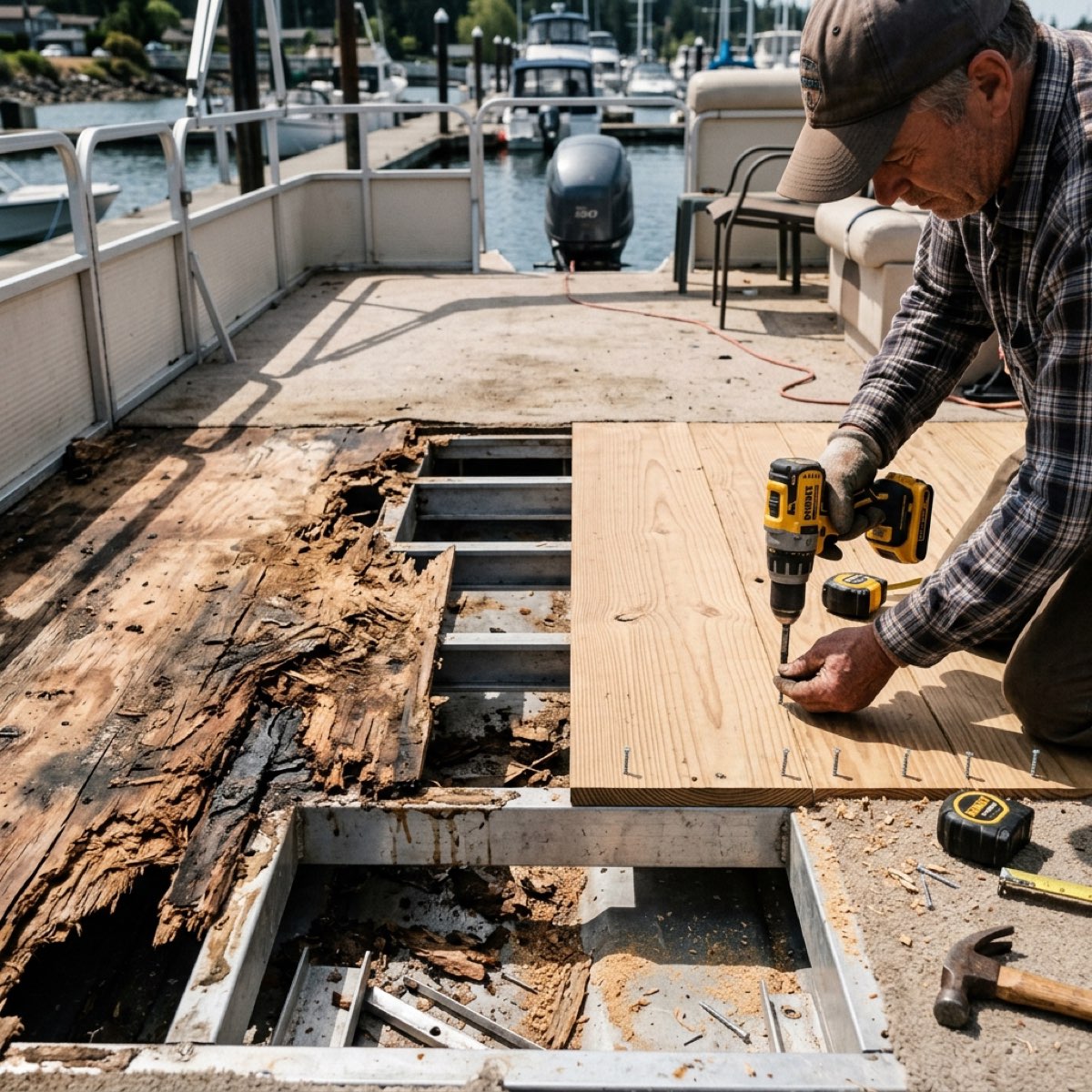
To permanently fix pontoon deck rot, you must remove the compromised wood entirely. Do not attempt to patch a soft spot. You must replace the deck with 7-ply, CCA-treated marine-grade plywood (never ACQ-treated, which causes galvanic corrosion with aluminum), secure it exclusively with 316-grade stainless steel elevator bolts, and seal the new deck with modern woven vinyl instead of water-trapping marine carpet.
There is a moment of pure dread every older pontoon owner experiences. You are walking across your boat, carrying a cooler or a tube, and you step near the boarding gate. Instead of a solid thud, the floor flexes beneath your foot. It feels spongy. It feels hollow.
You have just discovered deck rot.
As a marine service advisor, I can tell you that deck rot is the single most common cause of pontoon mortality. When the floor goes, the structural integrity of the entire "playpen" (the aluminum fencing and seating) is compromised. A single heavy wave on a rotten deck can tear the console right off its mounting bolts.
In this comprehensive guide, we are going to dive deep into the science of wood decay, why marine carpet is the enemy, the catastrophic mistake of using the wrong pressure-treated wood from a big-box hardware store, and the exact step-by-step cost breakdown of replacing your deck.
1. The Science of Wood Decay (Why it Spreads)
Before we talk about fixing the boat, you need to understand what you are fighting. Wood rot is not just "wet wood." It is an active, living fungal infection.
For wood rot fungi to survive and consume your deck, they need four things:
- Oxygen: Readily available on a boat.
- Favorable Temperatures: Between 50°F and 90°F (boating season).
- Food: The cellulose in the plywood.
- Moisture: A wood moisture content above 20%.
If you deprive the fungi of any one of these four things, the rot stops immediately. Since we cannot remove oxygen, control the weather, or remove the wood, our entire battle plan relies entirely on moisture control.
The "Dry Rot" Myth
Many boaters find a crumbly, dusty patch of wood under their seats and call it "dry rot." This is a misnomer. The fungi must have moisture to start eating the wood. It only appears "dry" because the fungus has consumed all the structural cellulose, died off due to a lack of water, and left behind a brittle, chalky skeleton.
If you find a patch of rot and simply screw a piece of aluminum or a new patch of wood over it, the living fungi spores at the microscopic edges of the rot will spread to the new wood within months. You must cut back at least 12 inches past the visible rot to ensure you have reached healthy, uninfected wood.
2. The Diagnosis: Finding the Soft Spots
You cannot evaluate a pontoon deck by just looking at the carpet. The carpet hides everything until it is too late. You have to physically stress the wood.
The Stomp Test
Walk the entire deck of your boat barefoot or in thin-soled boat shoes. You are looking for a lack of resistance. Pay special attention to the "High-Risk Zones":
- The Entry Gates: Port, starboard, and front gates are where passengers drip water from swimsuits and where rain blows in sideways under the mooring cover.
- The Helm Console: Water often pools around the heavy fiberglass base of the console.
- Under the L-Shaped Couch: If your seats don't have proper drainage channels, water becomes trapped in the corners.
The Awl Probe (The Underside Inspection)
If you suspect a soft spot, you must crawl underneath the boat while it is on the trailer. Bring a flashlight and a sharp awl or a Phillips-head screwdriver.
- Look for dark black or dark brown staining on the underside of the plywood.
- Look for white fungal "webs" stretching across the wood grain.
- Take your awl and press it firmly into the suspect wood. Healthy marine plywood will resist the awl; you might only dent it a millimeter. If the awl sinks a quarter-inch into the wood like it's made of soft cheese, that section of the deck is dead.
The Deck Restoration Toolkit
If you are preparing to rip up your floor, you need marine-grade sealants. Do not use bathroom silicone. Grab the exact sealants we use to ensure water never touches the wood again.
Affiliate disclosure: We may earn a commission if you purchase through these links.
3. Marine Plywood vs. Exterior Plywood (The Galvanic Bomb)
If you have decided that the floor is too far gone and needs a complete replacement, you are about to make the most important decision in the entire restoration process: What wood do you buy?
Many DIYers go to Home Depot, see "Pressure-Treated Exterior Plywood" for $45 a sheet, and think they are being smart. This is a catastrophic mistake that will destroy your boat.
The Danger of ACQ Treated Wood
Modern pressure-treated wood from residential hardware stores is treated with Alkaline Copper Quaternary (ACQ) or Copper Azole. These chemicals are highly effective at stopping termites and rot in a backyard deck.
However, they contain incredibly high levels of copper. When wet copper touches the raw aluminum cross-members of your pontoon boat, it creates a battery. This is called Galvanic Corrosion. The copper acts as the cathode, and the aluminum acts as the sacrificial anode. The aluminum frame of your boat will literally dissolve into white powder wherever the wood touches it. Within five years, your cross-members will fail, and the boat will be un-repairable.
The Only Safe Choice: CCA Marine Plywood
You must use Chromated Copper Arsenate (CCA) treated Marine Plywood.
- Zero Voids: Marine plywood is manufactured with 7 to 9 ultra-thin layers (plies) of wood, and is constructed with zero internal air voids. Standard plywood has gaps between the layers where water can pool and rot from the inside out.
- Waterproof Glue: The plies are held together with a WBP (Weather and Boil Proof) phenolic resin that will not delaminate even if submerged.
- Aluminum Safe: CCA treatment does not cause aggressive galvanic corrosion with aluminum when wet.
Yes, a sheet of 3/4" CCA Marine Plywood costs $120 to $150 compared to $45. Buy it anyway. It is the only way to ensure your new deck lasts for 20 years.
4. The "Hardware Horror" (Stainless vs. Zinc Bolts)
Let’s say you’ve spent $2,000 on the best CCA marine plywood. You are exhausted, you want to save a few dollars, so you reuse your old rusty bolts or buy a bucket of cheap zinc-plated bolts. You have just planted a "rot seed" in every single square foot of your new deck.
The Zinc-Plated Failure
Zinc-plated or galvanized bolts are meant for building fences, not boats. In a marine environment—especially when dealing with the chemicals inside pressure-treated wood—the thin zinc coating will corrode away within months. Once the bare steel is exposed, it will rust aggressively. As the rust expands, it forces water into the unprotected core of the plywood. You will begin to experience "sick wood" syndrome, where the plywood turns black and rots in a 3-inch halo around every single bolt on the deck.
The 316 Stainless Steel Requirement
You must use 316-grade Stainless Steel hardware exclusively. It does not rust, and it will not react with the CCA wood treatment.
Mike's Golden Rule: Buy a dedicated "Pontoon Decking Bolt Kit." These kits include massive 1/4-inch Elevator Bolts. Elevator bolts have a flat, quarter-sized head. When you tighten them down, the large flat head pulls flush into the top of the plywood. If you use standard hex bolts or carriage bolts, they will leave bumps under your new vinyl flooring, ruining the aesthetic of the restoration.
5. The Consequence of Wet Carpet
If you are replacing your deck, you must permanently banish marine carpet from your vessel.
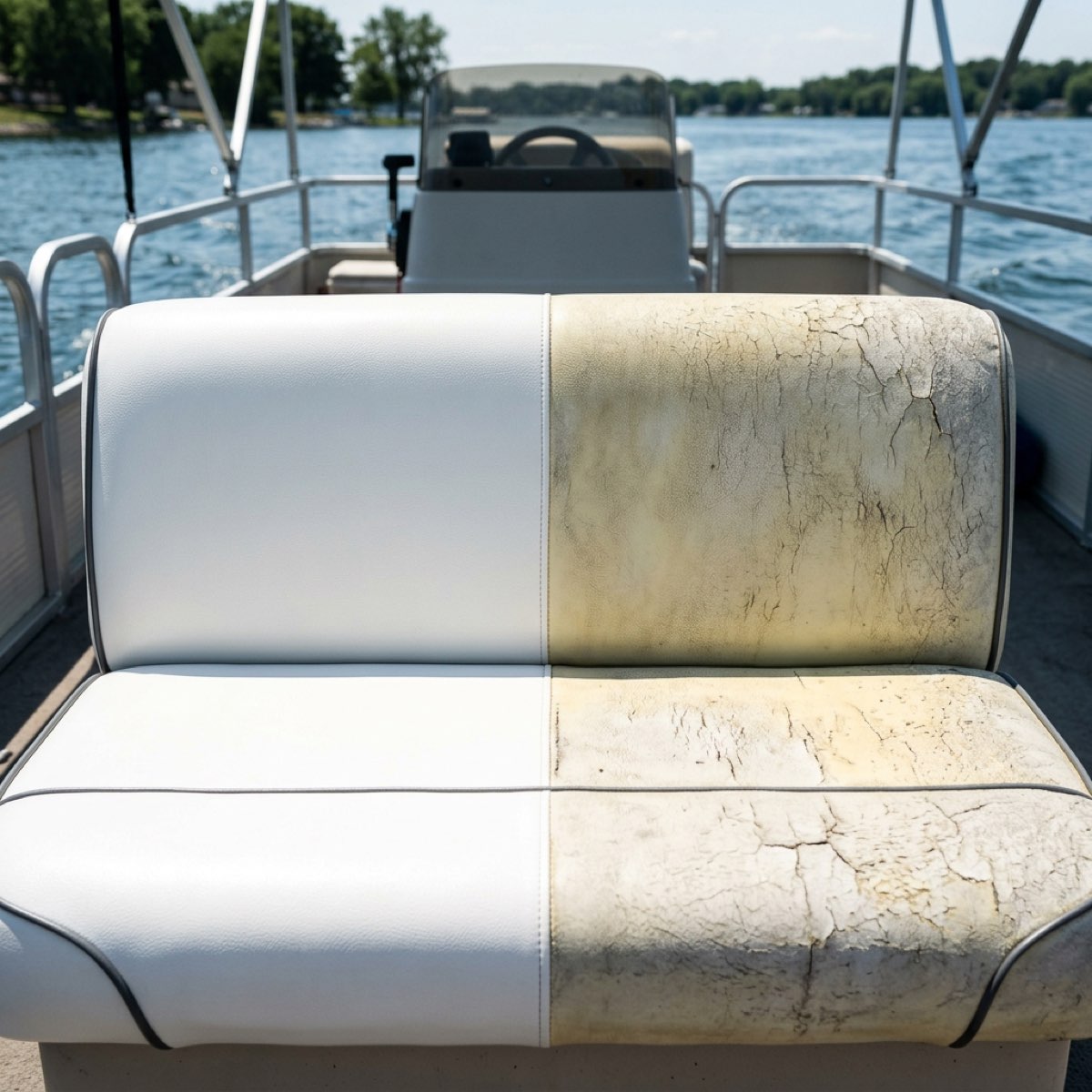
For decades, manufacturers used marine carpet because it was cheap and comfortable on bare feet. However, carpet acts like a giant sponge. It traps dirt, fish blood, and spilled drinks deep in its fibers. Most importantly, it traps moisture.
If you leave a carpeted boat uncovered after a rainstorm, the carpet will hold that moisture directly against the top layer of the plywood for weeks. Even with CCA-treated wood, constant exposure to trapped moisture and bacteria will eventually break down the phenolic resins in the plywood, leading to top-down rot.
The Upgrade: Woven Vinyl Flooring
Modern pontoon manufacturers have almost entirely switched to Luxury Woven Vinyl (like Infinity or MariDeck).
- Zero Absorption: Vinyl does not absorb a single drop of water.
- Rapid Drying: When the sun hits a vinyl deck, the water evaporates immediately, leaving the wood underneath perfectly dry.
- Easy Cleaning: You can power-wash a vinyl deck. You can scrub it with soap. It never develops that "wet dog" lake smell that plagues older carpeted boats.
6. Vinyl Floor Installation "Pro Tips" (Avoid the Bubbles)
Installing vinyl flooring is the most stressful part of the restoration. If you mess up the glue, you will have permanent, massive air bubbles across your entire deck.
- Do Not Glue the Entire Deck at Once: If you try to spread adhesive over an 8.5' x 20' area, the first section will be completely dry by the time you reach the back of the boat.
- Use the "Flip-Half" Method: Lay the vinyl out perfectly straight over the bare wood. Fold exactly half of the vinyl back onto itself (like folding a taco). Apply the specialized high-temp marine adhesive to the exposed wood. Wait for the glue to "tack up" (become sticky but not wet), and then carefully roll the vinyl back over the glue. Repeat for the other half.
- The Floor Roller: You must use a heavy, 100-lb floor roller (rentable at any hardware store for $20) to press the vinyl into the glue. Smoothing it with your hands is not enough. The roller forces out microscopic air pockets that would otherwise expand in the hot summer sun and cause permanent bubbling.
7. The True Cost: DIY vs. Professional Replacement
If your floor is rotten, you have to decide if you have the mechanical skill to handle a 60-hour project.
Estimated Deck Repair Costs (2026)
| Component | DIY Cost | Professional Cost | Notes |
|---|
| Marine Plywood (8.5' x 24') | $800 - $1,200 | $1,200 - $1,500 | Shop markup applies |
| Woven Vinyl Flooring | $600 - $900 | $1,200 - $1,800 | Includes high-temp adhesive |
| Hardware (Stainless Bolts) | $150 - $250 | $300 - $400 | Do not reuse old zinc bolts! |
| Labor Hours | 40 - 60 Hours | $2,500 - $4,500 | Console, motor, rail removal |
| Total Estimated Cost | $1,550 - $2,350 | $5,200 - $8,200 | Save $3k+ by doing it yourself |
The Professional Shop Reality: The massive labor cost is not for laying the wood. The labor cost is because a mechanic has to disconnect the steering cables, the throttle binnacle, the engine wiring harness, unbolt the massive outboard motor with a crane, and remove all the aluminum fencing just to expose the deck.
If you are reasonably handy, you can save over $3,000 by tackling this project in your driveway over the winter.
8. Pontoon Underskinning: The Secret to a 30-Year Deck
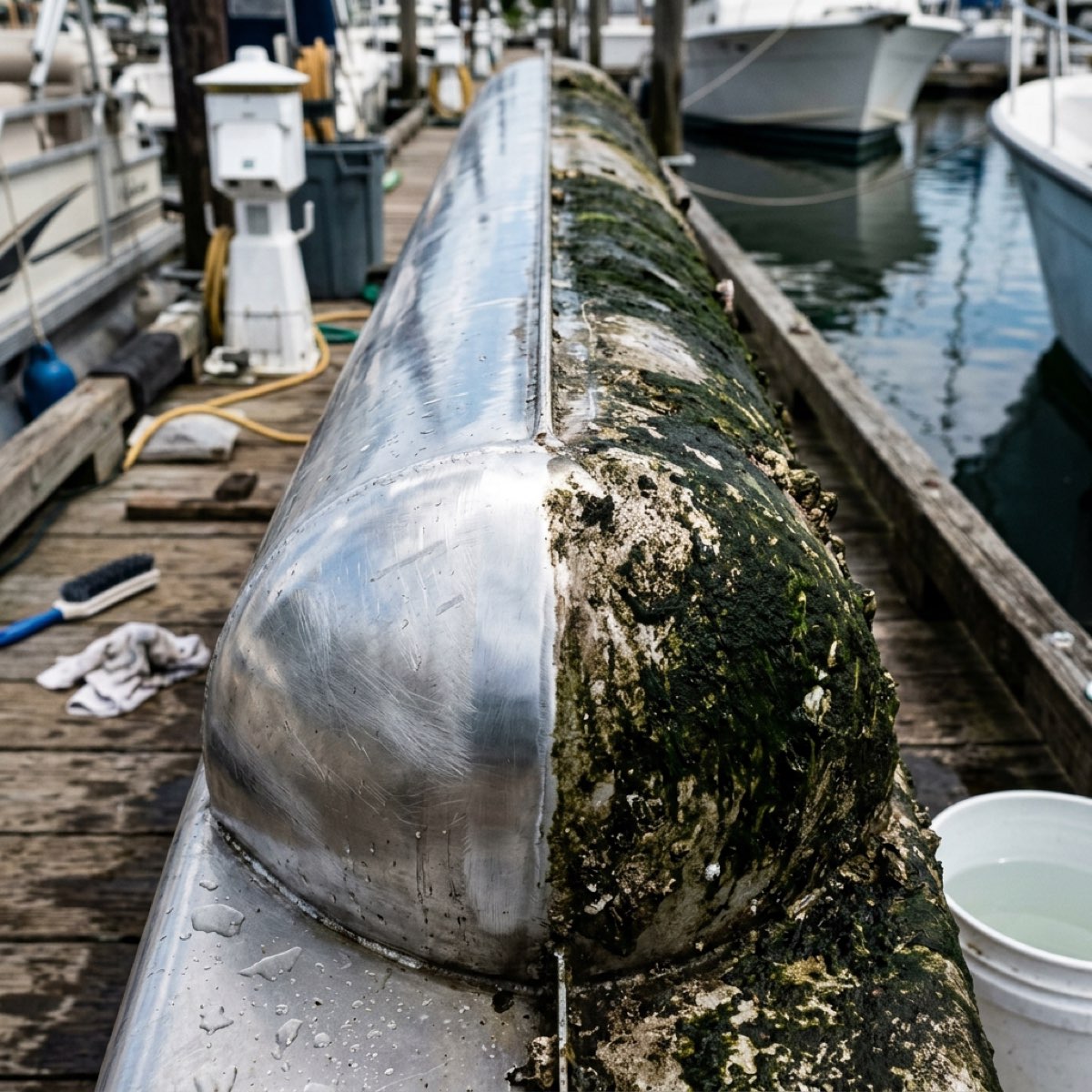
If you look at modern, high-end tri-toons, you will notice a smooth sheet of aluminum covering the entire bottom of the boat's frame. This is called "underskinning."
While underskinning is heavily marketed as a performance upgrade (it stops water from hitting the cross-members, reducing drag and increasing speed by 3-5 mph), its true value is deck protection.
When you are cruising at 25 mph, the waves are constantly surging up between the logs, violently splashing the unprotected bottom of your plywood. Over the course of a decade, the sheer force of this water can literally strip the protective chemical treatment out of the bottom plies of the wood. Furthermore, when towing the boat on the highway in the rain, the tires of your truck are blasting road spray directly into the wood.
If you are going through the immense effort of replacing your deck, spend an extra $400 on aluminum sheet metal and rivet it to the bottom of the cross-members. It acts as an impenetrable shield, keeping the underside of your new wood bone-dry for decades.
9. Winter Storage: Preventing the Rot from Returning
You have a brand new deck. How do you protect your $2,000 investment?
The vast majority of pontoon deck rot actually occurs in the winter while the boat is parked in the driveway.
- Never Store the Boat Level: If the boat is stored perfectly level on the trailer, water will pool on the deck. If a heavy snow melts, you will have a two-inch deep lake sitting on your new vinyl. Always raise the tongue jack of the trailer as high as it will go to allow gravity to pull water out the scuppers at the rear of the boat.
- Tent the Mooring Cover: You must use adjustable support poles under your canvas cover to create a steep, tent-like pitch. Water must run off the cover instantly. If the cover sags, it will tear, dumping hundreds of gallons of water directly onto your deck.
- Rodent Prevention: Mice love to build nests under pontoon seats during the winter. They use leaves, paper, and insulation, which traps moisture directly against the deck for six months. Use scent-based deterrents (like peppermint oil) to keep rodents out of the boat.
Final Thoughts
A spongy pontoon deck is not a death sentence for your boat, but it is a massive structural liability that cannot be ignored. A rotting deck will eventually cause the aluminum cross-members to fail and the console to tear loose.
By taking the time to completely strip the boat, investing in true CCA marine plywood, utilizing 316 stainless elevator bolts, and upgrading to a water-shedding woven vinyl floor, you are not just repairing the boat—you are modernizing it. A properly executed deck replacement will easily outlast the engine, providing you and your family with decades of safe, solid footing on the water.
10. The Chemistry of Adhesion: Solvent vs. Water-Based Glues
When you transition from bare wood to woven vinyl, the glue you choose is actually a structural component.
10.1 Water-Based Adhesives (The DIY Trap)
Many big-box hardware stores sell "Outdoor Carpet Glue" that is water-based.
- The Problem: On a hot August day, the temperature of your pontoon deck can reach 140°F. Water-based glues can "Re-Liquefy" at these temperatures.
- The Result: Your vinyl will begin to slide, and massive bubbles will form as the glue off-gases.
Professionals use high-temp, solvent-based contact adhesives (like G-21 or specialized MariDeck glue).
- The Engineering: These glues create a permanent chemical bond that is heat-resistant up to 180°F. Once it's down, it's down forever. You only get one chance to lay the vinyl correctly, but it will never bubble or peel.
11. The Hardware Debate: Huck Bolts vs. Elevator Bolts
If you look at a factory-new Bennington or Harris, you won't see elevator bolts. You'll see Huck Bolts.
- What is a Huck Bolt? It is a structural pin and collar fastener that is "Swaged" into place with a hydraulic tool.
- The Advantage: It never vibrates loose. Ever.
- The DIY Reality: Most boaters don't have a $2,000 hydraulic Huck tool. For a restoration, the 316 Stainless Elevator Bolt is the gold standard. However, you MUST use a "Nyloc" nut (a nut with a nylon locking insert) to simulate the vibration resistance of a factory Huck bolt. If you use a standard nut, the vibration of the outboard will shake the floor loose in 24 months.
12. Rail Spacers: The 1/4" Gap That Saves Your Boat
This is the most common mistake I see in DIY restorations. When people re-install the aluminum fencing (the rails), they bolt the rails directly onto the new vinyl.
DO NOT DO THIS.
- The "Water Trap": If the rail is flush against the floor, water cannot drain off the deck. It becomes trapped in the small gap between the aluminum rail and the vinyl. This creates a permanent moisture reservoir that will rot your new wood in 5 years despite the CCA treatment.
- The Solution: Use Plastic Rail Spacers. These are 1/4-inch thick shims that sit between the rail and the deck. They create a "Drainage Gap" around the entire perimeter of the boat. This allows rain and wash-water to escape instantly, keeping the wood dry and the vinyl clean.
13. Structural Torsion: How a Soft Deck Kills Your Logs
Boaters often think deck rot is just a "Cosmetic" or "Comfort" issue. It's actually a structural crisis.
- The "Box" Theory: A pontoon boat is essentially a large box. The aluminum cross-members are the frame, but the 3/4" plywood deck is the "Diaphragm" that provides the shear strength.
- The Torsion Problem: When your boat hits a wave, one log wants to go up while the other goes down. This is called "Torsion." A solid plywood deck stops this twisting.
- The Failure: When the wood is rotten, it can no longer resist that twisting force. The stress is then transferred entirely to the aluminum welds where the cross-members meet the logs. I have seen hundreds of pontoons with cracked welds because the owner waited too long to replace a rotten floor. Replacing wood is cheap; welding a cracked log is expensive.
14. Detailed Underskinning: The "Laminar Flow" Benefit
We mentioned underskinning earlier for rot prevention, but let's talk about the Engineering of Speed.
- The "Surging" Problem: In an open-frame pontoon, water is constantly "Surging" up and hitting the cross-members. This creates a "Shuddering" feeling and massive drag.
- Laminar Flow: By adding aluminum underskinning, you create a smooth surface for the water to glide over.
- The Specs: Use .063" or .080" thickness 5052-H32 aluminum sheet. Rivet it every 6 inches to the cross-members. Not only will your deck stay dry, but you will find that the boat is quieter, faster, and much more fuel-efficient.
15. Summary: The Callahan Deck Standard
Replacing a pontoon deck is the "Rite of Passage" for any serious boat owner. It is a grueling, dirty job that involves thousands of bolts and a lot of heavy lifting. But if you follow the CCA Plywood + 316 Stainless + Woven Vinyl protocol, you are building a boat that will last another 30 years.
Don't cut corners on the wood, don't reuse the bolts, and for heaven's sake, put the spacers under the rails.
I'll see you at the ramp.