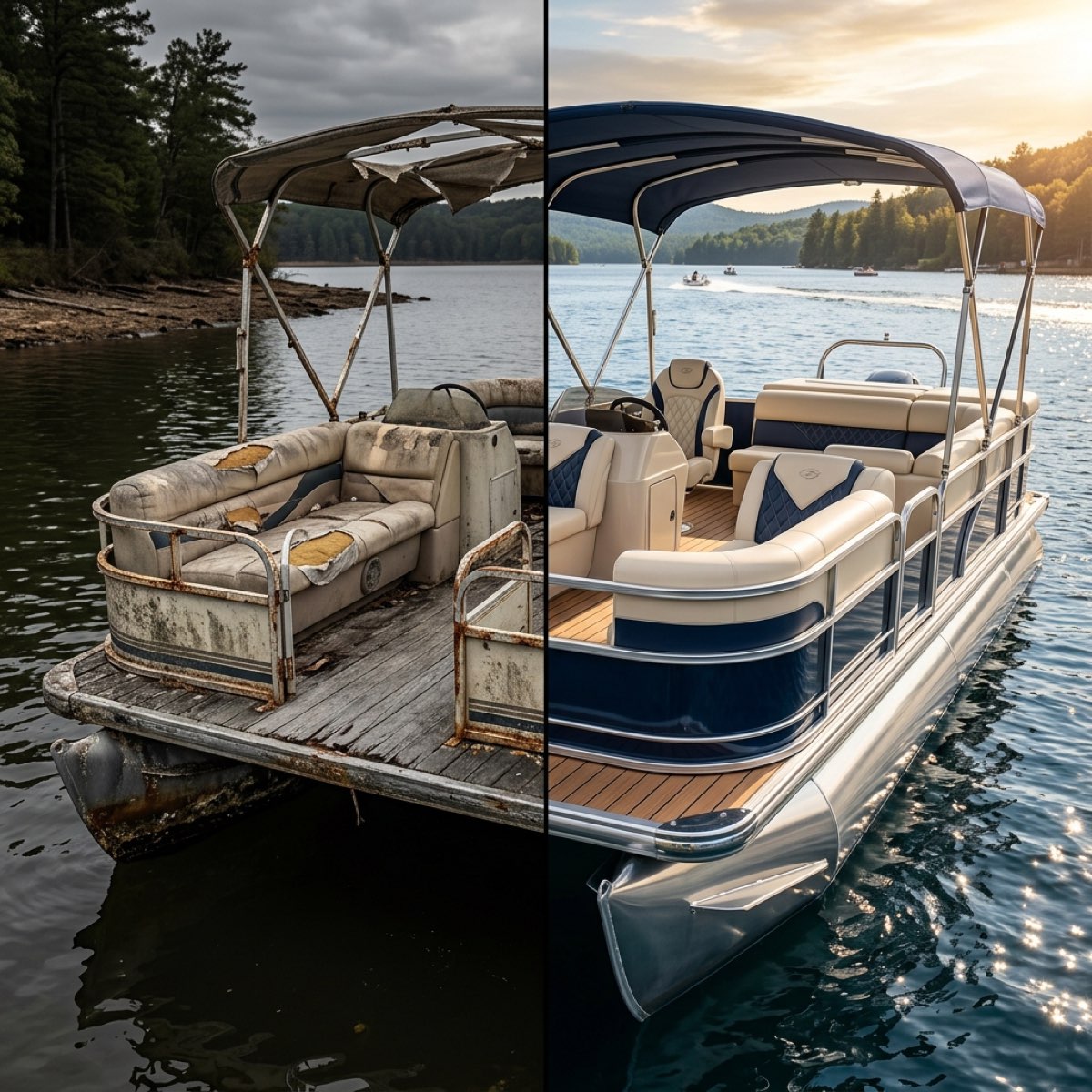
If you have ever seen a pontoon boat that looks like it has been "eaten" from the bottom up—covered in white, chalky pits and bubbling paint—you are looking at the aftermath of Galvanic Corrosion.
In a freshwater lake, your aluminum logs are relatively safe. But the moment you drop that boat into saltwater or brackish water, the entire vessel becomes a giant battery. Saltwater is a highly efficient electrolyte. Because your boat is made of aluminum but contains parts made of stainless steel (the prop, the bolts) and copper (the wiring), an electrical current begins to flow between the different metals.
In this electrical battle, the "weaker" metal is sacrificed to protect the "stronger" one. On a boat, the weaker metal is almost always your expensive aluminum logs.
As a marine service advisor, I have seen $50,000 pontoons ruined in a single season because the owner thought "Zinc anodes are only for big offshore boats." They aren't. They are a mandatory safety component for any aluminum vessel entering the salt.
In this guide, we’ll break down the chemistry of why your boat is at risk, how to choose the right anode material, and where to mount them to ensure your logs don't turn into a block of Swiss cheese.
1. The Science: Galvanic Corrosion Explained
To understand why you need anodes, you need to understand the Galvanic Series. This is a list of metals ranked by their electrical "nobility."
- Noble Metals (Strong): Stainless Steel, Bronze, Copper.
- Active Metals (Weak): Aluminum, Zinc, Magnesium.
When two different metals are submerged in saltwater and connected (either by touching or through the boat's wiring), the Active metal will begin to dissolve (corrode) to protect the Noble metal.
- The Problem: Your pontoon logs are the "Active" metal. They will literally sacrifice their own molecules to protect a stainless steel propeller or a bronze through-hull fitting.
- The Solution: You introduce an even weaker metal into the system—a Sacrificial Anode. The current will attack the anode instead of your logs.
2. Zinc vs. Aluminum vs. Magnesium: The 2026 Standard
For decades, we called these "Zincs." But today, zinc is rarely the best choice for a pontoon boat.
2.1 Zinc Anodes
Zinc is the traditional choice for pure saltwater.
- The Downside: If you take a zinc-equipped boat into freshwater for a few weeks, the zinc will develop a hard "calcium" coating. This coating insulates the anode, so when you go back into saltwater, the anode won't work.
2.2 Aluminum Anodes (The Modern Pro Choice)
Most experts now recommend Aluminum Anodes (specifically an alloy like Mil-Spec A-24779) for almost all environments.
- The Advantage: Aluminum anodes work in Saltwater, Brackish water, and Freshwater. They are lighter, cheaper, and more environmentally friendly than zinc. They also stay "active" even after being in freshwater.
2.3 Magnesium Anodes
Magnesium is the most active metal on the list.
- The Use Case: These are for Freshwater ONLY. In saltwater, magnesium is so active that it will fizz like an Alka-Seltzer and disappear in 48 hours. Never use magnesium in the salt.
3. Where to Mount Anodes on a Pontoon
An anode only protects what it can "see" electrically. You cannot just throw one in the bilge and call it a day.
3.1 The Log End-Caps
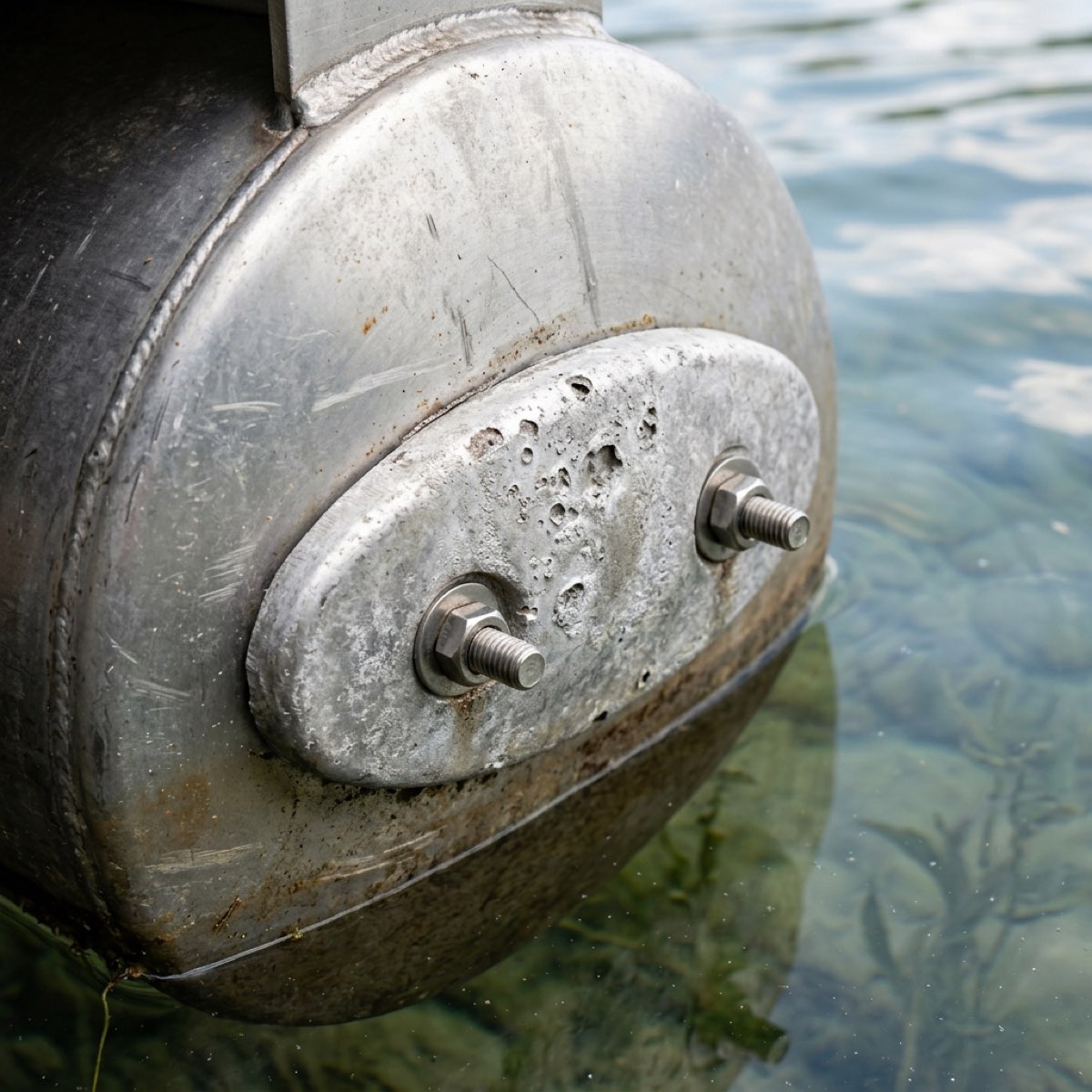
You should have at least one large "Plate Anode" bolted to a bracket on the rear end-cap of each pontoon log.
- The Connection: There must be a "Metal-to-Metal" connection between the anode and the log. If there is paint, dirt, or grease between the anode and the bracket, it will not work.
3.2 The Motor Bracket
Your outboard engine already comes with several anodes (one on the mounting bracket and one above the propeller).
- Crucial Tip: These engine anodes protect the engine, NOT the boat logs. You must have dedicated boat anodes in addition to the engine anodes.
4. The "Painted Log" Trap
If you paint your pontoon logs with anti-fouling paint (to prevent barnacles), you must be extremely careful.
4.1 Copper-Based Paint Warning
Most traditional anti-fouling paints contain copper. Never use copper-based paint on an aluminum pontoon. The copper in the paint will create a massive galvanic cell with the aluminum, destroying the logs in weeks.
- The Solution: Use an Aeron-based or Zinc-based anti-fouling paint specifically designed for aluminum.
4.2 Don't Paint the Anode
If you paint over your anodes, you have essentially "turned them off." Anodes must be bare metal to function. If your service yard accidentally paints your anodes, you must scrape the paint off immediately.
5. Maintenance: The 50% Rule
Anodes are designed to be destroyed. If your anodes still look brand new after a year in the water, it means they aren't working.
5.1 When to Replace
You should replace your anodes when they are 50% consumed.
- The Reason: As the anode gets smaller, it has less surface area. A small, 80%-consumed anode cannot generate enough electrical current to protect a 24-foot aluminum log.
- The Visual Check: If the anode looks "Spongy" or "Craters" have formed, it’s doing its job. Change it during your annual service.
6. Summary: The Callahan Protection Protocol
If you are moving your boat to a coastal area or a tidal river, follow these steps:
- Swap to Aluminum Alloy Anodes (not pure Zinc).
- Mount one plate anode per log on the rear brackets.
- Ensure a bare-metal connection (no paint under the anode).
- Inspect every 3 months if the boat is kept in a slip.
- Replace at 50% wear.
Protecting your logs for $100 in anodes is the smartest investment you can make. The alternative is a $10,000 welding bill or a sunken boat.
I'll see you at the ramp!
7. Stray Current Corrosion: The "Shore Power" Danger
If you keep your boat in a marina and plug it into a battery charger (Shore Power), you have a much higher risk of corrosion.
- The "Hot Marina": If the boat in the slip next to you has a "ground fault" (electrical leak), that electricity will travel through the water to your boat.
- The Defense: In a "Hot" marina, your anodes will disappear 3x faster than normal. You must check them every month. If they are dissolving in less than 90 days, you need to install a Galvanic Isolator on your shore power line to block that incoming current.
8. The "Continuity" Test: Is it Actually Working?
Just because the anode is bolted to the boat doesn't mean it's protecting it.
- The Multimeter Test: Set your digital multimeter to "Ohms" (Resistance). Touch one probe to the bare metal of the anode and the other probe to a bare aluminum part of the pontoon log.
- The Reading: You should see a reading of less than 1 Ohm. If the resistance is higher, there is a layer of paint or corrosion between the anode and the bracket. This is a "Dead Anode"—it’s on the boat, but it’s doing absolutely nothing. Clean the mounting surfaces until the resistance drops.
9. Final Checklist: The Callahan Protection Protocol
- Use Aluminum Alloy anodes for all-water protection.
- Mount them on the logs, not just the engine.
- Ensure a "Low Resistance" connection (test with a multimeter).
- Check for "Stray Current" if your anodes disappear too fast.
- Replace at 50% wear—don't wait for them to disappear.
A $100 set of anodes is the cheapest "Insurance" you can buy for your boat's structural integrity.
I'll see you at the ramp!
7. Stray Current Forensics: The Shore Power Threat
You can have the best anodes in the world, but if your neighbor at the marina has a "Hot" boat with a ground fault, your pontoon will still corrode.
- The Problem: Electricity takes the path of least resistance to the ground. If your boat is plugged into a shore power pedestal that isn't properly grounded, your aluminum pontoons become the "Return Path" for the marina's electricity.
- The Symptom: Anodes that disappear in 2-3 weeks, or "Pitting" that looks like small craters in the logs.
- The Callahan Solution: Install a Galvanic Isolator on your shore power system. This blocks the low-voltage DC currents from coming down the green "Ground" wire, while still allowing the safety AC ground to function in an emergency.
8. Aluminum Passivation: The "Black Algae" Myth
I often see boaters scrubbing their logs with harsh chemicals until they are "Silver" again.
- The Physics: Aluminum naturally develops a thin, dull, grey layer of Aluminum Oxide when exposed to air and water. This is called "Passivation."
- The Benefit: This oxide layer is actually a protective barrier. It is harder than the aluminum itself and prevents further corrosion.
- The Mistake: If you acid-wash your logs to a bright mirror finish, you are removing that protective layer. The aluminum will immediately begin to corrode again, often faster than before.
- The Callahan Advice: If your logs are grey, they are healthy. Only scrub them if you have organic growth (barnacles or algae) that is creating drag.
9. Summary: The Callahan Corrosion Audit
- Identify the Metal: Use Zinc for Salt, Aluminum for Brackish, and Magnesium for Fresh.
- Verify the Contact: Ensure the anode has a bright metal-to-metal contact with the log or the bracket.
- Check for Pitting: Look for small "Craters" that indicate stray current.
- Install an Isolator: If you leave your boat plugged in at a marina, a Galvanic Isolator is non-negotiable.
- Let it Stay Grey: Don't scrub off the protective oxide layer just for aesthetics.
Corrosion is a chemical war, and the anodes are your front-line soldiers. Choose the right material, ensure they are grounded, and keep an eye on your shore power, and your pontoon logs will last a lifetime.
I'll see you at the ramp!